
Table of Contents
ToggleMagnetic Level Gauge Troubleshooting: Introduction
Magnetic Level Gauges (MLGs) are widely used in process industries due to their leak-proof design, reliability, and safety, especially when handling hazardous or corrosive fluids. However, even the most robust instruments can face operational challenges over time.
Understanding Magnetic Level Gauge Troubleshooting is essential for maintaining accurate level measurement and avoiding costly downtime. In this article, we will explore common problems, their causes, and how to prevent them effectively.
Common Problems in Magnetic Level Gauges
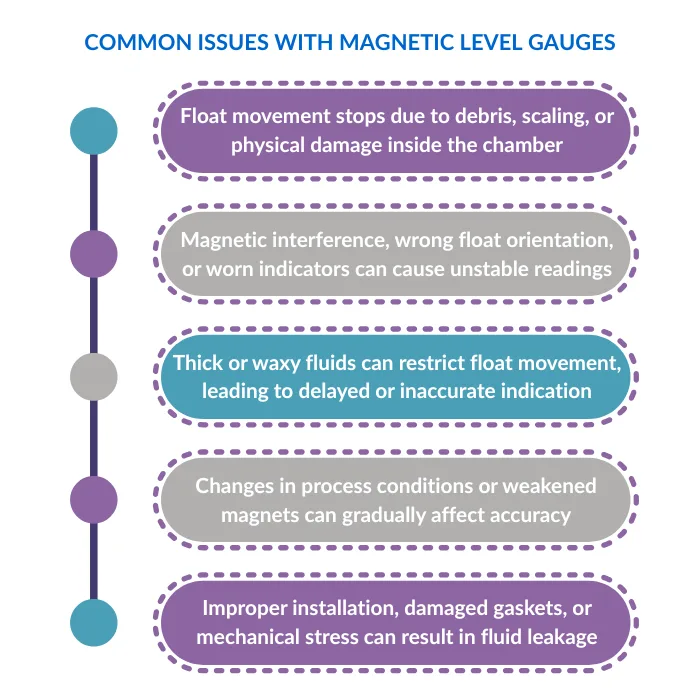
Here we will go through common issues with magnetic level gauges one by one with Symptoms, Possible Causes and Solutions. Let us start.
1. Float Sticking or Binding
One of the most frequent issues in magnetic level gauge troubleshooting is when the float stops moving despite changes in liquid level.
Symptoms
The level indication remains constant even when the actual liquid level changes. The float appears stuck at a fixed position inside the chamber.
Possible Causes
Debris, sludge, or sediment accumulation inside the chamber can restrict float movement. Scaling or mineral buildup on the float surface may increase friction. In some cases, dents or physical damage to the float can cause it to scrape against the chamber walls.
Solutions
Clean the chamber and float thoroughly to remove any deposits or buildup. Inspect the float for dents or damage and replace it if necessary. Installing filters or strainers upstream can help prevent recurring contamination.
2. Erratic or Incorrect Indication
Another major concern in magnetic level gauge troubleshooting is inconsistent or unstable readings.
Symptoms
The indicator fluctuates, shows sudden jumps, or does not match the actual liquid level in the vessel.
Possible Causes
External magnetic fields from nearby equipment can interfere with the indicator. Incorrect float orientation or improper installation may weaken magnetic coupling. Worn or damaged indicator flags can also result in inaccurate readings.
Solutions
Ensure the float is installed correctly with proper orientation. Check that the gauge is vertically aligned. Remove or shield nearby magnetic interference sources. Replace worn indicator components if required.
3. Clogging in High-Viscosity Fluids
In viscous fluid applications, magnetic level gauges may experience delayed or stuck readings.
Symptoms
The float moves slowly or does not respond immediately to level changes. In some cases, the indication lags significantly behind the actual level.
Possible Causes
Sticky or heavy fluids such as oils, wax, or chemicals can adhere to the float and chamber walls. Low temperatures can increase fluid viscosity, worsening the issue. Standard float designs may not be suitable for such applications.
Solutions
Use heat tracing or insulation to maintain fluid temperature and reduce viscosity. Select specialized float designs suitable for viscous fluids. Schedule regular cleaning to prevent buildup and ensure smooth operation.
4. Calibration Drift or Inaccurate Readings
Over time, you may notice gradual deviation in readings, which is a common issue in magnetic level gauge troubleshooting.
Symptoms
The gauge consistently shows higher or lower levels than the actual tank level. Accuracy decreases gradually over time.
Possible Causes
Changes in temperature or pressure can alter fluid density, affecting buoyancy. The float magnet may weaken due to prolonged exposure to harsh conditions. Incorrect initial calibration can also lead to long-term errors.
Solutions
Recalibrate the gauge as per manufacturer guidelines using a known reference level. Monitor process conditions regularly. Replace the float if magnetic strength has degraded.
5. Leakage or Seal Failure
Although magnetic level gauges are designed to be leak-proof, leakage may occur at flanges or joints.
Symptoms
Visible fluid leakage from connections or flanges. In some cases, pressure drop or safety concerns may arise.
Possible Causes
Improper tightening of flange bolts can result in uneven sealing. Gaskets may be damaged, worn out, or incompatible with the process fluid. Mechanical stress due to misalignment can also lead to seal failure.
Solutions
Tighten bolts as per recommended torque specifications. Use compatible and high-quality gasket materials. Ensure proper alignment during installation and provide adequate mechanical support to reduce stress.
Proactive Measures to Prevent Issues
Preventing problems is always easier than fixing them later.
A few simple practices can improve the reliability and life of your magnetic level gauge.
Routine Maintenance
Regular maintenance keeps your gauge healthy and reliable.
1. Inspect the chamber and float periodically
2. Remove debris, sludge, or scaling buildup
3. Check for early signs of wear or damage
Why it matters: Even small deposits can restrict float movement and lead to incorrect readings over time.
Proper Installation
A perfectly installed gauge performs flawlessly.
1. Ensure strict vertical alignment
2. Verify correct float orientation
3. Tighten flanges and seals properly
Why it matters: Improper installation directly affects magnetic coupling and can cause false indication.
Monitor Process Conditions
Your process conditions directly impact measurement accuracy.
1. Track temperature and pressure variations
2. Observe changes in fluid density
3. Review operating conditions regularly
Why it matters: Any change in fluid properties can affect buoyancy and lead to reading errors.
Use Suitable Components
Right selection = fewer problems.
1. Choose floats based on fluid type
2. Use corrosion-resistant materials when required
3. Select designs suitable for viscous or harsh media
Why it matters: Using the wrong components leads to clogging, damage, or frequent failures.
Upgrade When Required
Don’t wait for repeated failures.
1. Replace worn-out indicators or magnets
2. Upgrade to transmitters or switches if needed
3. Improve system capability for better monitoring
Why it matters: Modern upgrades improve reliability and help integrate with automation systems.
Ignoring small issues in magnetic level gauges can lead to serious consequences such as inaccurate readings, process inefficiencies, or even safety hazards.
A proactive troubleshooting approach helps in:
1. Improving measurement reliability
2. Reducing downtime
3. Extending instrument life
4. Enhancing plant safety
In industries like oil & gas, chemicals, and water treatment, even a minor level error can have a significant impact.
Frequently Asked Questions (FAQs)
1. What are common problems in magnetic level gauges?
Common issues include float sticking, incorrect readings, clogging in viscous fluids, calibration drift, and leakage.
2. How do I fix float sticking in a magnetic level gauge?
Clean the chamber, remove debris, and check for float damage or scaling buildup.
3. Why is my magnetic level gauge showing wrong readings?
This may be due to magnetic interference, incorrect installation, or worn indicator components.
4. Can magnetic level gauges handle viscous fluids?
Yes, but special float designs and proper maintenance are required for reliable performance.
5. How can I prevent magnetic level gauge failures?
Follow routine maintenance, ensure proper installation, monitor process conditions, and upgrade components when needed.
What we learn today?
Magnetic Level Gauge Troubleshooting is not just about fixing problems but it is about preventing them.
Most issues such as float sticking, erratic readings, or leakage arise due to improper installation, harsh process conditions, or lack of maintenance. By understanding these challenges and implementing proactive measures, you can ensure long-term, reliable performance of your level measurement system.
A well-maintained magnetic level gauge is a safe, accurate, and dependable solution for critical applications.
You can also read our article: How do Magnetic Level Switch Works?


I hope you like above blog. There is no cost associated in sharing the article in your social media. Thanks for Reading !! Happy Learning