
Rub a balloon against your hair and it clings to the wall. Walk across a carpet and touch a doorknob and you feel a shock. Both moments are static electricity doing exactly what it has always done, moving electrons from one place to another and leaving an imbalance behind.
Static electricity was noticed centuries before anyone understood what caused it, and the story of how engineers figured it out is really the story of how the atom itself was understood.
Static electricity is the result of an imbalance of electrons between two objects. It is called static because the displaced electrons tend to remain stationary once they move from one insulating material to another, at least until they find a path to redistribute themselves.
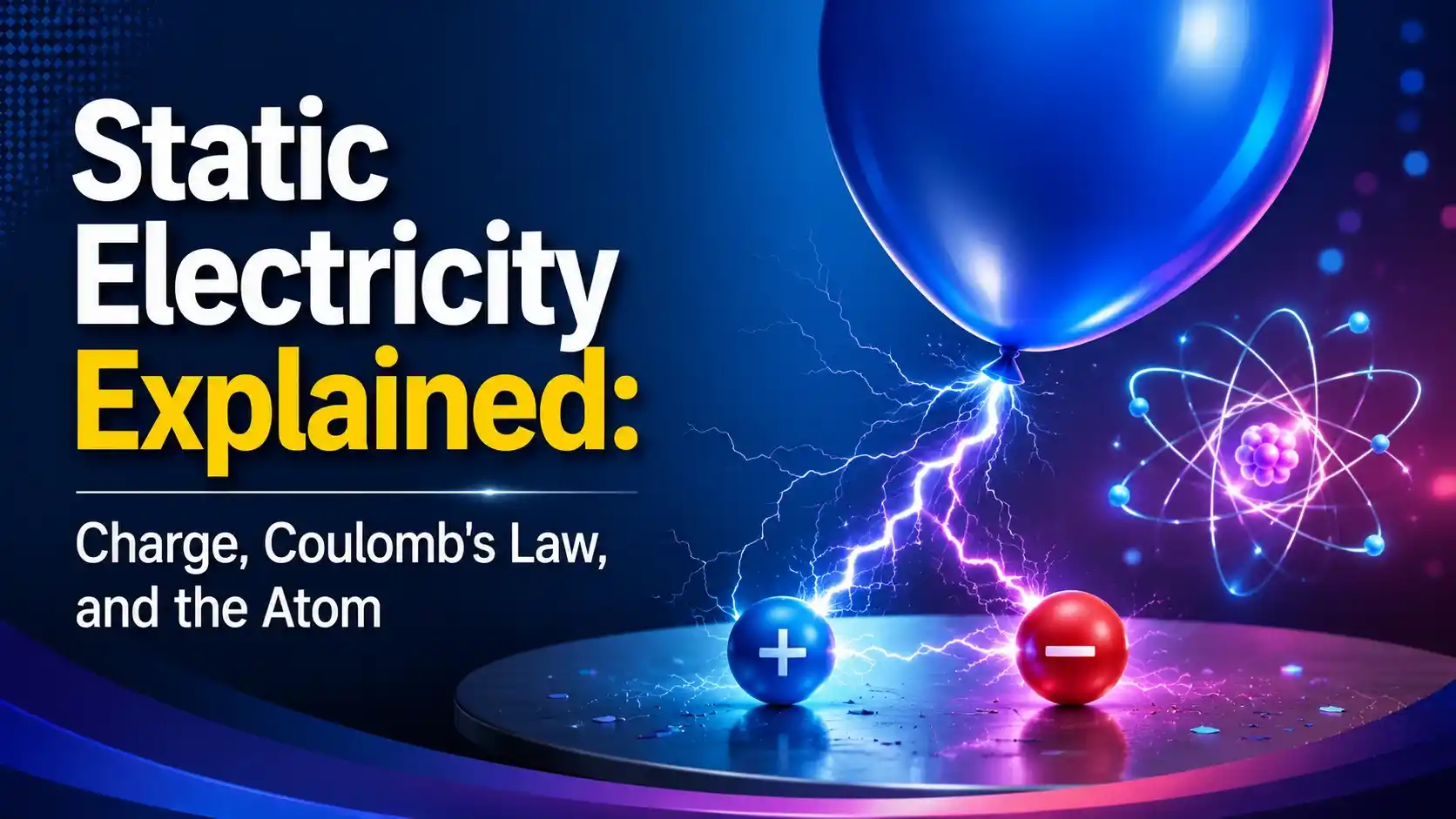
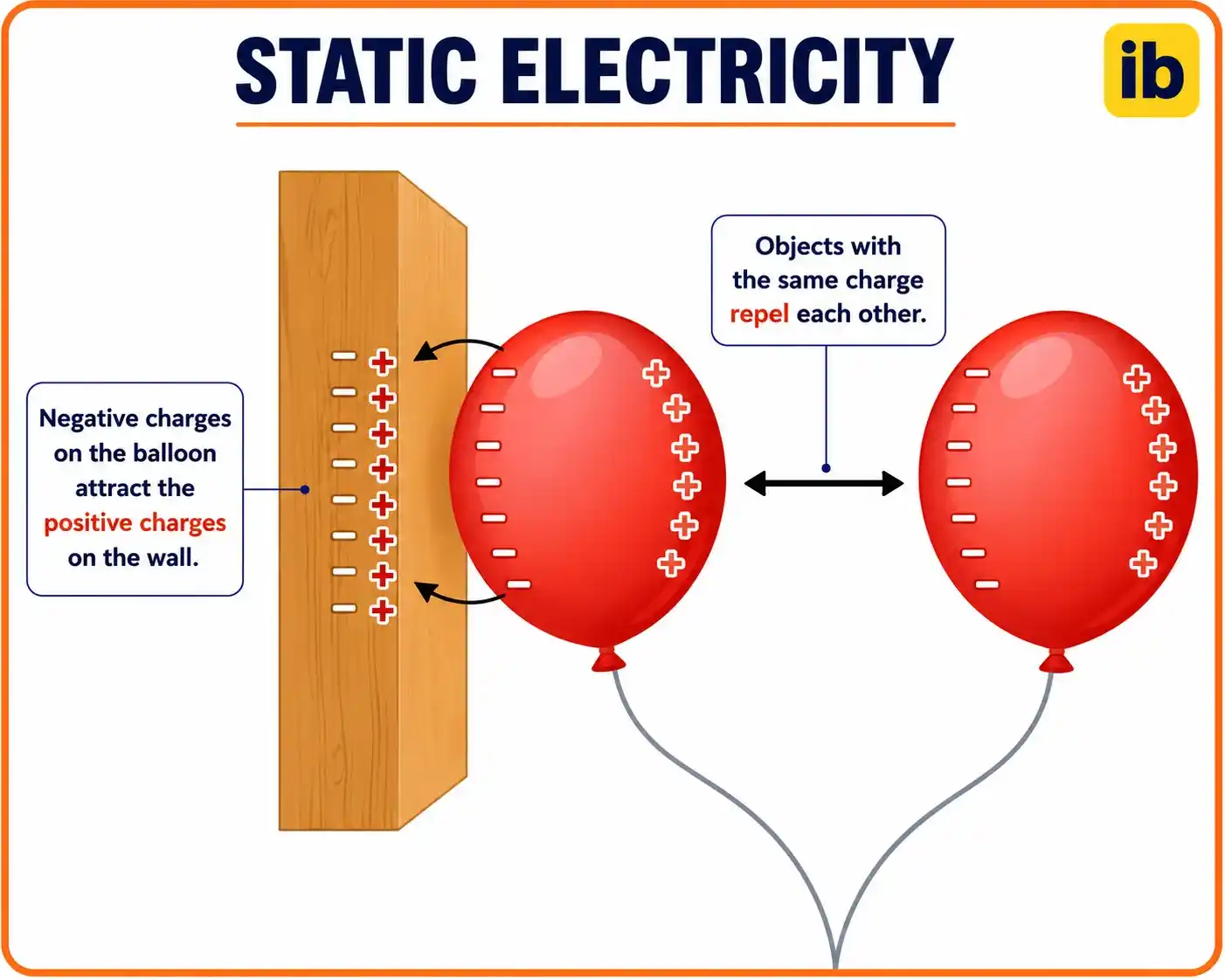
Centuries ago, experimenters noticed that certain materials would mysteriously attract one another after being rubbed together. Rubbing silk against glass left the two materials sticking together. Rubbing wool against wax produced the same effect. Anyone who has brushed against a latex balloon and watched it cling to their clothing has felt this same static electricity phenomenon firsthand.
This guide walks through what static electricity actually is, how the atom explains it, the real formula Charles Coulomb derived to quantify the force between charges, and where static electricity shows up as both a nuisance and a genuinely useful tool in modern engineering. Along the way, an interactive calculator lets you plug in real charge values and see the resulting force for yourself, rather than just reading about the formula in the abstract.
The Historical Discovery of Static Electricity
Early experimenters noticed something stranger than simple attraction. Two pieces of glass, each rubbed with silk, would repel each other. Two pieces of wax, each rubbed with wool, did the same. Yet a piece of rubbed glass and a piece of rubbed wax attracted one another every time.
Every material that showed this behavior fell into exactly one of two categories: attracted to glass and repelled by wax, or the reverse. Nothing was ever attracted to both, or repelled by both. Charles Dufay was among the first to demonstrate that two distinct types of change were being produced by rubbing, evident from the two distinct forces, attraction and repulsion, that resulted.
Benjamin Franklin later proposed that only one "fluid" was actually being exchanged, and that the two apparent charge types were simply an excess or a deficiency of that same fluid. Franklin guessed that wool was giving up fluid to wax, calling wax's resulting state "negative" and wool's "positive." As it later turned out, the actual electron transfer runs the opposite direction from what Franklin guessed, but his naming convention had already taken hold and remains standard today.
What Static Electricity Actually Is
Static electricity happens because atoms are built from three particles: protons, neutrons, and electrons. Protons carry a positive charge, electrons carry a negative charge, and neutrons carry no charge at all. In a neutral atom, the number of protons and electrons match exactly, and their charges cancel out.
Protons and neutrons cluster tightly together at the nucleus, held there by the strong nuclear force, a force so powerful it only needs to act across an extremely short distance. Electrons, by contrast, are far more loosely bound and can be dislodged from their atoms with comparatively little energy, sometimes leaving the atom entirely.
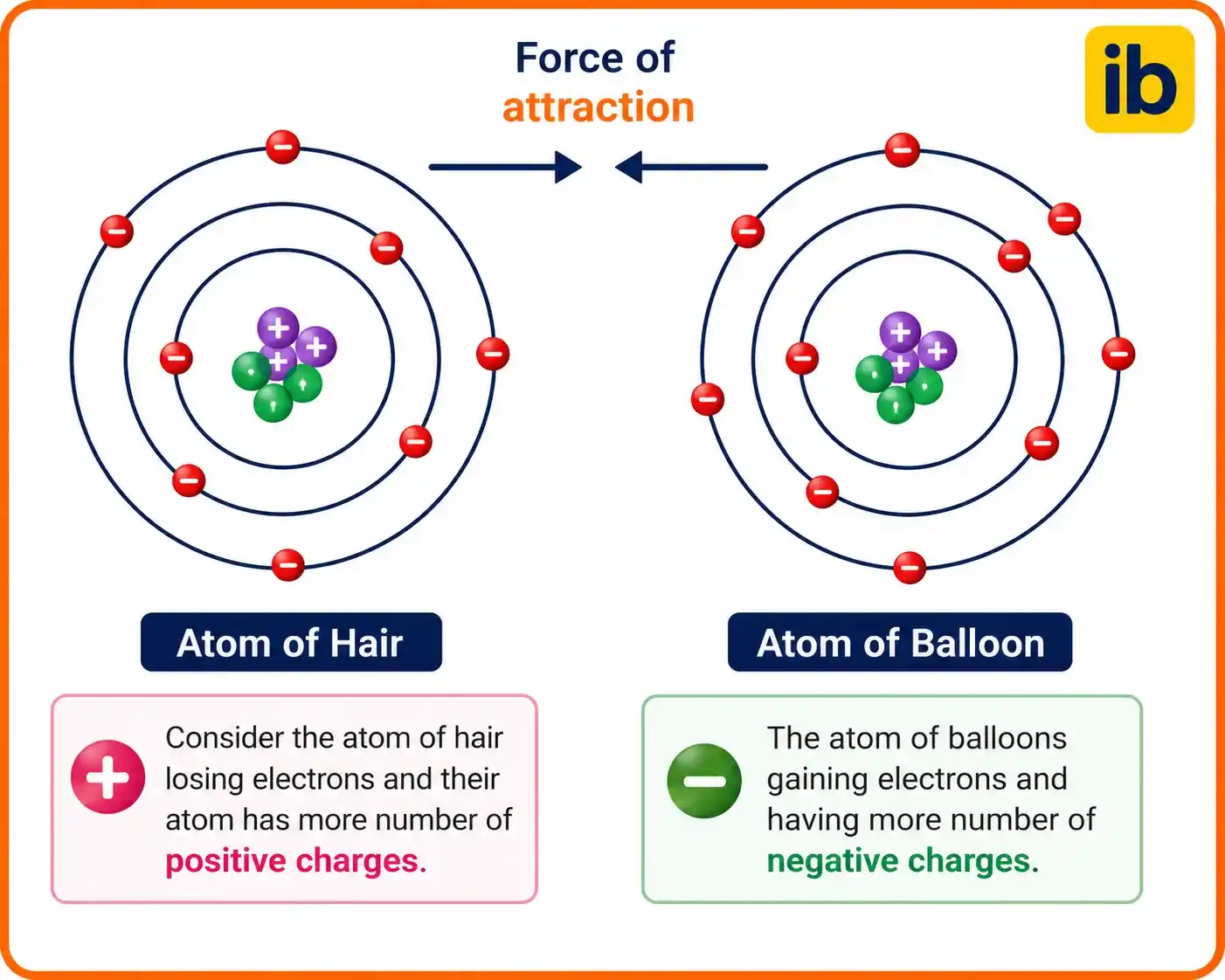
When two materials are rubbed together, electrons from one material's atoms are physically forced off and transfer onto the atoms of the other material. The material that gains extra electrons ends up negatively charged, while the material that loses electrons ends up positively charged. That imbalance, sitting stationary until it finds a way to redistribute, is static electricity in its purest form.
Positively Charged Object
Has lost electrons relative to its neutral state, leaving an excess of protons and a net positive charge.
Negatively Charged Object
Has gained electrons relative to its neutral state, leaving an excess of electrons and a net negative charge.
Coulomb's Law: Quantifying the Force of Static Electricity
Precise measurements of electric charge were carried out by the French physicist Charles Coulomb in the 1780s, using a torsional balance to measure the force generated between two charged objects. His work gave static electricity a real, quantifiable law rather than just a qualitative description of attraction and repulsion.
- F is the electrostatic force between the two charges
- k is Coulomb's constant, approximately 8.99 × 10⁹ N·m²/C²
- q1 and q2 are the two charge magnitudes, in coulombs
- r is the distance between the two charges, in meters
Two objects each carrying a charge of 1 coulomb and separated by 1 meter generate a force of roughly 9 billion newtons, which shows just how enormous a full coulomb actually is compared to the tiny static electricity charges built up by rubbing everyday materials.
🧮 Interactive Coulomb's Law Force Calculator
Enter two charge values and a separation distance to calculate the electrostatic force between them.
The Coulomb Unit and the Elementary Charge
The coulomb, the SI unit of electrical charge, is defined operationally through the force it generates between point charges. One coulomb corresponds to an excess or deficiency of about 6,250,000,000,000,000,000 electrons. Stated the other way around, a single electron carries a charge of about 0.00000000000000000016 coulombs, a value known as the elementary charge, since the electron is the smallest known carrier of electric charge.
Michael Faraday proved in 1832 that static electricity is fundamentally the same phenomenon as the electricity produced by a battery or a generator, just built up and held in place rather than continuously flowing. The particles carrying that charge were later identified as electrons, named after the ancient Greek word for amber, a material famous for exhibiting static electricity when rubbed.

Watch: Exploring Static Electricity
This video walks through atomic structure, charge, and Coulomb's law, covering the same fundamentals in a hands on, visual way.
Video: "Exploring Static Electricity", via YouTube.
Static Electricity: Nuisance and Useful Tool
For the most part, static electricity is treated as a nuisance in engineering settings. It can ignite black powder and smokeless powder, which is why graphite is deliberately added to those materials as a precaution. It also causes real, expensive damage to sensitive semiconductor circuitry when an uncontrolled electrostatic discharge passes through a component never designed to handle it.
Static electricity does have genuine practical applications, though. Xerographic printing relies on static electricity to attract toner particles to a charged drum. Electrostatic air filters use charged plates to attract and capture airborne particles. The high voltage Van de Graaff generator, a favorite in physics classrooms, builds up static electricity mechanically to demonstrate charge and force in a dramatic, visible way.
Xerographic Printing
Charged drums attract toner particles to form an image.
Electrostatic Air Filters
Charged plates capture airborne particles for cleaner air.
Van de Graaff Generators
Mechanically build up static electricity for demonstration and research.
Explosive Ignition Risk
A genuine hazard around black powder and flammable vapors.
Semiconductor Damage
ESD events can destroy sensitive electronic components instantly.
Everyday Static Cling
The familiar balloon-to-wall and doorknob shock effects.
Three Ways Objects Build Up Static Electricity
Rubbing is the most familiar way static electricity forms, but it is not the only mechanism. Engineers generally recognize three distinct charging methods, each moving electrons in a slightly different way.
Charging by Friction
Two different materials are rubbed together, and electrons transfer from the material that holds them more loosely to the one that holds them more tightly. This is the classic silk and glass, wool and wax mechanism behind most everyday static electricity, and it remains the easiest way to demonstrate the effect without any special equipment at all.
Charging by Conduction
A charged object physically touches a neutral one, and electrons flow directly between them until both objects share a similar charge. No rubbing is required, only direct contact between a charged surface and a neutral one.
Charging by Induction
A charged object is brought near, but never touches, a neutral one. The nearby charge repels or attracts electrons within the neutral object, redistributing them internally without any physical contact at all, leaving a temporary induced charge.
All three methods ultimately produce the same result: a measurable static electricity imbalance that can be described using the same charge and force principles covered by Coulomb's law above. Which method dominates in a given situation usually comes down to whether the objects involved actually touch, and for how long.
Why Static Electricity Is Worse in Dry Conditions
Anyone who has noticed more static shocks in winter than in summer has already observed a real, well documented effect. Water molecules in humid air are naturally good at carrying away small amounts of excess charge, quietly bleeding off static electricity before it can build to a noticeable level.
In dry conditions, that natural discharge path largely disappears. Charge that would normally dissipate into moist air instead stays put on your body, your clothing, or the object you are handling, which is exactly why static electricity shocks, hair standing on end, and clinging fabric all become far more common once humidity drops. This is also why electronics manufacturing facilities frequently control humidity deliberately, specifically to reduce the risk of static electricity related component damage on the production floor.
Static electricity is not a separate kind of electricity at all. Faraday proved in 1832 that it is exactly the same phenomenon a battery produces, just built up in place instead of flowing continuously as current.
FAQs on Static Electricity
You May Also Like
Electrical Conductivity Explained: Definition, Formula, Unit, and Real Examples
Static electricity behaves the way it does because most everyday materials are electrical insulators, letting charge sit in place rather than flow away. This guide covers electrical conductivity in depth, the property that determines whether a material lets charge move freely or hold still.
Read Full Article →External References
- Static Electricity, All About Circuits Textbook
- Coulomb's Law, Wikipedia
- Static Electricity, Wikipedia
What we learn today
- Static electricity is an imbalance of electrons between two objects, created whenever rubbing transfers electrons from one material to another.
- Every atom's identity comes down to its protons, neutrons, and electrons, with electrons being far easier to dislodge than the tightly bound nucleus.
- Coulomb's law, F = k(q1×q2)/r², quantifies the actual electrostatic force between two charged objects at a given distance.
- The coulomb, the SI unit of charge, corresponds to roughly 6.25 quintillion electrons, making it an enormous unit next to everyday static charges.
- Static electricity is mostly a nuisance around explosives and semiconductors, but also powers real applications like xerographic printing and electrostatic air filtration.