
Every litre of crude, diesel or LPG sold through a pipeline is billed from a flow meter reading, so a tiny meter error becomes a large money error. Proving that meter against a known volume, under real flowing conditions, keeps both buyer and seller confident.
A custody transfer flow meter is only as trustworthy as its last proving run. This guide explains how each prover type works, how the meter factor is calculated and how to judge repeatability in the field.
What Is a Meter Prover?
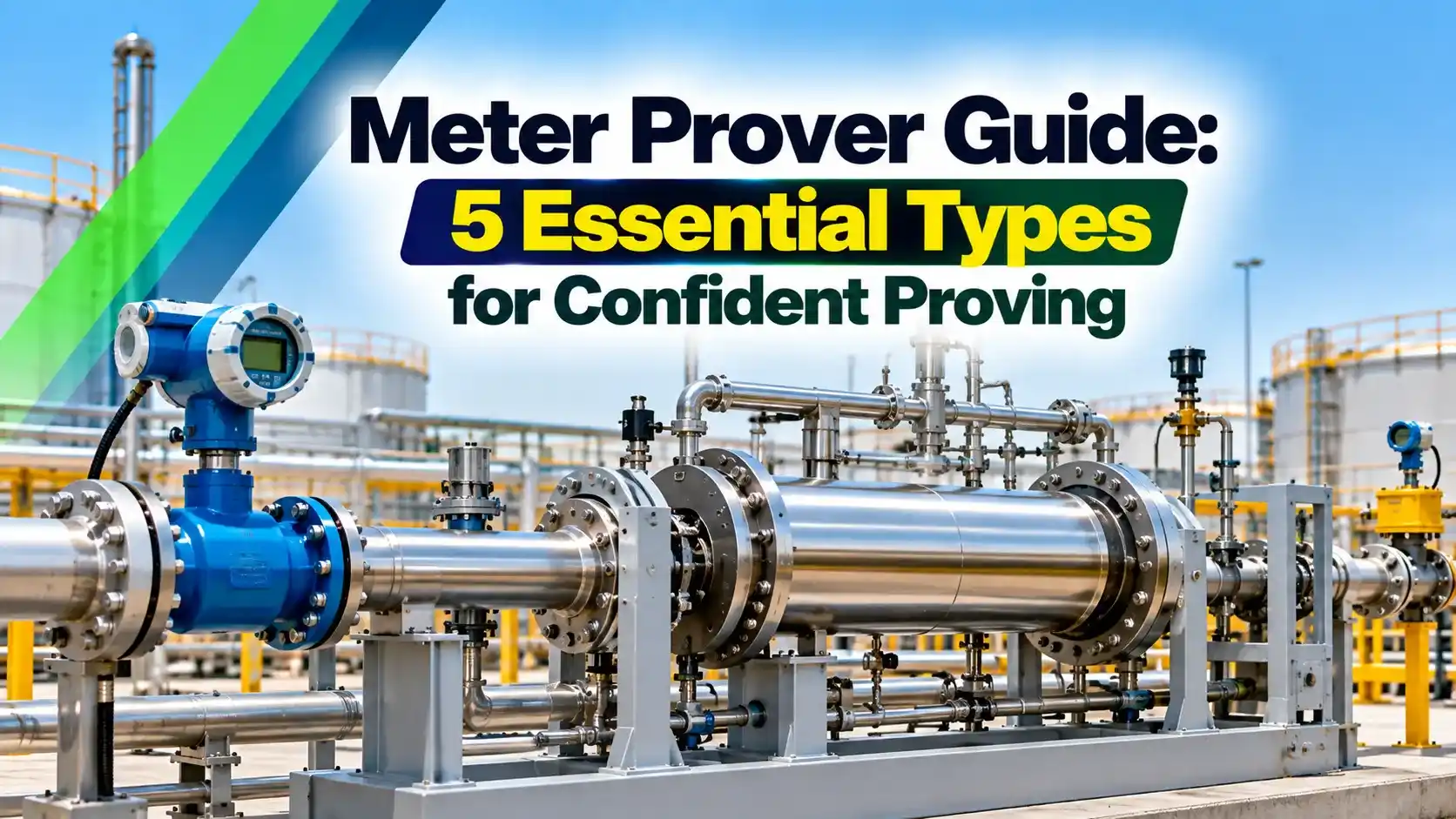
A meter prover is a device with an accurately known reference volume that is used to check a flow meter in service, under actual flowing conditions of product, pressure and temperature. It is the backbone of custody transfer measurement for crude oil, refined products and LPG.
During a proving run, liquid flows through the flow meter and then through the prover in series. The flow computer compares the volume the meter indicated with the certified volume the prover displaced, and the ratio becomes the meter factor.

Unlike a laboratory calibration, a meter prover checks the meter in its own piping with the real product. Viscosity, temperature and installation effects are therefore included in the result.
The American Petroleum Institute publishes the Manual of Petroleum Measurement Standards, and Chapter 4 is entirely about proving systems. Its sections cover displacement provers, tank provers, master meters, pulse interpolation, operation and waterdraw calibration.
How a Displacement Meter Prover Measures Volume
A displacement meter prover is a calibrated length of pipe with a sphere or piston that moves with the flow. Two detector switches mark the start and end of a precisely known section, and the volume between them is called the base volume.
The meter sends pulses in proportion to volume, as explained in flow meter K factor calculations. The flow computer divides the pulse count by the K factor to get the indicated volume and compares it with the corrected prover volume.
Greg Williams notes in his ASGMT paper on meter provers that a conventional pipe meter prover must collect at least 10,000 whole meter pulses in a single pass. The same paper gives a sphere velocity window of about 1 to 5 feet per second for a unidirectional pipe prover.
5 Essential Meter Prover Types
A sphere travels one way through a loop and is returned to the launch chamber.
A four way valve drives a sphere forward and back, one round trip per run.
A precision piston in a short honed cylinder sweeps a small volume and uses pulse interpolation.
A proved reference meter placed in series with the meter under test.
An open or closed certified volumetric tank receives a batch of product from the meter.
Williams defines a small volume meter prover as a displacement prover that does not have enough reference volume to accumulate 10,000 pulses in one pass. It therefore relies on pulse interpolation to resolve fractions of a pulse.
A master meter is usually a Coriolis flow meter or a turbine meter that is itself proved on a displacement prover. The ASGMT paper recommends that the master be roughly ten times more accurate than the meter under test.
Before a proving campaign, confirm that the meter prover base volume certificate is still valid and that its serial number matches the nameplate. An expired waterdraw certificate makes every meter factor from that prover disputable.
Meter Prover and Meter Factor Formula
The meter factor from a meter prover corrects the meter so that its reading matches true volume at base conditions. Both the prover volume and the meter volume must first be corrected for temperature and pressure effects on the steel and on the liquid.
Prover volume = Base volume × CTSp × CPSp × CTLp × CPLp
Meter volume = (Pulses ÷ K factor) × CTLm × CPLm
Example:
Base volume 1000 L, combined prover corrections 0.9985
Meter pulses 50,120 at K factor 50 pulses per L
Indicated volume = 50,120 ÷ 50 = 1002.4 L
Combined meter corrections 0.9990, so meter volume = 1001.40 L
Prover volume = 1000 × 0.9985 = 998.5 L
MF = 998.5 ÷ 1001.40 = 0.9971, meter reads high by 0.29 percent
CTSp and CPSp correct the steel prover for thermal expansion and pressure stretch, while CTL and CPL correct the liquid itself. These are the same ideas used in temperature and pressure compensation of flow signals.
Coastal Flow explains that a meter factor above 1 means the meter reads low and a factor below 1 means it reads high. In our example the meter over registers, so every indicated litre is multiplied by 0.9971 in the ticket.
Meter Prover Factor Calculator
Repeatability Rules in API MPMS 4.8
One proving run is never enough, because a single result cannot show scatter. API MPMS Chapter 4.8 links the number of runs to a repeatability limit so that the average meter factor has an uncertainty of about plus or minus 0.027 percent.
| Consecutive Runs | Maximum Repeatability Band | Typical Use |
|---|---|---|
| 5 | 0.05 percent | Conventional pipe and ball provers |
| 10 | 0.12 percent | Small volume provers, noisy meters |
| 20 | 0.22 percent | Very small prover volumes or difficult products |
Repeatability is calculated as the highest minus the lowest run result, divided by the lowest, times 100. The ASGMT paper lists exactly these three limits, and Coastal Flow confirms that five runs within 0.05 percent is equivalent to the 0.027 percent target.
Second Worked Example: Checking Five Runs
Suppose five consecutive runs give meter factors of 0.9970, 0.9972, 0.9971, 0.9973 and 0.9971. The band is (0.9973 minus 0.9970) ÷ 0.9970 × 100 = 0.030 percent, which is inside the 0.05 percent limit.
The average of the five runs, 0.99714, is reported as the new meter factor and entered in the flow computer. If a run falls outside the band, the whole set is rejected and repeated after checking the cause, as discussed in measurement uncertainty in calibration.
Coastal Flow notes that a bidirectional prover needs 20,000 pulses per round trip, which is twice the one way figure. That is why larger meters with high K factors suit a ball prover so well.
Pulse Interpolation in a Compact Meter Prover
A compact prover sweeps only a few tens of litres, so a meter may send far fewer than 10,000 pulses per pass. API MPMS Chapter 4.6 solves this with double chronometry, where two timers measure the exact time between detector switches and between whole meter pulses.
Coastal Flow reports that small volume provers often work with interpolated counts in the range of about 100 to 8,000 pulses. This makes the compact meter prover practical for turbine flow meters and positive displacement flow meters on crowded skids.
Flow Management Devices, a small volume prover maker, lists twelve models with maximum flow rates from 700 to 20,000 US gallons per minute. The company also states that its chrome plated measuring cylinders reach 68 to 72 Rockwell C, against below 30 for plain stainless steel.
Step by Step Meter Prover Procedure
A leaking diverter valve lets product bypass the meter prover section, which biases the meter factor even when runs repeat nicely. That is a classic case of accuracy versus precision.
Keep temperature transmitters at the meter and at the prover within a fraction of a degree of each other before you start. A mismatch between them is the most common hidden cause of a drifting meter factor.
Calibrating the Meter Prover Itself
The base volume of a displacement meter prover is set by a waterdraw calibration under API MPMS Chapter 4.9. Water is drawn from the prover between detector switches into certified test measures, or weighed on a scale, and corrected to standard conditions.
The test measures must themselves be traceable to national standards, and the calibrating laboratory is normally accredited under ISO 17025 laboratory requirements. In India, instruments used for trade also fall under the Legal Metrology Act 2009, so check which authority must witness the work.
Selecting the Right Meter Prover
Troubleshooting Poor Meter Prover Results
Many of these symptoms are general flow meter problems, so keep a simple trend of meter factor against date and flow rate. Methods from wet versus dry flow meter calibration help decide whether the meter needs a laboratory visit or only a new factor.
- Meter is checked with real product and conditions.
- No need to remove the meter from the line.
- Gives a legally defensible custody transfer record.
- Frequent proving catches wear early.
- Prover skids are costly and need space.
- Diverter valve leaks can hide real errors.
- Needs trained staff and calibrated secondary instruments.
- Waterdraw recalibration takes the prover out of service.
Meter Prover Fundamentals PDF
Provers and Master Meters Video
Meter Prover FAQ
It is a device with an accurately known reference volume used to check a flow meter in its own line. Product flows through the meter and the prover in series during each run.
The flow computer compares the two volumes and calculates a meter factor. That factor then corrects every custody transfer ticket issued from the meter.
The meter factor is the corrected prover volume divided by the corrected meter volume. A value below 1 shows that the meter reads high, and above 1 shows it reads low.
The factor is averaged over several consecutive runs that pass the repeatability test. It is then entered in the flow computer and multiplied into every indicated volume.
A pulse counter can be wrong by one whole pulse at the start or end of a run. With 10,000 pulses that possible error is only 0.01 percent of the total.
Compact provers cannot reach that count in their small volume, so they use pulse interpolation instead. Double chronometry measures time to recover the fraction of a pulse accurately.
API MPMS Chapter 4.8 allows five runs within a 0.05 percent band as a common choice. Ten runs may spread 0.12 percent and twenty runs may spread 0.22 percent.
Each option gives about the same overall uncertainty of 0.027 percent on the average factor. Contracts and local regulations may still fix a specific number of runs for a station.
A ball meter prover uses an elastomer sphere in a long pipe loop with a large base volume. It usually collects at least 10,000 pulses per pass without any interpolation.
A compact prover uses a precision piston in a short honed cylinder with a small volume. It needs pulse interpolation but takes far less space and can be mounted on a truck.
A master meter is used when a displacement prover is impractical, such as very high flow or mobile service. It is a reference meter placed in series with the meter under test.
The master must itself be proved regularly on a displacement prover. Williams suggests that it should be roughly ten times more accurate than the meter it checks.
The base volume is found by a waterdraw calibration described in API MPMS Chapter 4.9. Water displaced between the detector switches is collected in certified test measures or weighed.
The result is corrected to standard temperature and pressure and printed on a certificate. That certificate must be valid and traceable before the prover is used for custody transfer.
Related Articles
- What Is Custody Transfer
- Flow Computer Working Principle
- Flow Meter K Factor Calculations
- Turbine Flow Meter Working Principle
- Measurement Uncertainty in Calibration
External References
- Fundamentals of Meter Provers and Proving Methods, ASGMT
- Understanding Liquid Meter Provings and Proving Reports, Coastal Flow
- Custody Transfer, Wikipedia
What We Learn Today
- A meter prover holds an accurately known base volume, and comparing it with meter pulses in series gives a meter factor for custody transfer tickets.
- Pipe and ball provers need at least 10,000 whole pulses per pass, while compact provers use double chronometry pulse interpolation under API MPMS Chapter 4.6.
- API MPMS 4.8 accepts five consecutive runs within a 0.05 percent band, giving about 0.027 percent uncertainty on the averaged meter factor.