
Two logic families built from different transistors, with different voltage levels, power use and quirks when you connect them together.
TTL vs CMOS is the classic comparison between bipolar transistor logic and MOSFET based logic. The two families differ in voltage levels, power, speed and how safely they connect to each other.
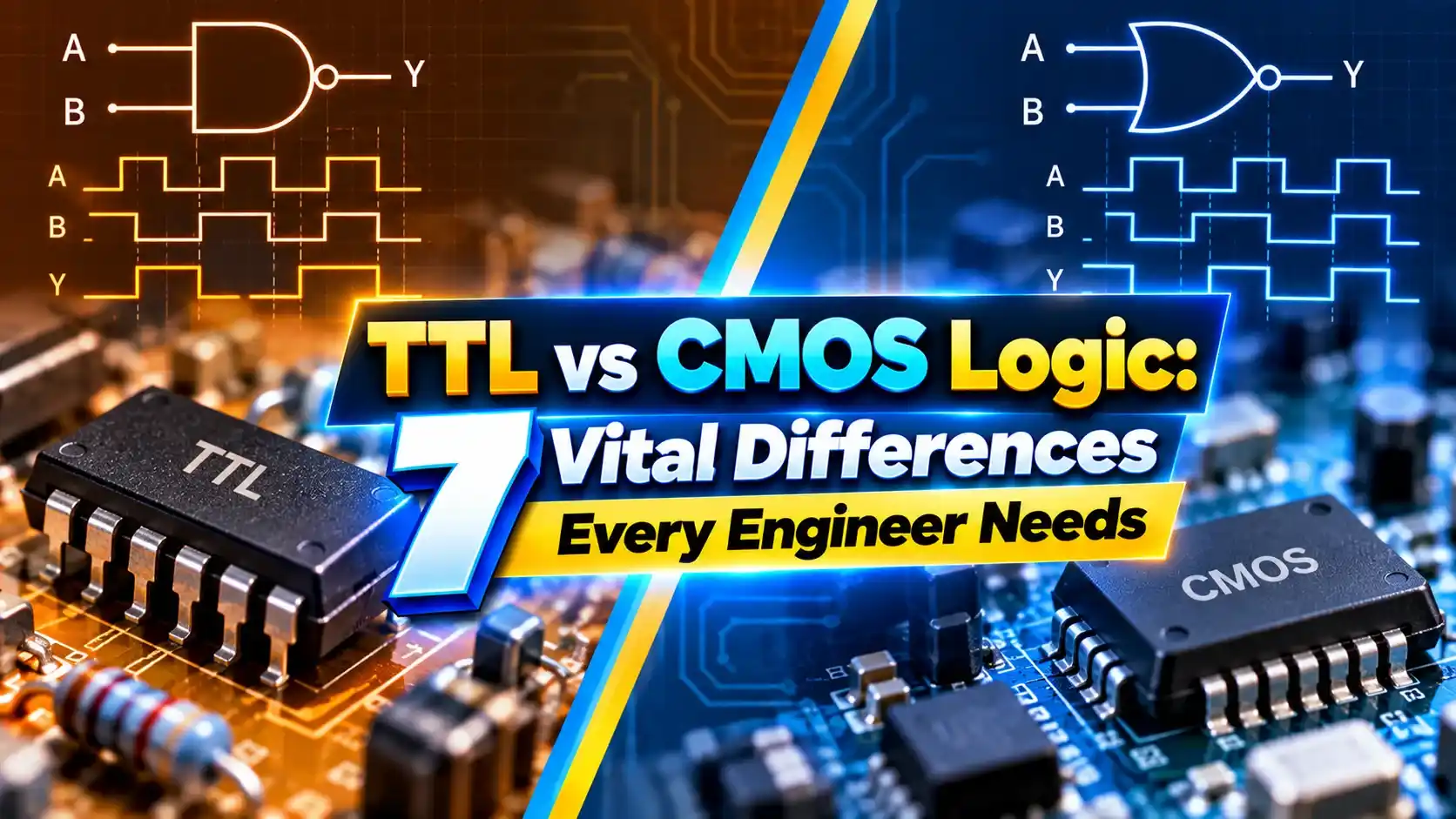
What Is the TTL vs CMOS Comparison?
The TTL vs CMOS comparison looks at two families of digital ICs, transistor transistor logic built from bipolar transistors and complementary MOS logic built from MOSFETs. Both implement the same logic gates, but they behave differently electrically.
TTL dominated early digital systems in the 7400 series. CMOS, in the 4000 series and later the 74HC family, now dominates almost everything because of its tiny power consumption.
TTL uses bipolar transistors that draw base current even when idle. CMOS pairs a P channel and N channel MOSFET so one is always off in a steady state.
That single design difference explains most of the other contrasts in power, voltage range and input behaviour.
7 Vital Differences
Components101 lists TTL power near 10 mW per gate against about 10 nW for CMOS at rest. That gap is why battery devices use CMOS exclusively.
CMOS power rises with switching frequency, because each transition charges internal and load capacitance. At very high speeds, the power advantage narrows.
Logic Level Comparison Table
| Parameter | TTL at 5 V | 74HC CMOS at 5 V |
|---|---|---|
| VIH minimum | 2.0 V | About 3.5 V |
| VIL maximum | 0.8 V | About 1.5 V |
| VOH minimum | 2.4 V | About 4.9 V |
| VOL maximum | 0.4 V | About 0.1 V |
| Input current | Significant | Almost zero |
TTL values come from Components101, while 74HC figures are typical datasheet values at 5 V. Always use the datasheet for the exact part and supply.
The table exposes the main interfacing problem. A TTL high of 2.4 V may not reach the 3.5 V that a 74HC input needs.
Noise Margin Formula With Example
NM low = VIL maximum minus VOL maximum
TTL example:
NM high = 2.4 minus 2.0 = 0.4 V
NM low = 0.8 minus 0.4 = 0.4 V
74HC example at 5 V:
NM high = 4.9 minus 3.5 = 1.4 V
NM low = 1.5 minus 0.1 = 1.4 V
A larger noise margin means more tolerance to ground bounce and interference. That is one reason CMOS behaves well in noisy boards.
Good layout still matters for both families, as described in noise reduction for digital ICs.
Interfacing TTL vs CMOS Safely
The 74HCT series keeps CMOS power levels but uses TTL input thresholds. It is the easiest bridge between old TTL outputs and new CMOS logic.
Going the other way, a 5 V CMOS output easily drives TTL inputs. At 3.3 V, check that the high level still meets the 2.0 V TTL threshold, which it normally does.
Mixed voltage systems with microcontrollers at 3.3 V often need level shifters when talking to 5 V CMOS parts.
Common Logic Sub Families
Low power Schottky TTL, common in older designs.
Wide supply CMOS from 3 to 15 V.
High speed CMOS with CMOS input levels.
High speed CMOS with TTL input levels.
Newer families such as 74LVC and 74AHC run at 3.3 V and below with very high speed. The same interfacing checks apply.
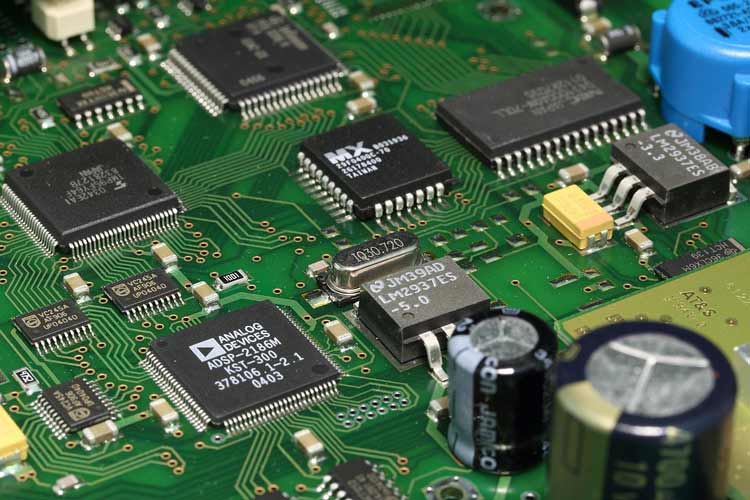
All these parts are examples of digital integrated circuits, usually in DIP or SOIC packages.
CMOS Dynamic Power Calculator
Halve the supply to 2.5 V and the power drops to one quarter. This is why modern logic keeps moving to lower voltages.
- Very low static power.
- Wide supply range in some families.
- High noise margin.
- High fan out.
- Sensitive to static discharge.
- Unused inputs must never float.
- Power rises with frequency.
- Input levels differ from TTL.
TI Logic Guide PDF
Logic Families Explained Video
TTL vs CMOS FAQ
Related Articles
- Digital Logic Gates Explained
- Basics of Transistors
- MOSFET Working Principle
- Types of Integrated Circuits
- Noise Reduction Techniques for Digital ICs
External References
- TTL and CMOS ICs Compared, Components101
- Logic Guide, Texas Instruments
- What Are Logic Families, excess.org
- Logic Level, Wikipedia
What We Learn Today
- TTL uses bipolar transistors, CMOS uses complementary MOSFETs with tiny static power.
- Input thresholds differ, so check levels before connecting families.
- 74HCT parts bridge TTL outputs to CMOS logic safely.