
Swap the worn carbon brushes of an old DC motor for a chip that switches current instead, and a Brushless DC Motor is what you get, running cooler, quieter, and for years longer.
A Brushless DC Motor replaces mechanical brushes with electronic switching, using a permanent magnet rotor and Hall sensor feedback so a controller energizes the right stator winding at exactly the right moment.
This one comes up often once a plant starts replacing brushed drives on fans, pumps, and small conveyors, so it pairs well with reading a Single Line Diagram for the feeder that powers the drive.
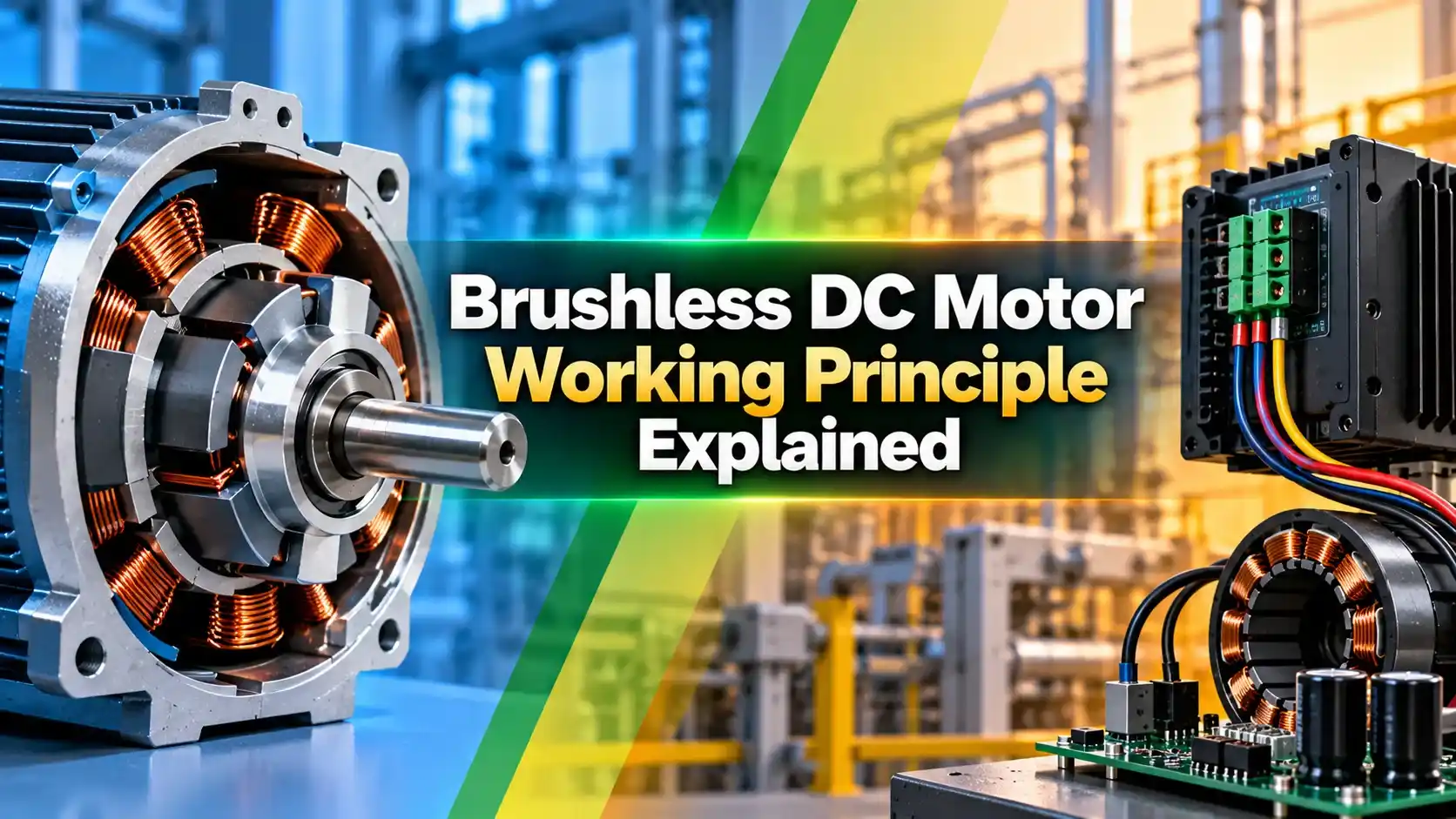
Brushless DC Motor Working Principle
A Brushless DC Motor, commonly shortened to BLDC, works by using an electronic controller to switch current through fixed stator windings in a specific sequence, creating a rotating magnetic field that continuously pulls a permanent magnet rotor around behind it.
Unlike a brushed motor, nothing physically touches the rotor to deliver current, so there are no brushes to wear down and no sparking commutator to maintain over the life of the machine.
That single design change is behind most of what people associate with these motors, longer service intervals, quieter running, and the ability to run sealed in a washdown or dusty environment where sparking contacts would be a genuine hazard.
Main Parts of a BLDC Motor
All four of these parts have to work together correctly for the motor to run smoothly.
A fault in any single one, from a cracked magnet to a failed Hall sensor wire, typically shows up as rough or jerky rotation rather than a complete failure to start.
Two rotor layouts are common depending on the application, an inrunner design spins a magnet inside a surrounding stator, while an outrunner design spins a magnet shell around a fixed inner stator for higher torque at lower speed.
Stator windings are also wired in one of two standard configurations, star or delta. The star configuration gives higher torque at low speed while delta favors higher top speed at the same voltage.
This is why manufacturers list both winding options for the same physical frame size, letting an engineer pick the version that matches the application without changing the motor's outer dimensions.
Types of BLDC Motors by Rotor Position
How Electronic Commutation Works
This whole sequence happens electronically at whatever speed the motor is spinning, which is exactly what a mechanical commutator and brushes did in an older design, just without physical contact or wear.
Trapezoidal vs Sinusoidal Drive
Most low cost BLDC controllers switch current in six discrete steps, producing a trapezoidal current waveform that is simple to generate but causes a small amount of torque ripple as each step changes.
Higher end controllers instead drive a smooth sinusoidal current waveform, trading extra processing power for quieter, more precise rotation. This is why sinusoidal drive shows up more often in robotics and precision positioning equipment than in a basic cooling fan.
Speed Control via PWM
Speed is not set by changing voltage the way an older brushed motor might use a rheostat. Instead the controller rapidly switches full voltage on and off using pulse width modulation.
The percentage of time the voltage stays on during each switching cycle determines the effective average voltage the winding actually sees.
A Brushless DC Motor spinning at half speed is really still seeing full voltage pulses, just fewer of them per second, which keeps torque strong even at low speed unlike a simple voltage reduction approach.
Sensored vs Sensorless Operation
| Type | How Position Is Known | Typical Use |
|---|---|---|
| Sensored | Three Hall sensors report rotor position directly | Compressors, pumps, applications needing reliable low speed starts |
| Sensorless | Controller infers position from back EMF voltage | Fans, drones, cost sensitive high volume products |
The choice is rarely just about cost, a sensored design also tolerates a wider range of loads without stalling on startup, which matters for equipment that must reliably start against a heavy static load such as a loaded conveyor or a compressor cylinder.
Current sensing adds a further layer on top of position sensing, most controllers monitor phase current directly so they can limit torque during startup and protect the power transistors from an overload if the shaft is jammed or overloaded.
Cogging Torque and How It Is Reduced
Cogging torque is the slight notchy feel a permanent magnet rotor produces even with no current applied, caused by the magnets briefly aligning with the stator's iron teeth as they pass.
Manufacturers reduce it by skewing the magnets slightly along the shaft or by shaping the stator slots. A well designed BLDC motor should feel almost perfectly smooth when turned by hand with the controller disconnected.
Thermal Management
Heat comes from two places in a Brushless DC Motor, resistive losses in the copper windings and switching losses in the controller's power transistors.
Larger frame sizes and better ventilation handle winding heat, while the controller usually needs its own heatsink or fan, since electronics often fail from overheating well before the motor windings do.
BLDC Motor vs Brushed DC Motor
| Feature | BLDC Motor | Brushed DC Motor |
|---|---|---|
| Commutation | Electronic, via controller and sensors | Mechanical, via brushes and commutator |
| Maintenance | Minimal, no wearing contacts | Periodic brush replacement needed |
| Efficiency | Higher, less friction and heat loss | Lower, brush friction wastes energy |
| Cost | Higher upfront, needs a controller | Lower upfront, simpler drive circuit |
| Noise | Quieter, no brush sparking or arcing | Noisier, audible brush contact and arcing |
Why Plants Are Switching to BLDC Motors
Advantages
Longer service life, higher efficiency, precise speed control, and far less routine maintenance than a brushed equivalent.
Trade Offs
Higher initial cost, needs a dedicated controller, and troubleshooting requires understanding the drive electronics as well as the motor.
Payback usually comes from fewer unplanned shutdowns rather than the electricity bill alone. A brushed motor on a continuously running fan or pump might need brush replacement every year or two.
Each of those stops costs more in lost production time than the difference in purchase price ever did, which is the real argument plant managers respond to.
Common Applications
A Brushless DC Motor rarely gets replaced by a brushed motor once installed, the maintenance savings alone usually justify the higher purchase price within the first year or two of continuous operation.
Common Mistakes When Selecting a BLDC Motor
Datasheets list a rated voltage, rated current, and a KV rating showing rpm per volt at no load. Matching all three to the intended supply voltage matters more than most buyers expect.
Getting that match wrong leaves a motor that either stalls under load or spins dangerously fast with nothing attached to the shaft, so it is worth double checking against the actual power source before ordering.
Watch: How a BLDC Motor Works
BLDC Motor FAQs
Related Articles on This Site
- How AC Induction Motor Works
- Synchronous Motor Working Principle
- Servo Motor vs Stepper Motor
- Why Servo Motors Fail
- Induction Motor Slip Explained
External References
What We Learn Today
- A BLDC motor uses electronic commutation instead of mechanical brushes to energize its stator windings.
- Hall sensors or back EMF sensing tell the controller when to switch current to the next winding pair.
- Less maintenance, higher efficiency, and quieter running make it the preferred choice over brushed motors today.
Taken together, a fixed stator, a permanent magnet rotor, and an electronic controller reading position feedback are what let a Brushless DC Motor deliver years of low maintenance running that a brushed design simply cannot match.