
A reject decision on a fast moving line cannot wait for a round trip to a data center, and that single fact is why edge AI and cloud AI end up doing very different jobs on the same plant floor.
Edge AI vs cloud AI in industrial automation comes down to where inference actually runs, local hardware near the process for instant decisions, or a remote data center for fleet wide analytics and heavier model training.
This builds on our earlier looks at artificial intelligence and machine learning and how SCADA compares to IIoT architecture.
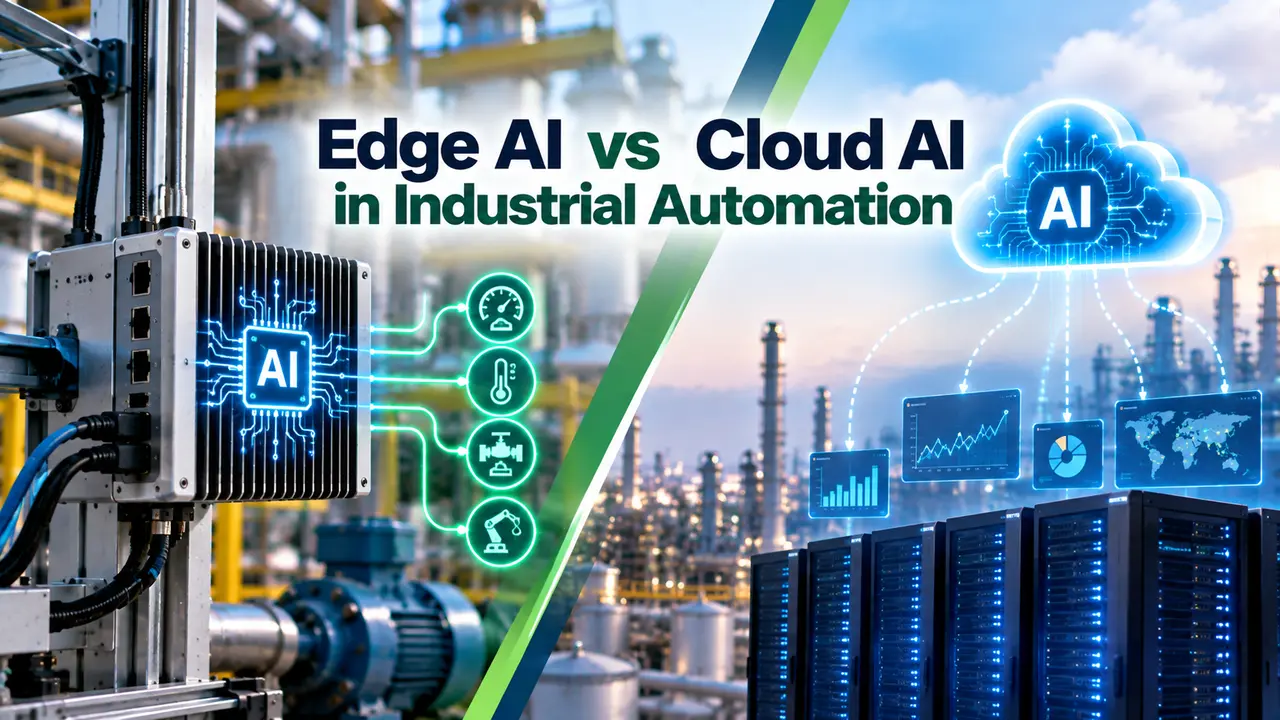
What Edge AI and Cloud AI Actually Mean
Edge AI runs inference directly on local hardware close to the physical process, an edge gateway, an industrial PC, or a smart camera or sensor sitting right at the machine.
Cloud AI instead sends data over the network to a remote data center or cloud platform, where a far larger model processes it and returns a result, typically for less time sensitive analytics rather than an instant control decision.
Why Latency Is the First Deciding Factor
Edge inference typically completes in single digit to low double digit milliseconds since there is no network round trip involved, making it suitable for closed loop control and safety related decisions.
Cloud round trip latency commonly runs anywhere from a few tens of milliseconds on a good connection to several hundred milliseconds or more, which is perfectly fine for a dashboard but far too slow for a millisecond scale control loop.
Bandwidth, Data Volume, and Connectivity
An offshore platform or a remote pumping station cannot always guarantee a reliable connection, and edge AI keeps making local decisions regardless, while a cloud dependent system simply stops until the link comes back.
Compute, Model Size, and Security
Edge hardware has limited memory and processing power, so models running there usually go through quantization, pruning, or a deliberately smaller architecture to fit within that constrained footprint without sacrificing too much accuracy.
Cloud platforms carry virtually unlimited compute by comparison, making them the natural place to train large models on aggregated historical data before a lighter, optimized version gets pushed back down to the edge.
Where the Data Actually Lives
Keeping sensitive operational data on premises through edge processing reduces the attack surface, since raw process data never has to leave the plant network in the first place.
Centralizing data in the cloud does simplify fleet wide analysis and governance, but it also means securing the transmission path and trusting the platform with a much broader view of plant operations.
A plant weighing this tradeoff should treat data classification as the starting point, deciding upfront which signals are sensitive enough to stay local and which are fine to aggregate centrally for broader analysis.
Edge AI vs Cloud AI Side by Side
| Factor | Edge AI | Cloud AI |
|---|---|---|
| Latency | Single digit to low double digit milliseconds | Tens to hundreds of milliseconds or more |
| Connectivity | Keeps working through an outage | Depends on a reliable connection |
| Compute available | Limited, requires an optimized model | Virtually unlimited for training |
| Best fit | Real time control and safety decisions | Fleet wide analytics and model training |
Why Hybrid Is the Dominant Real World Pattern
Typical Use Case Split
Edge AI Use Cases
Vision inspection reject decisions, vibration anomaly alerts, and safety interlocks.
Cloud AI Use Cases
Fleet wide predictive analytics, long term trending, and large scale model training.
A single plant will often run both at once, an edge model making the reject call on the line in real time while the cloud quietly aggregates that same line's history alongside every other line in the company.
Choosing the Right Split for a New Project
Start by asking how quickly a decision genuinely needs to happen, if a control action has to occur within milliseconds of a signal changing, that decision belongs at the edge regardless of how appealing a cloud platform's tooling looks.
Everything that can tolerate a delay, especially anything that benefits from being compared across many machines or many sites at once, is a much better fit for the cloud side of the architecture.
Cost and Total Ownership Considerations
Edge hardware carries an upfront capital cost per device, multiplied across every machine that needs coverage, while cloud platforms typically shift cost toward ongoing subscription and data transfer fees that scale with usage over time.
A site with hundreds of similar assets often finds edge hardware costs add up quickly, which is one more reason the hybrid pattern wins in practice, concentrating edge spending on the assets that truly need millisecond decisions.
Maintaining Edge Devices in the Field
Unlike a cloud platform a vendor patches centrally, an edge device physically sitting in a cabinet or on a machine needs its own update and maintenance plan, including a way to push firmware and model updates remotely.
Planning for that lifecycle upfront, rather than treating edge hardware as install and forget, avoids a fleet of devices quietly running outdated models years after they were first commissioned.
Watch: Cloud AI vs Edge AI Explained
Edge AI vs Cloud AI FAQs
Related Articles on This Site
- SCADA vs IIoT
- Artificial Intelligence and Machine Learning
- AI in PLC, SCADA, and DCS
- Digital Twin in Industrial Automation
- Wireless Pressure Transmitters in IIoT Systems
External References
What We Learn Today
- Edge AI runs inference locally for millisecond decisions, cloud AI handles fleet wide analytics and training.
- Bandwidth limits and offline resilience push high frequency sensor processing toward the edge.
- Most real deployments combine both, retraining models in the cloud and pushing improvements back to the edge.