
Insertion flow meters place a sensor element into the pipe through a small bore fitting. Full-bore flow meters replace a section of pipe and measure across the entire cross-section.
Choosing between them depends on pipe size, fluid type, accuracy needs, installation constraints and long-term maintenance requirements.
We will cover how each design works, where each one is the better choice, and what factors drive the decision including pipe size, accuracy, cost, and fluid conditions.
We will also look at a comparison table across the key selection criteria and a set of practical guide rows to help you decide quickly in the field.
Getting this selection right at the project stage saves money and avoids costly retrofits. The wrong choice can mean poor accuracy, high maintenance, or a full pipe shutdown to replace the meter.
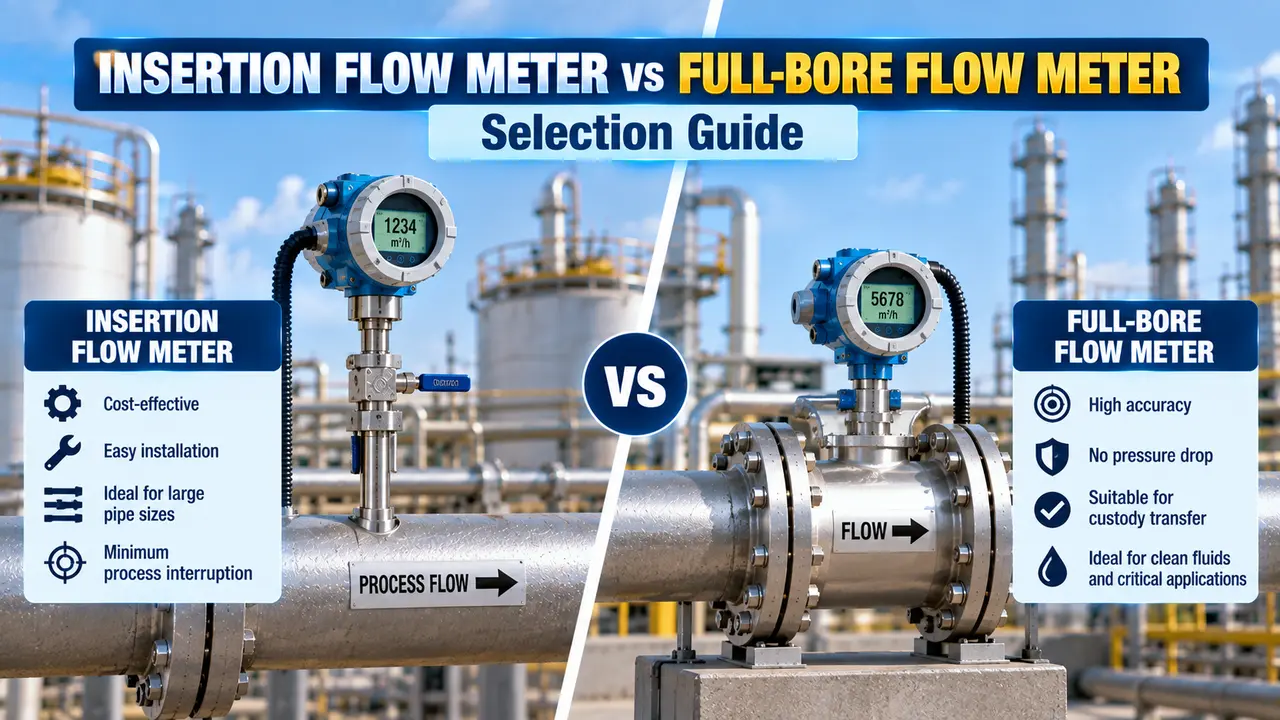
Insertion Flow Meter vs Full Bore Flow Meter: What Each One Is
A sensor element is inserted through a fitting into the pipe, typically reaching the pipe centerline or a defined insertion depth.
The meter measures velocity at one point or a small number of points, then converts this to flow using a known pipe cross-sectional area.
Available as insertion magnetic, insertion vortex, insertion turbine, averaging pitot tube, and thermal mass types.
The meter body replaces a section of the pipe spool and provides measurement across the full internal diameter.
All of the flowing fluid passes through the meter body. Measurement uses the full velocity profile, not a sample at one depth.
Available as magnetic, coriolis, vortex, turbine, ultrasonic, and differential pressure element types.
Key Factors That Drive the Selection
Full Comparison Table: Insertion vs Full-Bore
| Parameter | Insertion Flow Meter | Full-Bore Flow Meter |
|---|---|---|
| Pipe size suitability | Best for 200 mm and above; cost-effective in large pipes | Best for 15 mm to 600 mm; expensive above 600 mm |
| Typical accuracy | 1 to 3% of reading (single point); 0.5 to 1% for averaging types | 0.2 to 0.5% of reading for magnetic, ultrasonic and coriolis |
| Shutdown required to install? | No, hot-tap insertion possible | Yes, full pipe break and shutdown required |
| Installation cost | Low: one fitting, no flanges, no spool piece | High: two flanges, spool piece, gaskets, bolting |
| Meter purchase cost | Low to medium | Medium to very high (scales with pipe size) |
| Permanent pressure loss | Negligible | Zero (magnetic/ultrasonic) to high (orifice plate) |
| Velocity profile sensitivity | High: single-point types need long straight run | Lower: full-bore types are less affected by profile distortion |
| Dirty or abrasive fluids | Poor: sensor tip is exposed to the fluid | Good: lined magnetic meters handle slurries well |
| Retractable under pressure? | Yes, if retraction mechanism is fitted | No: requires isolation valves and shutdown |
| Custody transfer use | Not accepted in most standards | Yes, widely accepted with calibration certificate |
| Gas measurement | Thermal mass insertion and averaging pitot types work well | Coriolis and vortex full-bore types preferred for gas |
| Typical applications | Large water mains, HVAC, cooling water, plant utilities, air ducts | Process plant, fiscal metering, custody transfer, chemical dosing |
When to Choose Each Type in Practice
Choose an insertion flow meter when the pipe is 300 mm or larger and a process shutdown is not acceptable. It suits utility monitoring and energy metering with clean, non-abrasive fluids.
Choose a full-bore flow meter when accuracy better than 1% is required or the fluid is dirty.
It is also the right choice for custody transfer, or when the pipe is small enough for a full-bore spool piece.
A single-point insertion meter placed at the pipe centerline reads the peak velocity, not the average velocity. The meter manufacturer provides a correction factor or profile factor to convert the centerline velocity to average velocity. This factor changes with Reynolds number and with the velocity profile shape. If the profile is distorted by an upstream fitting, the correction factor no longer applies and error increases. Always provide the specified straight pipe run upstream and downstream of any insertion meter to keep the profile symmetric.
Technology Variants Available in Each Category
| Technology | Insertion Version Available? | Full-Bore Version Available? | Best Application |
|---|---|---|---|
| Electromagnetic | Yes, single probe or multipoint FPI | Yes, standard lined mag meter | Conductive liquids: water, slurry, chemicals |
| Ultrasonic | Yes, insertion transducers | Yes, clamp-on or spool piece | Clean liquids and gases; large pipe retrofit |
| Vortex | Yes, insertion vortex types available | Yes, wafer or flanged body | Steam, gas, clean liquids above minimum velocity |
| Turbine | Yes, insertion turbine probes | Yes, axial turbine body | Clean low-viscosity liquids and gases |
| Thermal mass | Yes, most thermal mass meters are insertion | Yes, inline types for small pipes | Gas flow, compressed air, nitrogen, biogas |
| Averaging pitot tube | Yes, this is an insertion type by design | No | Gas and liquid in large pipes and ducts |
| Coriolis | No | Yes, U-tube or straight tube body | Mass flow, density; highest accuracy requirement |
| Orifice plate | No | Yes, between flanges | Steam, gas, liquid; most established DP type |
Watch: Insertion Mag Flow Meter Comparison Explained
Insertion Flow Meter vs Full-Bore Flow Meter Questions
Related Articles on This Site
- Types of Flow Meters and Their Applications
- Magnetic Flow Meter Sizing and Installation
- Vortex Flow Meter Working Principle
- Orifice Plate Flow Measurement Explained
- Ultrasonic Flow Meter Troubleshooting Guide
External References
What We Learn Today
- An insertion flow meter places a sensor into the pipe through a small fitting and measures velocity at one or a few radial points. A full-bore flow meter replaces a pipe spool and measures across the full cross-section. Insertion meters cost far less in large pipes and can be hot-tapped into a live system without a shutdown.
- Full-bore meters give better accuracy (0.2 to 0.5% of reading) than single-point insertion types (1 to 3%). Full-bore meters are required for custody transfer metering and handle dirty or abrasive fluids better. Insertion meters are the practical choice above 300 to 600 mm pipe diameter for utility and non-fiscal applications.
- Both technologies are available in electromagnetic, ultrasonic, vortex and turbine versions. Thermal mass and averaging pitot tube meters are predominantly insertion types. Coriolis and orifice plate meters are only available as full-bore designs. The selection decision always starts with pipe size, accuracy requirement, and whether a shutdown is acceptable.