
A Karnaugh map turns a Boolean truth table into a grid, and that single change makes a simplification problem visible instead of algebraic.
Instead of chasing Boolean theorems on paper, an engineer just looks for blocks of matching cells and reads the answer straight off the grid.
Every cell in the grid sits one bit away from its neighbor, which is the entire reason grouping cells together simplifies the expression at all.
This guide covers how the grid is built, the grouping rules that make it work, and a live tool to practice simplifying a few real cases.
A Karnaugh map is a grid based tool for simplifying Boolean expressions, arranging every possible input combination so that adjacent cells differ by exactly one variable, which makes matching groups of cells easy to spot and simplify by eye.
A Boolean expression built straight from a truth table is often longer than it needs to be, full of terms that could cancel out with a bit of algebra.
Working through that algebra by hand is slow and easy to get wrong on anything beyond a couple of variables.
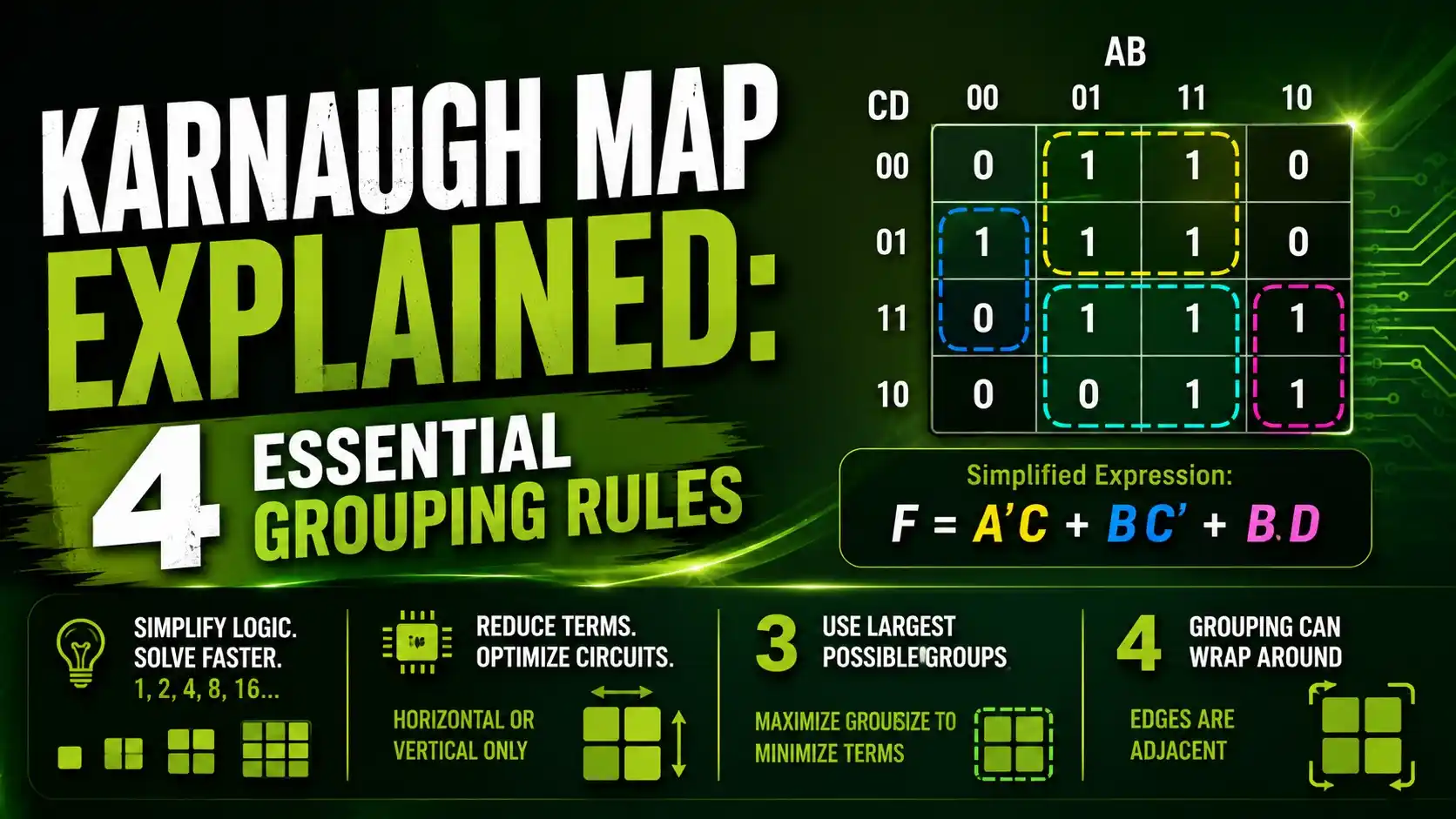
A Karnaugh map replaces that algebra with a visual grouping exercise, and this article walks through exactly how that grouping produces a correct, minimal expression.
What a Karnaugh Map Actually Is
A Karnaugh map is a rectangular grid where every cell represents one row of a truth table, one specific combination of input variables.
Each cell holds the output value for that combination, a 1 or a 0, exactly as it would appear in the truth table.
The difference from a plain truth table is the layout. Cells are arranged so that any two neighbors differ in only one input variable, and that single property is what makes visual grouping possible at all.
How Cells Are Arranged Using Gray Code
Ordinary binary counting jumps by more than one bit between some neighboring numbers, for example 011 to 100 changes all three bits at once. Gray code counting never does that. Each step changes exactly one bit.
A Karnaugh map labels its rows and columns using Gray code specifically so that moving to any adjacent cell only changes one input variable.
This keeps the one bit difference rule true across the whole grid, including where the grid wraps from the last column back to the first.
K Map Sizes for 2, 3, and 4 Variables
| Variables | Total Cells | Grid Layout |
|---|---|---|
| 2 Variables | 4 cells | 2 rows by 2 columns |
| 3 Variables | 8 cells | 2 rows by 4 columns |
| 4 Variables | 16 cells | 4 rows by 4 columns |
Every additional variable doubles the cell count, since each new variable doubles the number of possible input combinations that need a place on the grid.
Grouping Rules That Make Simplification Work
Powers of Two
Valid groups contain 1, 2, 4, 8, or 16 cells, never 3, 5, or 6. Any other size cannot simplify cleanly.
Adjacent Cells Only
Every cell in a group must sit directly next to another cell already in that group, sharing an edge.
Wraparound Edges
The top row connects to the bottom row, and the leftmost column connects to the rightmost column, so groups can wrap around.
Largest Groups First
A bigger group removes more variables from the final term, so always look for the largest valid group before settling for a smaller one.
Don't care cells, positions where the output could be either 1 or 0 without breaking the design, may be grouped in only when doing so helps form a larger group, and otherwise left alone.
Karnaugh Map Grouping Simplifier
Pick a set of minterms below to see the simplified expression a proper Karnaugh map grouping would produce for that set.
Two Minterm Groups Simplified Side by Side
Group one covers minterms 0, 1, 2, and 3, a full block where the A variable never changes.
Binary values = 000, 001, 010, 011
A stays 0 across all four, B and C both change
Simplified expression = F = A'
Group two covers minterms 1, 3, 5, and 7, where C is the variable that never changes.
Binary values = 001, 011, 101, 111
C stays 1 across all four, A and B both change
Simplified expression = F = C
Both groups reduce a four term expression down to a single literal, which is the entire point of grouping cells instead of working through Boolean algebra term by term.
SOP vs POS: Two Ways to Read the Same Map
| Approach | What Gets Grouped | Result Form |
|---|---|---|
| Sum of Products (SOP) | Groups of 1s | Product terms combined with OR |
| Product of Sums (POS) | Groups of 0s | Sum terms combined with AND |
The same Karnaugh map supports both approaches. Grouping the 1s gives the simplest expression when the output is true for fewer combinations, while grouping the 0s gives a simpler result when the output is false for fewer combinations.
Why Engineers Still Use Karnaugh Maps in a CAD Era
Modern logic synthesis tools handle circuits with hundreds of variables automatically, far beyond what any Karnaugh map could ever display on a grid.
The map still earns its place in teaching and in small circuit design, because it builds the same intuition the automated tools rely on internally, just made visible by hand.
An engineer who understands grouping on a grid reads a synthesis tool's simplified output with real understanding, rather than treating it as a black box.
Karnaugh Map Do's and Don'ts
✓ Do
- Always look for the largest valid group before settling for a smaller one
- Check for wraparound adjacency along every edge of the grid
- Use don't care cells only when they help form a bigger group
- Double check that every 1 is covered by at least one group before finishing
✗ Don't
- Group cells that are diagonal to each other, only shared edges count
- Form a group of 3, 5, or 6 cells, only powers of two are valid
- Force a don't care cell into a group when it does not actually help
- Stop at the first grouping found without checking for a bigger one
Resources for Practicing Karnaugh Maps
Karnaugh Map Questions Students Ask
External References
- All About Circuits: The Karnaugh Map Boolean Algebraic Simplification Technique
- GeeksforGeeks: Introduction of K Map, Karnaugh Map
What We Learn Today
- A Karnaugh map arranges truth table values into a grid using Gray code, so every neighboring cell differs by exactly one variable.
- Groups must be powers of two in size, made only of adjacent cells, including wraparound edges.
- Larger groups produce simpler expressions, since more variables cancel out of the surviving term.
- The same map supports both SOP grouping of 1s and POS grouping of 0s, whichever produces the simpler result.