
Two MCCBs can share the exact same amperage rating and still behave completely differently the moment a real fault hits.
Current rating is only the first number on the nameplate. The rest of the label is what actually decides whether the breaker survives the fault it was bought to clear.
How to select right MCCB rating means matching the breaker's continuous current rating, frame size, breaking capacity, and trip unit type to the actual load, the actual fault current, and the actual panel it will sit in, not just picking the next size up from an MCB.
How to select right MCCB rating
Once a circuit outgrows a standard MCB, the selection process gets meaningfully more complicated, not just larger.
An MCB really only asks one question: is the current rating high enough? An MCCB asks that question too, but it's just the entry point into several more.
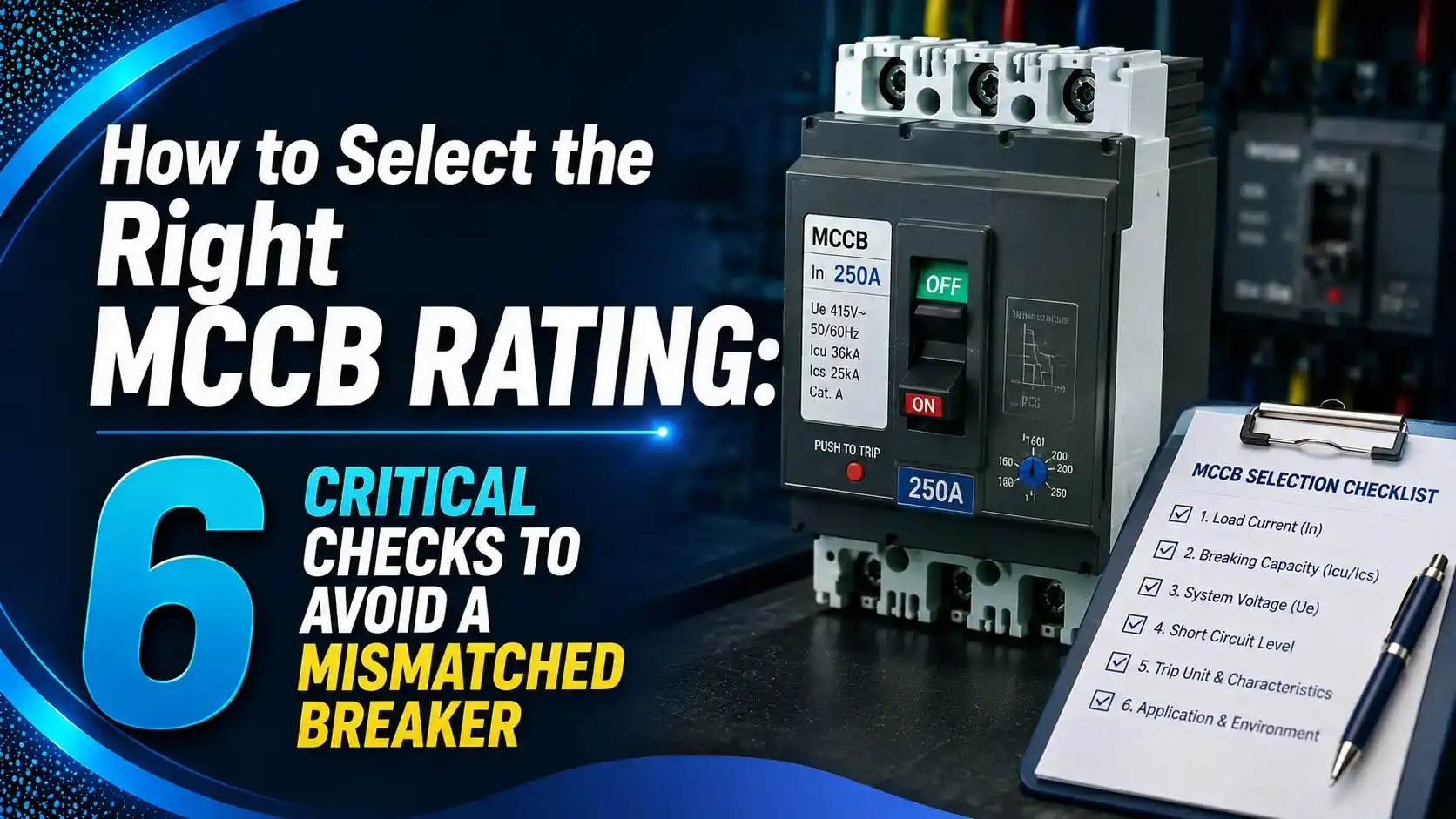
Frame size, breaking capacity, trip unit type, and voltage rating all interact with each other, and getting any single one wrong can leave a system that looks correctly protected on paper but fails the first time it's actually tested by a real fault.
Per VIOX's MCCB selection guide, this is exactly why safety-first practice always starts with the breaking capacity requirement, checking that Icu clears the fault current available at the installation point before anything else is even considered.
This builds directly on the sizing math already covered in our MCB rating calculation guide, since the underlying design current formula doesn't change. What changes is everything layered on top of it.
The rest of this guide walks through that layered selection process, one real checklist item at a time.
Frame Size vs Rated Current: Not the Same Number
This is the single most common point of confusion in MCCB selection, and it's worth settling before anything else.
The housing stays the same size no matter which trip setting sits inside it. Choosing too small a frame reduces thermal margin and shortens breaker lifespan. Choosing too large a frame simply wastes panel space and budget for no protective benefit.
The 6 Critical Checks for MCCB Selection
Work through all six, a sequence Oohmage's MCCB selection guide also treats as inseparable. Skipping any one of them is how a correctly amperage-rated breaker still ends up unsafe.
Design Current With the 125% Margin
Same starting point as MCB sizing: calculate Ib, apply 125% for continuous loads, round up to the nearest standard rating.
Frame Size Selection
Choose the smallest frame that still meets both the current rating and the breaking capacity requirement together.
Breaking Capacity: Icu, Ics, Icw
Verify Icu exceeds the prospective short-circuit current with margin, and check Ics against the reliability the application needs.
Trip Unit Type
Thermal-magnetic for simple, stable loads. Electronic (LSI) when adjustability or selective coordination is required.
Voltage Rating and Derating
Confirm Ue and Ui against system voltage, then apply temperature and altitude derating for the real installation environment.
Standards, Panel SCCR, and Physical Fit
Confirm UL 489 or IEC 60947-2 compliance, panel SCCR compatibility, and space for required accessories.
Icu vs Ics vs Icw: Three Different Breaking Capacity Numbers
These three ratings sound similar on a nameplate but answer completely different engineering questions.
| Rating | What It Means | Selection Guidance |
|---|---|---|
| Icu (Ultimate) | Maximum fault current interrupted once, may not be reusable after | Must exceed PSCC at the installation point, with margin |
| Ics (Service) | Fault current interrupted repeatedly while staying fully operational | 100% of Icu for critical loads; 50 to 75% acceptable for standard circuits |
| Icw (Short-time withstand) | Current the breaker can withstand for a set delay without tripping | Relevant mainly for upstream breakers needing selective coordination |
Per Electrical Trader's MCCB selection checklist, prospective short-circuit current is calculated as PSCC = V / Ztotal, using the total impedance from source to breaker, with engineering practice typically applying 20 to 25% headroom above that figure.
Interactive Trip Unit Setting Calculator
Enter frame size and target load current to calculate a recommended electronic trip setting (Ir) as a fraction of frame rating.
Thermal-Magnetic vs Electronic Trip Units
Both provide overload and short-circuit protection, but per JUTRION's nameplate rating guide, they differ sharply in adjustability and cost.
Thermal-Magnetic
Bimetal strip for overload, magnetic coil for instantaneous fault response. Fixed or minimally adjustable pickup settings.
Electronic (LSI/LSIG)
Microprocessor-based, adjustable Long-time, Short-time, and Instantaneous settings, sometimes Ground fault too.
Voltage Ratings and Standard Applications
Building Feeders
Medium-frame MCCBs (250 to 630A) serving sub-mains.
Main Distribution Boards
Large-frame MCCBs protecting main incomers.
Motor Control Centers
Electronic trip units handling large motor inrush.
Data Center Switchgear
Ics = 100% Icu required for maximum service continuity.
Hospital Distribution
Critical loads demanding full service breaking capacity.
Renewable Energy Sites
Transformer secondary protection at variable fault levels.
Do's and Don'ts of MCCB Rating Selection
✓ Do
- Verify Icu against the actual prospective short-circuit current, not an assumption
- Choose the smallest frame that satisfies both current rating and breaking capacity
- Use Ics = 100% Icu for hospitals, data centers, and other critical loads
- Check panel SCCR compatibility, since a high-kA breaker alone doesn't raise it
✗ Don't
- Assume two MCCBs with the same amperage rating perform identically
- Confuse frame size with the actual installed trip current setting
- Skip temperature and altitude derating for enclosed or high-altitude panels
- Use thermal-magnetic trip units where selective coordination is required
MCCB vs ICCB: When 1200A Isn't Enough
Beyond a certain point, standard MCCB frames stop being the right tool for the job entirely.
Insulated Case Circuit Breakers cover the range above typical MCCB limits, up to roughly 4000A, and offer higher short-time withstand ratings than standard MCCBs provide.
That higher Icw makes ICCBs the natural choice for main incomers and large switchgear where selective coordination with multiple downstream MCCBs is a hard requirement, not a nice-to-have.
Reference Materials on MCCB Selection
FAQs on MCCB Rating Selection
External References
- MCB vs MCCB: A Practical Guide to Icu/Ics and IEC 60898 vs 60947-2, CHAYO
- MCCB Selection Guide: Trip Units, Frame Size and Interrupt Rating, Oohmage
- Understanding MCCB Nameplate Ratings: Icu, Ics, Icw, JUTRION Electric
- MCCB Selection Guide: Sizing, Breaking Capacity and IEC 60947-2, VIOX
- MCCB Trip Unit Settings Guide, VIOX
What we learn today
- Selecting the right MCCB rating means checking six things together: design current, frame size, breaking capacity, trip unit type, voltage rating, and standards compliance.
- Frame size and rated current answer different questions; one frame can support several different trip current settings.
- Icu, Ics, and Icw are three separate breaking capacity ratings, each answering a different reliability question.
- Critical loads like hospitals and data centers should specify Ics equal to 100% of Icu, not just a high Icu alone.
- A high-kA MCCB does not raise a panel's overall Short Circuit Current Rating if other components in the assembly are rated lower.