
A single 17th-century observation about squeezed fluid quietly explains how a car jack lifts two tonnes, how a U-tube manometer reads a gas line, and how a modern pressure transmitter turns a diaphragm's flex into a 4-20mA signal. Here is exactly how Pascal's law shows up across each one.
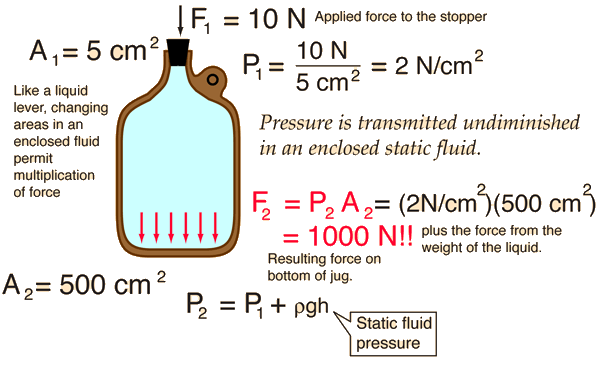
Pascals law states that a pressure change applied at any point in a confined, incompressible fluid is transmitted equally throughout the fluid and to the walls of its container.
Blaise Pascal formulated this in the 17th century, and it still underlies nearly every pressure instrument built today. Squeeze a sealed tube of toothpaste at one spot, and the pressure you apply reaches the nozzle just as strongly, exactly the same effect that powers a hydraulic jack, a manometer, and an electronic pressure transducer alike.

Pascals Law Formula: P = F/A
Pressure is simply force spread across an area. This single relationship, applied at two different points in the same confined fluid, is what makes Pascal's law so useful.
Pressure: P = F / A
Since pressure is equal everywhere in the fluid, P₁ = P₂
Therefore: F₁/A₁ = F₂/A₂
Pascal's Law and the Hydraulic Press
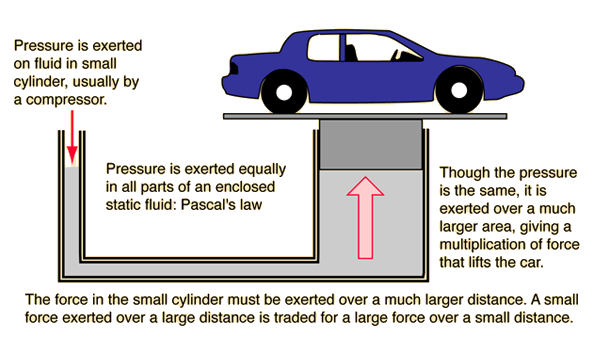
The hydraulic press is the clearest demonstration of Pascal's law in action. It uses two pistons of different sizes connected by an incompressible fluid, usually oil.
A small force pushes down on the smaller piston, creating pressure in the fluid. Since that pressure reaches the larger piston completely undiminished, the larger piston's surface area does the rest of the work.
Rearranging for output force: F₂ = (F₁/A₁) × A₂
Worked example: F₁ = 50 N, A₁ = 0.01 m², A₂ = 0.5 m²
F₂ = (50 / 0.01) × 0.5 = 2,500 N
Try It: Hydraulic Press Force Calculator
Enter the input force and both piston areas to see the output force a hydraulic press produces.
Applications of Pascal's Law in Hydraulic Presses
Manufacturing: stamping and forming metal car body panels
Forging heavy components for aerospace and machinery
Waste compaction and recyclable material baling
Pascal's Law in Manometers
Long before digital sensors, manometers gave engineers a direct, visual way to see Pascal's law in action, balancing an unknown pressure against a known column of liquid.
Simple Manometer (Piezometer)
A single tube tapped into the pressure point. Liquid rises to a height that directly balances the pressure, since Pascal's law guarantees the pressure at the tube's base equals the fluid pressure at that point.
U-Tube Manometer
A U-shaped tube with one end open to atmosphere. Higher source pressure pushes the fluid down on the connected side and up on the open side, and the height difference reads the gauge pressure directly.
Differential Manometer
Both ends connect to separate pressure points instead of one side being open to atmosphere. Pascal's law ensures each source's pressure transmits accurately to the fluid, so the height difference reads the pressure difference between the two points.
Inclined Manometer
The reading tube tilts at an angle, stretching a small vertical height change into a much longer, easier-to-read movement along the tube. This makes very small pressures measurable with real precision.
Applications of Pascal's Law in Manometers
HVAC duct air pressure verification
Filter pressure drop monitoring for cleaning schedules
Gas line leak detection and lab pressure experiments
Pascal's Law in Electronic Pressure Transducers
Modern instrumentation still leans on Pascal's law, just at its very first stage. Applied pressure transmits uniformly to a sensing element, which then produces the actual electrical signal.
Strain-Gauge Pressure Transducers
Pressure transmits uniformly across a diaphragm, deforming it and straining a bonded strain gauge. That strain changes the gauge's resistance, measured through a Wheatstone bridge circuit as a voltage proportional to pressure.
Capacitive Pressure Transducers
One capacitor plate is a flexible diaphragm exposed to process pressure. As pressure transmits and pushes the diaphragm closer to the fixed plate, the capacitance changes and is converted into a proportional electrical signal.
Piezoelectric Pressure Transducers
Pressure transmits through a diaphragm to a piezoelectric crystal, generating a charge proportional to the applied stress. Since the charge dissipates over time, these excel at dynamic pressure, not static readings.
Applications of Pascal's Law in Pressure Transducers
Oil and gas wellhead and pipeline monitoring
Aerospace hydraulic and fuel pressure measurement
Automotive oil, fuel, and tire pressure monitoring
Pascal's Law Instruments Compared
| Instrument | How Pascal's Law Applies | Best Suited For |
|---|---|---|
| Hydraulic Press | Multiplies force between two piston areas | Lifting, forming, forging heavy loads |
| U-Tube Manometer | Balances pressure against a liquid column | Low-cost, visual gauge and differential pressure readings |
| Inclined Manometer | Stretches small height changes for precision | Very low pressure measurement |
| Strain-Gauge Transducer | Diaphragm deformation changes resistance | General industrial pressure, high durability |
| Capacitive Transducer | Diaphragm movement changes capacitance | Low-pressure, high-sensitivity applications |
| Piezoelectric Transducer | Crystal generates charge under stress | Fast, dynamic pressure changes |
Watch: Pascal's Law and the Hydraulic Lift System
This video works through Pascal's principle and the hydraulic lift system with fluid mechanics problems.
FAQs on Pascal's Law in Pressure Instruments
External References
- University of Sydney, Pascal's Law and Buoyancy Lecture Notes
- IIT Management, Chapter 2, Manometers and Pascal Law
- YouTube, Pascal's Principle, Hydraulic Lift System, Fluid Mechanics Problems
What we learn today
- Pascal's law states that a pressure change in a confined, incompressible fluid transmits equally throughout the fluid and to its container walls.
- A hydraulic press multiplies force by applying that pressure across a much larger piston area, expressed as F2 = (F1/A1) × A2.
- Manometers, from the simple piezometer to the inclined type, all balance an unknown pressure against a known liquid column using this same principle.
- Electronic pressure transducers, whether strain-gauge, capacitive, or piezoelectric, still rely on Pascal's law to transmit pressure uniformly onto their sensing element.
- Choosing between these instruments comes down to the specific pressure range, dynamic behavior, and precision each application actually needs.