
Pressure Measurement · Instrumentation Basics · Signal Types
Pressure Transducer and Sensor: 4 Costly Differences Every Engineer Should Know
Here is the short version, stated plainly: every sensor is a transducer, but not every transducer is a sensor. That single sentence resolves most of the confusion around these two words, and this guide unpacks exactly why it is true, using real pressure instrumentation examples.
The One Sentence That Actually Settles This
A transducer is any device that converts one form of energy into another. That is a deliberately broad definition, and it includes far more than measuring instruments. A sensor is a specific type of transducer, one whose job is to detect a physical quantity, such as pressure, and produce a signal that represents it.
Because sensing a physical change inherently requires converting that change into a signal, every sensor is, by definition, doing the work of a transducer. But plenty of transducers do not sense anything at all. A motorized valve actuator converts electrical energy into mechanical motion to move a valve. It is genuinely a transducer, since energy conversion is happening, but it detects nothing, so it is not a sensor.
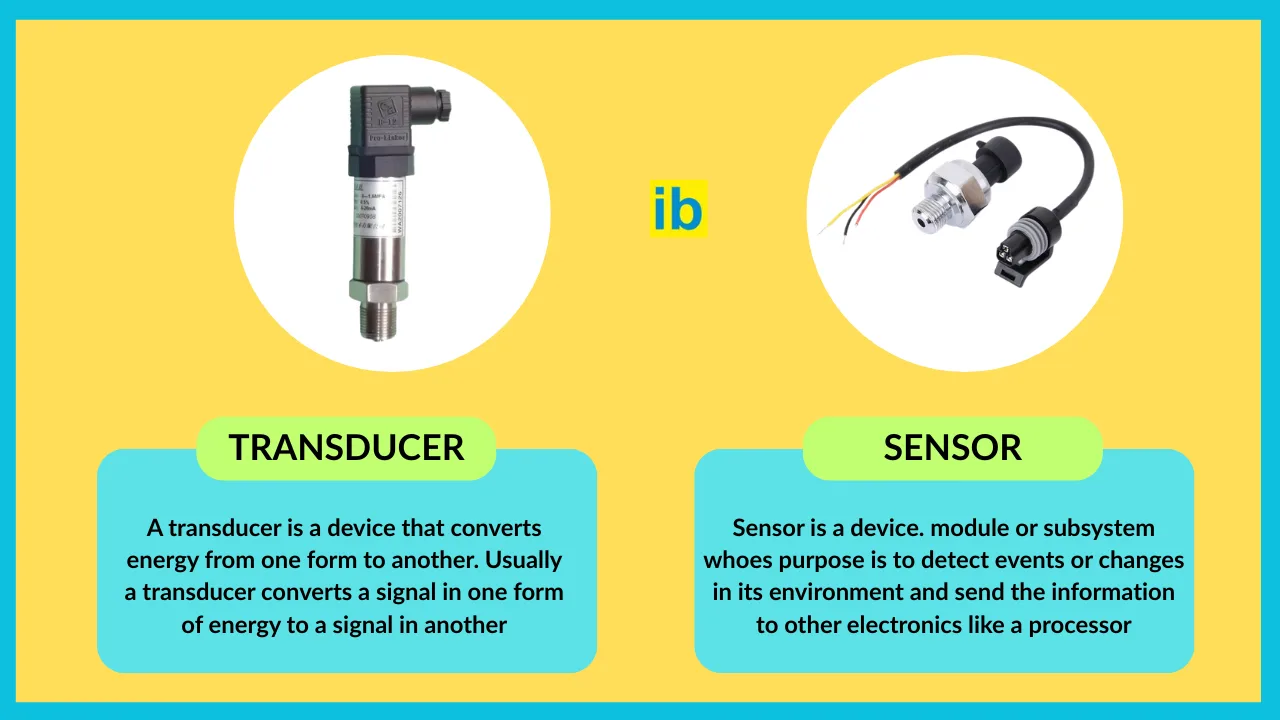
4 Differences Between Pressure Transducer and Sensor
Is It a Sensor, a Transducer, or Both?
Understanding pressure transducer and sensor terminology gets much easier once you test it against real devices. Click each device to see how it classifies, and why.
Pressure Sensing Diaphragm
A diaphragm exposed to process pressure deforms mechanically, and that deformation changes an electrical property such as resistance or capacitance. It detects a physical quantity (pressure) and converts that detection into an electrical signal.
Sensor Transducer Both, simultaneouslyThermocouple
A thermocouple detects a temperature difference between two junctions and, through the Seebeck effect, generates a proportional voltage directly. It senses and converts in the same physical process.
Sensor Transducer Both, simultaneouslyMotorized Valve Actuator
This device converts electrical energy into mechanical motion to reposition a valve and control flow. It performs real energy conversion, but it does not detect or measure any process condition.
Transducer only Not a sensorMicrophone
A microphone detects sound pressure waves and converts them into an electrical signal. Like the pressure diaphragm example, it senses a physical quantity and converts that detection into a signal in the same step.
Sensor Transducer Both, simultaneouslyLight Bulb
A light bulb converts electrical energy into light and heat. This is genuine energy conversion, which makes it a transducer, but it does not detect or measure anything about its surroundings.
Transducer only Not a sensorFull Comparison Table
This table summarizes the pressure transducer and sensor distinction across every angle covered above.
| Feature | Sensor | Transducer |
|---|---|---|
| Scope of the term | Narrow, a specific type of transducer | Broad, the general category of energy converting devices |
| Primary function | Detects a physical quantity | Converts one form of energy into another |
| Direction of energy flow | One way only, physical stimulus to signal | Either direction, input sensing or output actuation |
| Example that qualifies as this, but not the other | No clean example exists, every sensor is a transducer | Motorized valve actuator, light bulb, loudspeaker (as output devices) |
| Example that qualifies as both at once | Pressure sensing diaphragm, thermocouple, microphone | |
How This Plays Out on an Actual Pressure Datasheet
Within a single pressure instrument, the sensor versus transducer distinction narrows to something more practical. The sensing element, typically a diaphragm paired with a strain gauge or piezoresistive material, is often called the sensor on its own. Once that sensor is combined with signal conditioning circuitry that outputs a calibrated, standardized signal, the complete package is more commonly called the transducer.
This is why the same physical component can honestly be described both ways depending on which part of the assembly you are referring to, and it connects to the same signal reasoning covered in the basics of pressure measurement, where reference point and signal type both shape how a reading should be interpreted.
Quick FAQs: Pressure Transducer and Sensor
These are the questions engineers ask most often once they start comparing pressure transducer and sensor terminology on real datasheets.
External References
- AutomationForum.co: All Sensors Are Transducers, But All Transducers Are Not Sensors
- InstrumentationTools.com: What Is the Difference Between Sensor and Transducer?
- Wikipedia: Transducer
What we learn today
- Transducer is the broad category, any device converting one form of energy into another, while sensor is a specific type of transducer built to detect a physical quantity.
- Every sensor is a transducer, since detecting something inherently means converting it into a signal, but not every transducer is a sensor.
- A motorized valve actuator is the clearest proof of this: it converts energy, so it is a transducer, but it senses nothing, so it is not a sensor.
- On an actual pressure datasheet, "sensor" and "transducer" can also refer to the detecting element alone versus the complete conditioned assembly, a separate but equally valid distinction.