
Pressure Measurement · Diaphragm Seals · Fill Fluids · Selection Guide
Fill Fluid Selection for Diaphragm Seals: 5 Costly Mistakes Engineers Must Avoid
Two diaphragm seals can look identical on the outside and behave completely differently in service, all because of what fluid sits inside them. This guide walks through fill fluid selection for diaphragm seals with an interactive selector tool, a video from WIKA, and a live thermal expansion estimator.
Why the Fluid Inside Matters as Much as the Diaphragm Itself
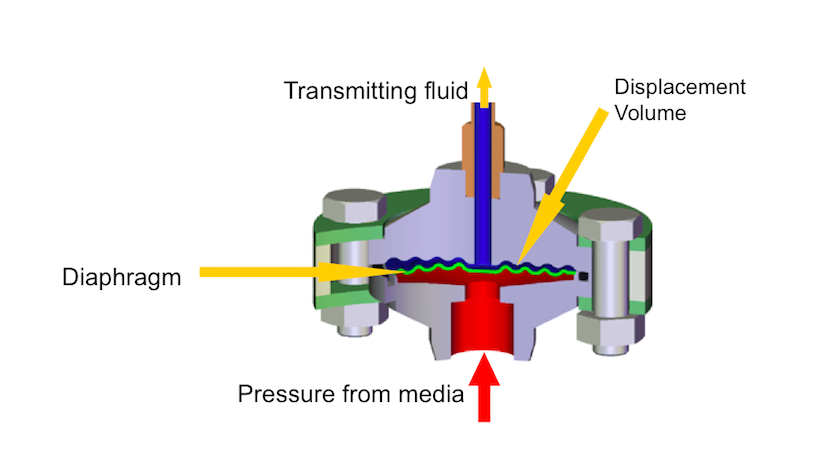
A diaphragm seal protects a pressure gauge or transmitter from a harsh process, but the seal itself does not do the measuring. Between the diaphragm and the instrument sits a fill fluid, a hydraulic liquid that carries pressure from the process side to the measuring element. Get this fluid wrong, and the seal that was supposed to protect the instrument quietly introduces its own errors instead.
Every diaphragm seal assembly, gauge, fill fluid, and capillary if fitted, is filled and sealed at a reference fill temperature, typically around 20°C. From that point on, the fluid expands and contracts with real world temperature swings, and that expansion is exactly what drives many of the mistakes covered below.
Interactive Fill Fluid Selector
Tell us your application, and this tool recommends a starting point for fill fluid selection.
The 5 Costly Fill Fluid Mistakes
These five patterns explain most real world failures when choosing a fill fluid for a diaphragm seal.
Every fill fluid has hard limits. Exceed them and the fluid degrades or the reading drifts.
Glycerin is not recommended for capillary connected assemblies or vacuum ranges.
Food and pharma applications need an FDA approved fluid, not a standard industrial one.
A longer capillary means more fill volume, and more fill volume means a bigger thermal zero shift.
Oxygen and chlorinated service need a fluid that will not react, not just one rated for temperature.
Ranges shown are approximate and illustrative. Always confirm exact limits with your specific fill fluid manufacturer datasheet.
Fill Fluid Compatibility Matrix
| Fill Fluid | Food/Pharma Safe | Vacuum Compatible | Capillary Compatible | High Temp (>250°C) |
|---|---|---|---|---|
| Glycerin/Water | ✔ | ✘ | ✘ | ✘ |
| FDA White Oil | ✔ | ✔ | ✔ | ✘ |
| Silicone DC510 (low temp) | ✘ | ✔ | ✔ | ✘ |
| Silicone DC704 (vacuum grade) | ✘ | ✔ | ✔ | ✘ |
| Silicone DC550 (high temp) | ✘ | ✔ | ✔ | ✔ |
| Syltherm 800 | ✘ | ✔ | ✔ | ✔ |
| Fluorolube / Halocarbon | ✘ | ✔ | ✔ | ✘ |
Manufacturer Reference: NOSHOK Fill Fluid Temperature Table
For exact published figures rather than illustrative ranges, this reference table reproduces NOSHOK's fill fluid temperature and viscosity data, including the thermal expansion coefficient (Et) for each fluid.
| Fill Fluid | Viscosity (cSt) | Vacuum/Compound Range | Pressure Range | Et (per °F) |
|---|---|---|---|---|
| Glycerin (99.7%) | 1,110 | N/A | 60°F to 462°F | 0.000294 |
| Silicone 200 (5 cSt) | 5 | -130°F to 176°F | -130°F to 356°F | 0.000588 |
| Silicone 200 (50 cSt) | 50 | -4°F to 250°F | -4°F to 392°F | 0.000582 |
| Silicone 200, Food Grade | 350 | N/A | 0°F to 572°F | 0.000533 |
| Silicone 510 | 50 | -60°F to 250°F | -60°F to 400°F | 0.000533 |
| Silicone 550 | 125 | -40°F to 325°F | -40°F to 450°F | 0.000520 |
| Silicone 710 | 500 | 0°F to 348°F | 0°F to 500°F | 0.000430 |
| Halocarbon 4.2 Oil | 4 | -40°F to 176°F | -40°F to 347°F | 0.000565 |
| Syltherm 800 | 9 | 4°F to 392°F | -40°F to 750°F | 0.000962 |
| Mineral Oil | 57 | -4°F to 338°F | -4°F to 482°F | 0.000356 |
| Neobee M-20 | 10 | -10°F to 200°F | -10°F to 400°F | 0.000511 |
Table Data Reference: NOSHOK Fill Fluid Temperature Table
Watch: How Diaphragm Seals Work
This official WIKA video explains the basic principle behind diaphragm seals and their fill fluid.
Fill Fluid Thermal Expansion Estimator
Ambient and process temperature changes cause the fill fluid to expand or contract, creating a zero shift. Estimate that volume change here.
Selecting Fill Fluid the Right Way: A Quick Checklist
Consistent fill fluid selection for diaphragm seals comes down to a handful of habits, repeated every time.
Where Fill Fluid Choice Really Matters
Quick FAQs: Fill Fluid Selection for Diaphragm Seals
External References
- WIKA USA: Diaphragm Seal Overview, Basic Principle and Applications
- ESP Gauges: Selecting Fill Fluids for Diaphragm Seals
- Wikipedia: Pressure Measurement
What we learn today
- Fill fluid selection for diaphragm seals depends primarily on temperature range, chemical compatibility, and whether the application involves a capillary, vacuum, or FDA regulated process.
- Glycerin is a common general purpose choice but is not recommended for capillary connected assemblies or vacuum and compound pressure ranges.
- Longer capillaries hold more fill fluid, which increases the thermal zero shift caused by the same ambient temperature swing.
- Specialized fluids exist for high temperature, low temperature, FDA regulated, and oxygen or chlorine service, each with a clearly defined operating range.