
Instrumentation · Temperature Measurement · Thermocouple Types
Thermocouple Types Explained: J, K, T, E, N, S, R and B: Full Comparison Guide
A complete guide to all eight IEC-standardised thermocouple types: materials, temperature ranges, accuracy, wire colour codes, applications and a selection chart to help you choose the right one for your process.
When you need to measure temperature in an industrial process, a thermocouple is almost always the first instrument considered. Thermocouples are rugged, fast-responding, available in a wide range of materials and temperature ratings, and significantly cheaper than RTDs for high-temperature applications. But choosing the wrong type for your application can result in poor accuracy, premature failure or dangerously incorrect readings.
There are eight standard thermocouple types defined by IEC 60584 and ASTM E230: J, K, T, E, N, S, R and B. Each uses a different pair of metal alloys, which gives it a unique temperature range, sensitivity (millivolt output per degree), accuracy class and set of environmental strengths and weaknesses. Understanding the differences is essential for every instrumentation engineer and technician.
This guide explains all eight types clearly, gives you a complete comparison table, explains the wire colour coding system, and provides a practical selection guide so you can always choose the right thermocouple type for your process. If you are new to thermocouples, start with our article on what is a thermocouple and how does it work before reading this comparison.
How Thermocouples Work: A Quick Recap
A thermocouple consists of two wires made from different metal alloys, joined at one end. The joined end is called the hot junction (or measuring junction) and is placed in contact with the process being measured. The other end is called the cold junction (or reference junction) and terminates at the measuring instrument or temperature transmitter.
When a temperature difference exists between the hot junction and the cold junction, a small voltage (in the millivolt range) is generated. This phenomenon is called the Seebeck effect. The magnitude of the voltage depends on the two metals used and the temperature difference between the two junctions. The measuring instrument converts this voltage into a temperature reading using a standard lookup table specific to each thermocouple type, defined by IEC 60584.
The temperature transmitter also measures the cold junction temperature and compensates for it automatically. This is called cold junction compensation, and it is essential for accurate measurement. A common source of thermocouple error is a faulty or poorly compensated cold junction.
Thermocouple Temperature Ranges at a Glance
The chart below from TE Connectivity, one of the world's leading thermocouple manufacturers. It shows the approximate usable temperature range for all standard thermocouple types. This is a useful first reference when screening types for your application:
The key takeaway from this chart is clear: Type K covers the widest temperature range of all base metal types (from -270°C to +1,260°C), making it the most versatile and the most widely used in general industry. Types S, R and B reach higher temperatures but at a much higher cost. Type T is the best choice below 0°C.
Base Metal Thermocouple Types: J, K, T, E and N
Base metal thermocouples are the workhorses of industrial temperature measurement. They are inexpensive, robust and available in a huge variety of sheath diameters, connection styles and insulation materials. Most process plants use Types K and J for the vast majority of their temperature loops.
Type K Thermocouple (Nickel-Chromium / Nickel-Aluminium)
The most widely used thermocouple type in industrial automation and process control worldwide.
Best for: General purpose industrial applications: kilns, boilers, process heating, HVAC, food processing, engine testing. Works in oxidising or inert atmospheres. Type K is the default choice when no specific reason exists to choose another type.
Limitations: Susceptible to green rot (preferential oxidation of chromium in low-oxygen environments at high temperatures). Experiences calibration drift due to short-range ordering between 300°C and 600°C on repeated cycling. Not recommended in sulphurous, reducing or vacuum atmospheres above 500°C.
Type J Thermocouple (Iron / Constantan)
The second most common type. Widely used in older plants and reducing atmosphere applications.
Best for: General industrial process measurement, particularly where reducing atmospheres are present (plastic moulding, heat treating). Type J is one of the few base metal types that can operate safely in reducing atmospheres where oxygen is deficient. Very common in older process plants in North America.
Limitations: The iron positive leg oxidises rapidly above 540°C. Not recommended above 760°C even in larger gauge sizes. Susceptible to rust in moist environments. Maximum temperature range is narrower than Type K. Type K will generally outlast Type J in the same application.
Type T Thermocouple (Copper / Constantan)
The best thermocouple for sub-zero, cryogenic and low-temperature applications.
Best for: Cryogenic research, ultra-low temperature freezers, pharmaceutical cold storage, food freezing tunnels, HVAC, and any application below 0°C. Excellent repeatability between -200°C and +200°C. Type T is moisture-resistant and stable in moist, mildly oxidising or reducing atmospheres. It is the preferred type for food industry applications.
Limitations: Limited upper temperature (370°C maximum in air). The copper positive leg has high thermal conductivity, which can cause measurement errors if there is significant heat conduction along the wire. Not suitable for high-temperature industrial applications.
Type E Thermocouple (Nickel-Chromium / Constantan)
Highest millivolt output of all base metal types with excellent signal-to-noise ratio.
Best for: Applications where a strong output signal is needed to overcome electrical noise, including industrial heating, drying ovens, plastics processing. Suitable in vacuum, inert or mildly oxidising atmospheres. Non-magnetic, making it useful near strong magnetic fields such as MRI equipment, particle accelerators and scientific instruments.
Limitations: Less common than K or J, which can make replacement sensors and extension cable harder to source. Not recommended for use in sulphurous or reducing atmospheres.
Type N Thermocouple (Nicrosil / Nisil)
A modern, improved alternative to Type K with better stability at high temperatures.
Best for: Applications above 800°C where Type K shows instability or drift. Type N was specifically developed to address Type K's short-range ordering and green rot problems. The addition of silicon to both legs suppresses preferential oxidation and gives significantly better long-term stability in cyclic high-temperature applications. Good choice for gas turbines, industrial furnaces and long-term high-temperature monitoring.
Limitations: Slightly more expensive than Type K. Lower millivolt output than Type K at the same temperature. Less commonly stocked, which can complicate replacement planning. Uses the same broad temperature range as K but instruments must be configured correctly for the N curve, which is different from K.
Noble Metal Thermocouple Types: S, R and B
Noble metal thermocouples use platinum and platinum-rhodium alloys. They are the choice for very high temperature applications (above 1,200°C), laboratory reference measurements, and industries requiring the highest accuracy and long-term stability: pharmaceutical, glass manufacturing, ceramics and metallurgy.
All three noble metal types share important characteristics: they must always be used with a ceramic (refractory) protection tube, they are extremely sensitive to contamination from base metals or silica, they require careful storage and handling, and their cost per sensor is many times higher than base metal types.
Type S Thermocouple (Platinum-10% Rhodium / Platinum)
High accuracy noble metal type. The original ITS-90 reference standard for temperatures above 660°C.
Best for: Pharmaceutical sterilisation (autoclave monitoring), glass manufacturing, ceramic kilns, metallurgical furnaces, laboratory reference measurements. Type S was historically used as the international temperature scale reference point (ITS-90) between 660°C and 1,064°C. It is common in biotech and pharmaceutical applications because of its high accuracy and excellent long-term stability.
Limitations: Relatively low millivolt output requires high-quality instrumentation. Very sensitive to contamination. Even touching the platinum wire with bare hands deposits oils that cause drift. Must always be used inside a clean ceramic protection tube. Very expensive compared to base metal types.
Type R Thermocouple (Platinum-13% Rhodium / Platinum)
Similar to Type S but with 13% rhodium, giving slightly higher output and better stability.
Best for: Very high temperature furnace and kiln applications where Type S performance is adequate but slightly higher millivolt output is preferred. Type R has the same temperature range as Type S but with a higher percentage of rhodium which provides marginally better stability and slightly higher output at elevated temperatures. Used in glass manufacturing, metallurgy, ceramic production and high-temperature laboratory work.
Limitations: More expensive than Type S due to higher rhodium content. Same sensitivity to contamination as all noble metal types. ANSI wire colours for R are identical to Type S (both Black positive, Red negative, Green jacket), which creates identification confusion in the field. Always verify by checking the transmitter configuration or the instrument tag.
Type B Thermocouple (Platinum-30% Rhodium / Platinum-6% Rhodium)
The highest temperature thermocouple in the standard series. Both legs are platinum-rhodium alloys.
Best for: The highest temperature applications in industry: glass melting furnaces, steel and iron foundries, sintering furnaces, high-temperature metallurgy. Type B can continuously measure up to 1,820°C, which is higher than any other standard thermocouple type. Both legs are platinum-rhodium, which makes Type B unusually contamination-resistant compared to Types S and R (which have a pure platinum leg).
Limitations: Type B produces nearly zero output below approximately 50°C, which means it cannot be used in ambient temperature conditions. The very low output below 600°C makes it impractical at moderate temperatures. It is the most expensive of the standard thermocouple types. Requires a ceramic primary tube and a refractory outer protection tube.
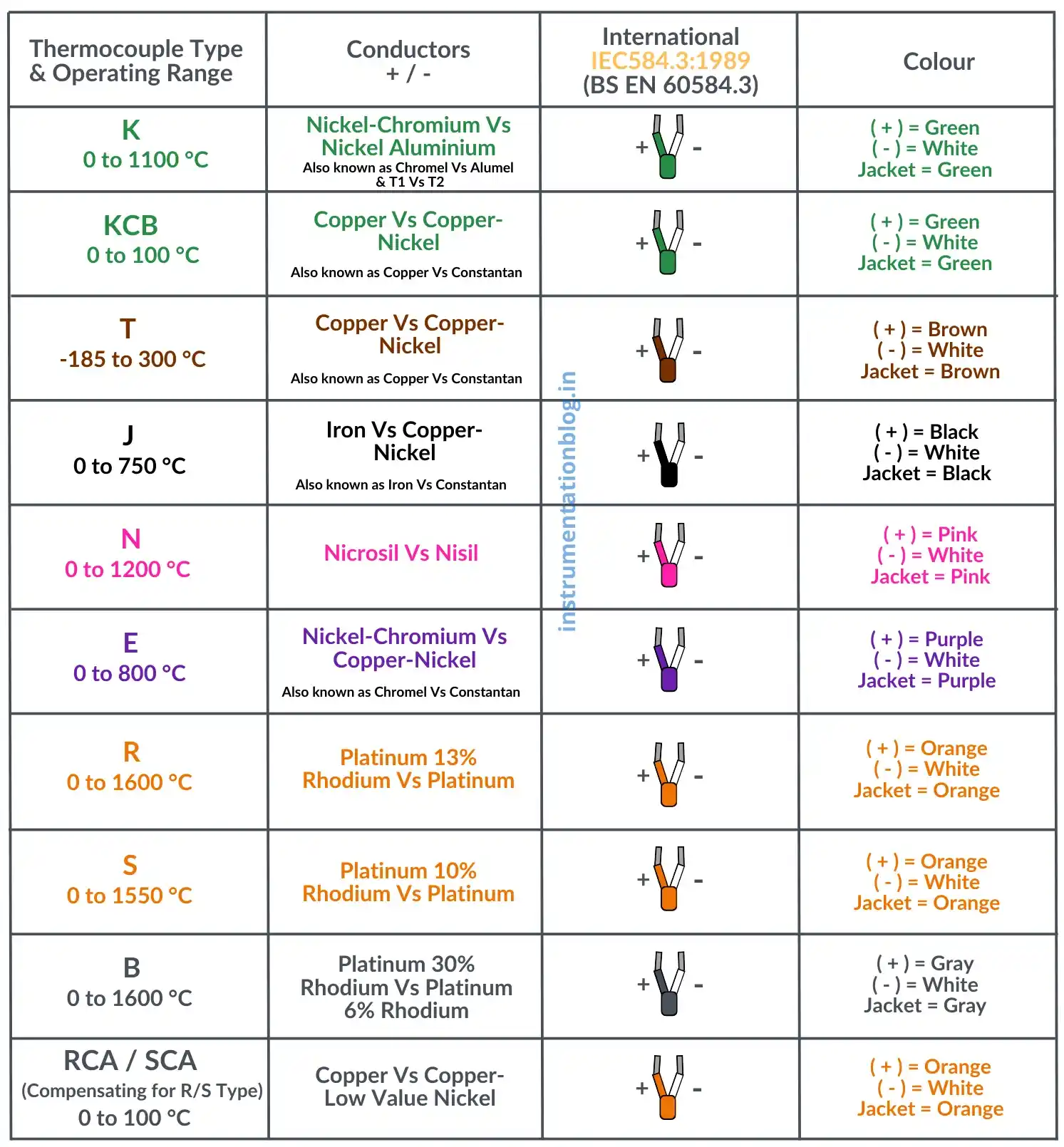
Thermocouple Wire Colour Codes: ANSI vs IEC
Every thermocouple type has a designated wire colour code to identify the type and polarity in the field. Two major standards are in use: ANSI/ASTM E230 (used primarily in North America) and IEC 60584-3 (used in Europe, Asia and most of the rest of the world). These two standards use different colours for the same thermocouple types, which is a common source of wiring errors when equipment from different regions is mixed on the same installation.
| Type | ANSI Positive (+) | ANSI Negative (−) | ANSI Jacket | IEC Positive (+) | IEC Negative (−) | IEC Jacket |
|---|---|---|---|---|---|---|
| K | Yellow | Red | Yellow | Green | White | Green |
| J | White | Red | Black | Black | White | Black |
| T | Blue | Red | Blue | Brown | White | Brown |
| E | Purple | Red | Purple | Purple | White | Purple |
| N | Orange | Red | Orange | Pink | White | Pink |
| S | Black | Red | Green | Orange | White | Orange |
| R | Black | Red | Green | Orange | White | Orange |
| B | Grey | Red | Grey | Grey | White | Grey |
For a printable version of the full colour code chart including British (BS) and German (DIN) standards, refer to the Omega Engineering colour code reference page. The WIKA international thermocouple colour code chart PDF is also an excellent field reference covering multiple national standards.
Full Comparison Table: All Eight Thermocouple Types
| Type | Material pair | Max temp (°C) | Min temp (°C) | Accuracy | Output (µV/°C) | Class | Best application |
|---|---|---|---|---|---|---|---|
| K | Ni-Cr / Ni-Al | 1,260 | -270 | ±2.2°C / ±0.75% | 41 (at 400°C) | Base metal | General purpose: the default choice |
| J | Iron / Constantan | 760 | -210 | ±2.2°C / ±0.75% | 55 (at 400°C) | Base metal | Reducing atmospheres, older installations |
| T | Copper / Constantan | 370 | -270 | ±1.0°C / ±0.75% | 60 (at 350°C) | Base metal | Cryogenic and sub-zero, food industry |
| E | Ni-Cr / Constantan | 870 | -270 | ±1.7°C / ±0.5% | 68 (at 400°C) | Base metal | High EMF output, noisy environments |
| N | Nicrosil / Nisil | 1,260 | -270 | ±2.2°C / ±0.75% | 39 (at 400°C) | Base metal | High temp cycling, alternative to K |
| S | Pt-10%Rh / Pt | 1,600 | -50 | ±1.5°C / ±0.25% | 10 (at 1000°C) | Noble metal | Pharma, glass, laboratory reference |
| R | Pt-13%Rh / Pt | 1,600 | -50 | ±1.5°C / ±0.25% | 12 (at 1000°C) | Noble metal | High temp furnaces, metallurgy |
| B | Pt-30%Rh / Pt-6%Rh | 1,820 | 50 (min usable) | ±0.5% above 600°C | 6 (at 1500°C) | Noble metal | Glass melting, highest temp applications |
How to Choose the Right Thermocouple Type
Use the questions below in sequence. The first question that narrows your options is usually the most important one.
| Question | If yes, consider | Notes |
|---|---|---|
| Is the temperature above 1,260°C? | S, R or B (noble metal) | Base metal types cannot be used reliably above 1,260°C. Noble metal types are the only option. Budget for ceramic protection tubes and proper handling procedures. |
| Is the temperature below 0°C or in a cryogenic application? | Type T | Type T has excellent accuracy and stability at sub-zero and cryogenic temperatures. Types K and J can also be used below 0°C but with reduced performance. |
| Is a reducing atmosphere present (low oxygen, carbon monoxide, hydrogen)? | Type J or Type N | Type J is specifically suited to reducing atmospheres. Type K suffers green rot in these conditions. Type N also performs better than K in low-oxygen environments. |
| Is there significant electrical noise or a weak signal path? | Type E | Type E produces the highest millivolt output of all base metal types (~68 µV/°C). A stronger signal is less affected by electrical noise in the cable. |
| Will the thermocouple cycle repeatedly between 300°C and 1,000°C? | Type N (over Type K) | Type K experiences calibration drift on repeated thermal cycling in this range. Type N was specifically developed to solve this problem. |
| Is this for pharmaceutical, biotech or laboratory reference use? | Type S | Type S is the preferred choice in FDA-regulated industries due to its stability and traceability to ITS-90. Widely accepted in pharmaceutical validation protocols. |
| None of the above: general process measurement? | Type K | Type K is the default choice for general-purpose process temperature measurement where no special atmosphere, extreme temperature or accuracy requirement applies. It is the most supported type by instrument manufacturers worldwide. |
Common Thermocouple Mistakes to Avoid
| Mistake | What happens | How to avoid it |
|---|---|---|
| Wrong thermocouple type configured in transmitter | Large non-linear temperature error that no calibration trim can fix | Always verify the transmitter type setting matches the physical thermocouple before calibrating. Check via HART communicator or local display menu. |
| Reversed polarity wiring | Temperature reading decreases as actual temperature increases. Reading goes below ambient. | Use a voltmeter at the transmitter terminals. Heating the junction should produce a positive millivolt reading. Swap wires if negative. Know your colour code standard (ANSI vs IEC). |
| Copper extension wire used instead of thermocouple extension wire | Creates a parasitic junction where the thermocouple alloy meets copper. Measures temperature at the junction point, not the probe tip. | Always use matched thermocouple extension wire of the same type. If a 4-20 mA transmitter is fitted at the head, copper cable can be used after the transmitter only. |
| Touching noble metal thermocouple wire with bare hands | Oil and salts from skin contaminate the platinum wire, causing measurement drift at high temperatures. | Always handle Type S, R and B thermocouples with clean cotton gloves. Store in their protective sheaths when not in use. |
| Using Type K in a reducing atmosphere | Green rot. The chromium in the positive Chromel wire oxidises preferentially, causing the wire to turn green and the calibration to drift significantly. | Use Type J or Type N in reducing or low-oxygen atmospheres. Or use Type K in a sealed metal protection tube with an inert atmosphere inside. |
For detailed calibration procedures for temperature transmitters connected to thermocouples, see our guide on how to calibrate a temperature transmitter step by step. For burnout function settings that protect your system when a thermocouple open-circuits, see our article on the burnout function in temperature transmitters explained.
Further Reading and External Resources
- TE Connectivity: Thermocouple Types Comparison Chart. Complete reference from one of the world's largest thermocouple manufacturers, including temperature ranges and tolerance tables for all types.
- Omega Engineering: Thermocouple Colour Codes. Printable ANSI and IEC colour code reference for all standard thermocouple types.
- Watlow: Thermocouple Types and Environmental Considerations. Practical guidance on thermocouple selection for different process environments from a leading temperature instrument manufacturer.
- WIKA: How Many Thermocouple Types Are There?. Thorough overview including tungsten thermocouple types not covered in the standard IEC series.
Frequently Asked Questions: Thermocouple Types
- What Is a Thermocouple and How Does It Work?
- Cold Junction Compensation in Thermocouples Explained
- How to Calibrate a Temperature Transmitter: Step-by-Step Procedure
- Burnout Function in Temperature Transmitters Explained
- RTD Sensor Connections: 2-Wire, 3-Wire and 4-Wire Explained
- Common Temperature Measurement Errors and Their Causes
- Thermocouple vs RTD: Which Should You Choose?
What we learn today
- There are eight standard thermocouple types: J, K, T, E, N (base metals) and S, R, B (noble metals). Each uses a different alloy pair giving a unique temperature range, sensitivity and set of environmental strengths.
- Type K is the most widely used in industry. Type T is best for sub-zero and cryogenic work. Types S, R and B are for very high temperatures above 1,200°C. Type N is the improved alternative to Type K for cyclic high-temperature applications.
- Wire colour codes differ between ANSI (North America) and IEC (international). In ANSI, the negative wire is always red. In IEC, the negative wire is always white. Confusing these standards will reverse polarity and produce completely wrong readings.
- Always verify that the transmitter type setting matches the physical thermocouple installed. A mismatch creates a non-linear error that cannot be corrected by zero and span calibration.

