
Table of Contents
ToggleFlow Meter End Connections: Introduction
When selecting a flow meter, most engineers naturally focus on things like accuracy, flow range, or the type of technology being used. Whether it is electromagnetic, ultrasonic, or turbine, these are usually the first considerations.
But in real industrial environments, something much simpler often becomes the deciding factor in performance and safety.
The end connection of the flow meter
It may look like a small mechanical detail, but it can determine whether your system runs smoothly or develops leaks, failures, and costly shutdowns.
IMany flow meter issues are not caused by the measuring principle at all but they are caused by improper connection to the pipeline.
So let us explore this topic in a practical way, without overcomplicating it.
Understanding What End Connections Really Do
Every flow meter needs to be physically integrated into a pipeline. This is where end connections come into play.
At a basic level, they serve two important roles:
1. They hold the flow meter firmly in place
2. They ensure a leak-proof seal under operating conditions
But beyond that, they also influence how the system behaves under pressure.
A pipeline carrying water at 3 bar is very different from one carrying steam at 25 bar or gas at fluctuating pressures. The connection must be able to handle not just pressure but also vibration, thermal expansion, and long-term stress.
That’s why the choice of connection is not just mechanical but it’s a design decision.
Why Pressure Rating Is Not Just About the Meter
One common misunderstanding in instrumentation is assuming that the pressure rating depends only on the flow meter body.
In reality, the system behaves as a whole.
The maximum pressure a system can handle is limited by its weakest point.
And very often, that weakest point is the connection.
For example, you may have a flow meter rated for high pressure, but if it is connected using a weaker interface, the overall system rating effectively drops.
This is why experienced engineers always evaluate both:
1. The meter construction
2. The meter connection type
before finalizing a selection.
1. Threaded Connections
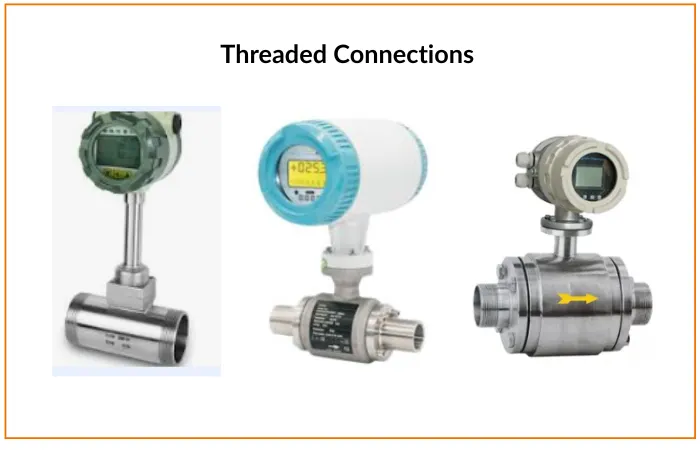
Threaded connections are probably the most familiar type. They are commonly used in smaller pipelines and utility systems where installation needs to be quick and straightforward.
In many water systems or HVAC applications, threaded flow meters work perfectly fine. They are easy to install, cost-effective, and convenient when frequent replacement is expected.
However, their simplicity comes with a limitation.
Because sealing depends on the threads themselves, these connections are more vulnerable under higher pressure or repeated pressure cycles. Over time, threads can wear, loosen, or develop micro-gaps, leading to leakage.
This is why threaded connections are typically avoided in critical or high-pressure applications.
In practice, they are best suited for systems where pressure is relatively low and the consequences of leakage are minimal.
2. Flanged Connections
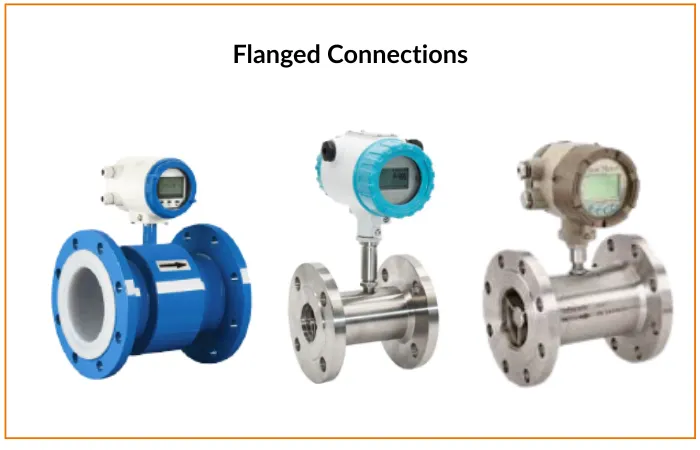
If you visit any large industrial plant, you will notice that most flow meters are installed using flanged connections.
There is a reason for this widespread use.
Flanged connections provide a strong and reliable seal by using two matching flanges bolted together, with a gasket placed in between. This design distributes pressure evenly and creates a robust mechanical joint.
Unlike threaded connections, flanges can handle much higher pressures, and they are standardized into classes such as 150, 300, or 600. This makes it easier for engineers to select a connection that matches the system’s pressure requirements.
Another advantage is maintainability.
Flow meters with flanged ends can be removed and reinstalled without damaging the pipeline, which is a big benefit in industrial environments where maintenance is part of regular operations.
Because of their strength, flexibility, and reliability, flanged connections have become the default choice for medium to high-pressure applications.
3. Welded Connections
In certain applications, even flanged connections are not enough.
This is where welded connections come in.
A welded flow meter becomes a permanent part of the pipeline. There are no bolts, no threads, and no gaskets — just a continuous metal structure.
This eliminates potential leak paths and provides the highest possible strength.
That’s why welded connections are commonly used in high-pressure gas systems, steam lines, and hazardous chemical applications where even a small leak can be dangerous.
However, this strength comes with a trade-off.
Once installed, the flow meter is not easy to remove. Maintenance becomes more complex, and any replacement usually requires cutting and re-welding.
So while welded connections offer unmatched reliability, they are typically used only where safety and pressure demands justify the added complexity.
4. Sanitary Connections
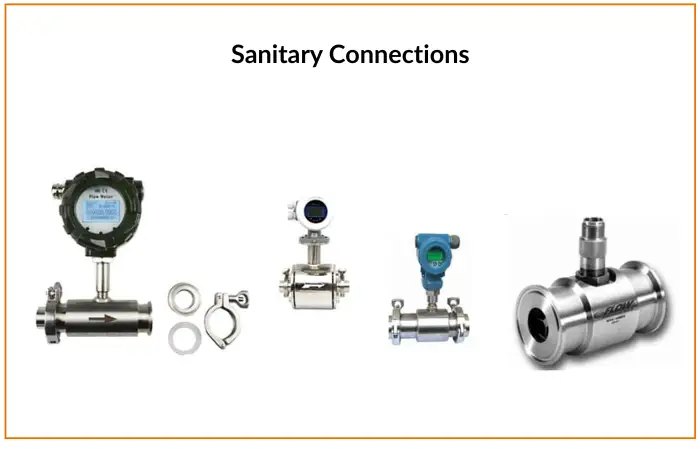
In industries like food processing and pharmaceuticals, the priority shifts from pressure handling to hygiene.
Here, sanitary connections are used, typically based on tri-clamp designs that allow quick assembly and disassembly.
These connections are made from corrosion-resistant materials and are designed to avoid crevices where bacteria can accumulate. They also support cleaning processes like CIP (Clean-In-Place) and SIP (Sterilize-In-Place).
While they can handle moderate pressure, they are not intended for heavy industrial conditions.
So in these applications, engineers must balance two factors:
1. Maintaining hygiene standards
2. Ensuring sufficient pressure capability
This is why sanitary connections are chosen specifically for clean processes rather than high-pressure environments.
Choosing the Right Connection
Instead of memorizing rules, it is better to think in terms of application needs.
If the system operates under low pressure and simplicity is important, threaded connections can be sufficient.
As pressure increases and reliability becomes more critical, flanged connections become the safer choice.
For extreme conditions or hazardous fluids, welded connections provide the highest level of safety.
And in hygienic industries, sanitary connections are essential, even if it means accepting moderate pressure limits.
In real engineering, the decision is rarely based on a single factor. It’s always a balance between pressure, fluid type, maintenance needs, and operational safety.
Let us take an example
Let’s consider a simple but realistic situation.
A plant installs a flow meter in a high-pressure gas line. To reduce cost and simplify installation, a threaded connection is selected.
Initially, everything works fine.
But after some time, small leaks begin to appear. These leaks may seem minor, but under pressure, they gradually worsen. Eventually, the system requires shutdown for repair.
The root cause is not the flow meter technology — it is the connection choice.
Situations like this are more common than many people realize.
What we learn today?
At the end of the day, a flow meter does not operate in isolation.
It is part of a complete system, and its performance depends on how well it is integrated into that system.
And that integration begins with the end connection.
So the next time you select a flow meter, take a moment to go beyond the specifications.
Ask yourself:
Is the connection strong enough for my pressure?
Is it suitable for my application?
Because in real-world instrumentation…
The smallest components often carry the biggest responsibility.


I hope you like above blog. There is no cost associated in sharing the article in your social media. Thanks for Reading !! Happy Learning
2 Comments