
Both parts look similar on a bill of materials and both quiet down electrical noise, yet reaching for the wrong one wastes board space and still leaves a design failing EMI testing.
Ferrite Bead vs Common Mode Choke comes down to how many conductors pass through the core, a single wire gets simple broadband damping while two matched windings protect a differential signal from common mode noise.
Reading how a common mode choke works on its own is a good companion piece here, since this article builds on that mechanism directly.
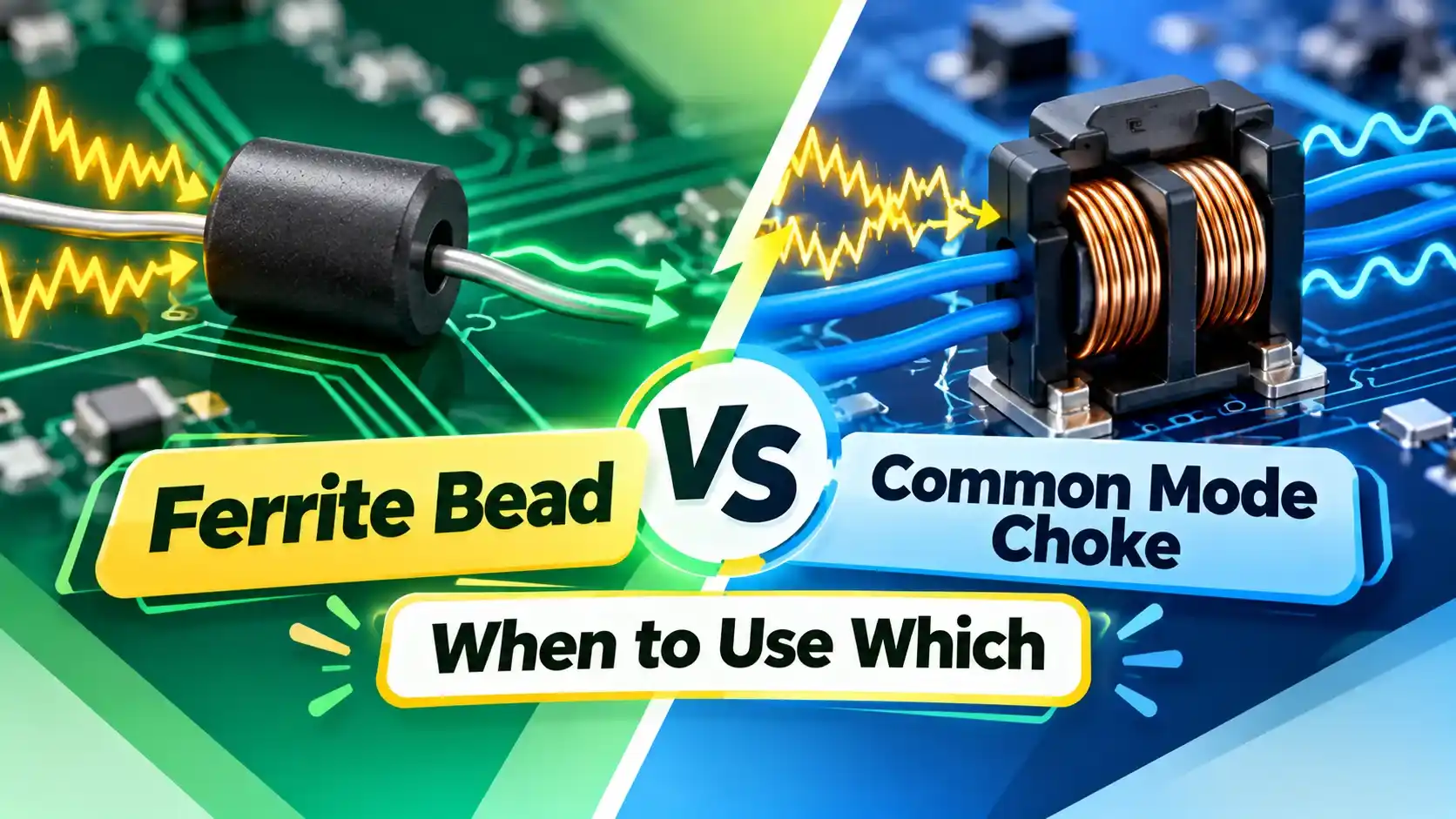
Ferrite Bead vs Common Mode Choke
A ferrite bead is a single piece of ferrite material placed around one conductor, turning that short section of wire into a lossy, frequency dependent resistor that dissipates high frequency energy as heat.
A common mode choke wraps two or more conductors through the same ferrite core in a specific winding pattern, so the component behaves completely differently depending on what kind of current flows through it.
Choosing between these two components is really a question of whether the noise sits on a single line or specifically between two paired conductors that also carry a wanted differential signal.
How a Ferrite Bead Works
A single wire passes straight through the ferrite bead, and at low frequency the bead looks almost like a plain piece of wire with negligible added resistance or inductance.
As frequency climbs into the tens or hundreds of megahertz, the ferrite material becomes lossy rather than purely magnetic, and that lost energy shows up as heat instead of continuing down the wire as noise.
This makes a ferrite bead a broadband, unselective fix, it attenuates whatever high frequency content happens to be present on that one wire, wanted signal included if the signal itself sits in that same band.
How a Common Mode Choke Works
Two wires wind through the same core in opposite directions relative to each other, so a differential signal current, the wanted current flowing out on one wire and back on the other, produces magnetic flux that cancels almost completely inside the core.
A common mode current, unwanted noise flowing in the same direction on both wires at once and returning through ground or stray capacitance, produces flux that adds up instead of cancelling, and the core presents high impedance to exactly that current.
The result is a component that blocks common mode noise aggressively while barely touching the differential signal riding on the same pair, which a single ferrite bead simply cannot distinguish between.
Key Differences Between the Two
The two options also differ in how forgiving they are of a design mistake, a bead on the wrong line rarely causes real harm, a poorly matched choke can distort a fast differential signal noticeably.
| Property | Ferrite Bead | Common Mode Choke |
|---|---|---|
| Conductors through core | One | Two or more, matched |
| Differential signal loss | Present, unavoidable | Very low by design |
| Common mode attenuation | Limited, incidental | High, primary purpose |
| Typical placement | Single power or signal trace | USB, Ethernet, motor, and AC input lines |
| Saturation with DC current | Can saturate at high current | Flux cancels, tolerates higher DC current |
When a Ferrite Bead Is the Right Choice
When a Common Mode Choke Is the Right Choice
Common Applications
Common Mistakes When Choosing Between Them
None of these mistakes show up on a schematic review, they only surface once a board reaches an EMI chamber or a field return comes back with an unexplained noise complaint.
Checking a Design Before It Ships
A quick continuity and polarity check on every choke winding, along with a datasheet review of its rated current and impedance curve, catches most of these problems before a board ever reaches formal testing.
Picking a Ferrite Bead by Impedance, Not Guesswork
A ferrite bead datasheet publishes impedance in ohms at a stated frequency, usually 100 megahertz, along with a breakdown of how much of that impedance is resistive versus reactive.
The resistive part is what actually dissipates noise energy as heat, so a bead with a mostly reactive impedance at the target frequency behaves more like a small inductor than a true noise absorber.
Matching the bead's peak impedance frequency to the actual noise frequency measured on the line, rather than picking a generic part off a reel, is what separates an effective fix from a part that does very little.
Picking a Common Mode Choke by Rated Current and Impedance
A choke datasheet lists a maximum rated current for each winding, and exceeding it drives the core toward saturation, at which point common mode impedance collapses right when it is needed most.
Common mode impedance is also specified at a stated frequency, and a choke chosen for a differential pair should show strong impedance across the actual noise band that the line needs to reject.
Insertion loss curves published in a manufacturer's datasheet let a designer compare several candidate chokes directly, rather than assuming any part with the right footprint will perform the same as another.
Ferrite Bead vs Common Mode Choke: Quick Selection Guide
Ferrite Bead
Cheap, small, easy to add anywhere on a single line, but attenuates the wanted signal along with the noise.
Common Mode Choke
Protects differential signal integrity while blocking common mode noise, at higher cost and board space.
Neither component is universally better, the right pick between them depends entirely on whether a differential signal on that line actually needs protecting from the fix itself.
Many real designs use both together, a bead on a single ended line here, a choke on a differential pair there, matched to what each specific line actually carries.
Watch: Ferrite Beads and Common Mode Chokes Explained
Ferrite Bead vs Common Mode Choke FAQs
Related Articles on This Site
- Common Mode Choke Working Principle
- What Is Electromagnetic Interference EMI
- EMI vs EMC: 15 Key Differences
- How Decoupling Capacitors Work
- Noise Reduction Techniques in Digital ICs
External References
What We Learn Today
- A ferrite bead uses one wire and damps any high frequency noise on that line, wanted signal included.
- A common mode choke uses matched windings so it blocks common mode noise while sparing the differential signal.
- Pick based on whether the line carries a differential signal that a bead would also degrade.