
A dedicated electronic device that turns raw meter, pressure, and temperature signals into corrected, auditable volumes you can bill against.
A flow computer collects signals from a flow meter and its pressure and temperature transmitters, then calculates volume at standard base conditions. It also stores a tamper evident audit trail, which is why pipeline operators trust it for billing.
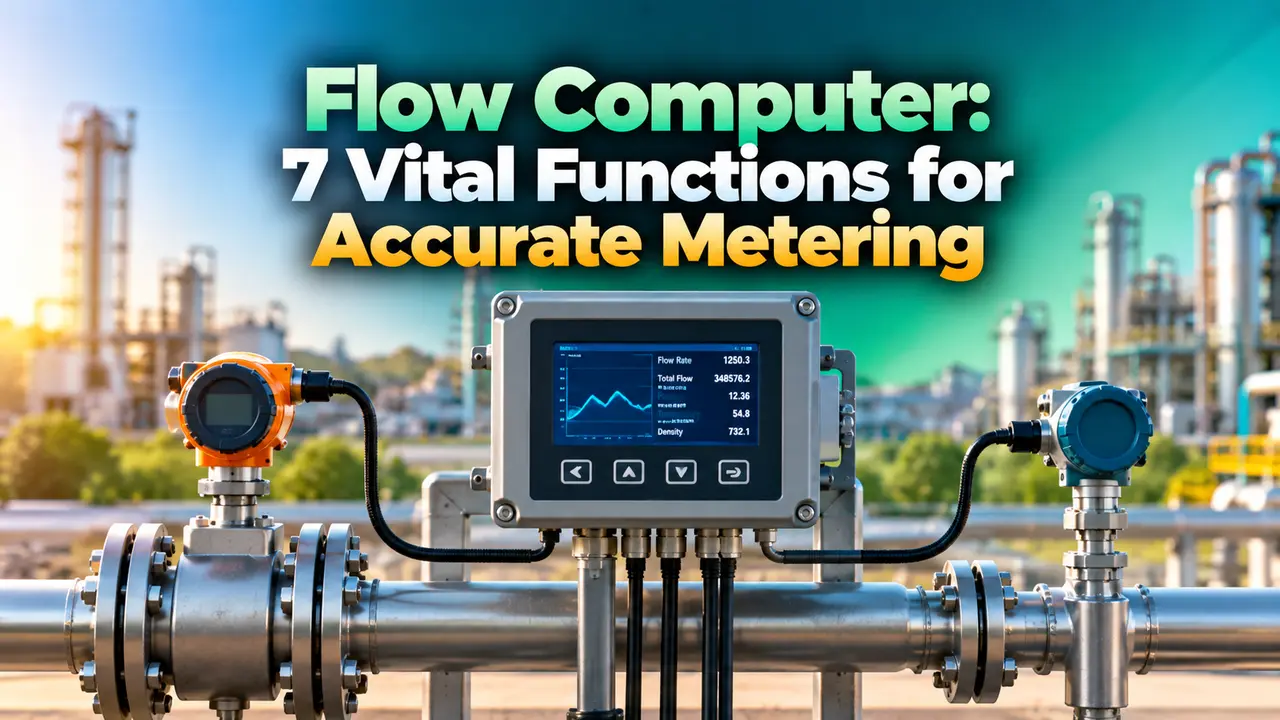
What Is a Flow Computer?
A flow computer is a specialised electronic unit that reads flow, pressure, temperature, and sometimes density or gas composition. It then applies industry standard equations to report corrected volume, mass, and energy.
A gas turbine meter only tells you how many cubic metres passed at line pressure and line temperature. That number is almost useless for billing, because the same gas occupies far less space at 50 bar than at atmospheric pressure.
This is exactly the gap covered in our guide on actual flow, standard flow and normal flow. The correction needs live pressure, live temperature, and a compressibility factor calculated from gas composition.
A general purpose controller can do some of this math. However, contracts and regulators demand approved algorithms, fixed calculation intervals, and records that cannot be edited quietly.
That is where a dedicated metering device earns its place. It sits between the field instruments and the custody transfer point, and its numbers become the invoice.
Unlike a simple totalizer, it follows published calculation methods such as AGA Report No. 3 for orifice meters and AGA Report No. 7 for turbine and rotary meters. It uses AGA Report No. 8 to calculate gas compressibility from the composition.
In this article we will walk through its functions, types, the core correction formula with a worked example, a live calculator, and the standards you must know.
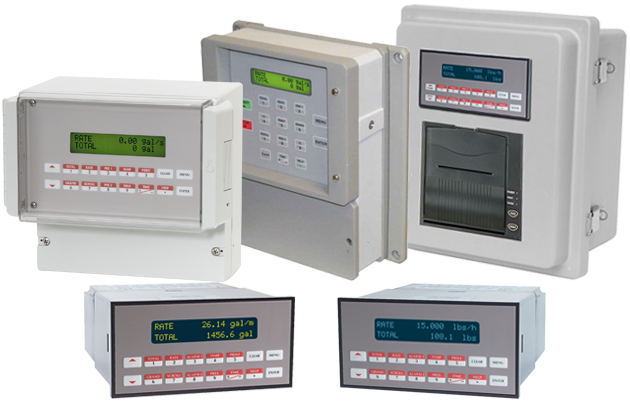
Inputs usually come from a meter pulse or a differential pressure transmitter, plus a static pressure transmitter and an RTD. Many modern skids use a single multivariable transmitter that sends all three values over HART or Modbus.
The output is not a control signal. Instead, it is a set of hourly, daily, and batch quantity records, plus alarms and events, that operators and accountants rely on.
Signal Path From Meter to Invoice
Every stage of this chain is logged. If a transmitter fails, the flow computer can switch to a keypad or default value, and it records exactly when and why that happened.
This matters because a single percent of error on a large gas pipeline can mean crores of rupees per year. That is why engineers treat the metering skid as a financial instrument, not just a process instrument.
7 Vital Functions of a Flow Computer
Functions 3 and 4 are the heart of the device. Without them, you would be billing for gas at line conditions, which changes every minute with pipeline pressure.
Function 6 is what separates this device from a PLC. API MPMS Chapter 21.1 requires records that let an auditor rebuild every reported quantity months later.
Flow Computer Types by Application
Runs AGA 3, AGA 7 and AGA 8 calculations and often reads a gas chromatograph for live composition.
Applies API volume correction factors for temperature and pressure, and handles meter proving.
Battery or solar powered, explosion proof housing, often with an integrated multivariable sensor.
Installed in a control room cabinet, handles several meter runs and a prover with redundancy.
Base Volume Correction Formula With a Worked Example
For a linear meter such as a turbine or rotary meter, the AGA 7 approach corrects the measured volume using pressure, temperature and compressibility ratios. The meter volume itself comes from pulses divided by the K factor.
Vf = volume at flowing conditions
Pf, Tf = flowing absolute pressure and temperature
Pb, Tb = base pressure and temperature
Zb, Zf = compressibility at base and flowing conditions
Worked example:
Vf = 1000 m³ from a turbine meter
Pf = 5 bar gauge + 1.01325 = 6.01325 bar absolute
Pb = 1.01325 bar absolute
Tf = 25 °C = 298.15 K, Tb = 15 °C = 288.15 K
Zf = 0.985, Zb = 0.998
Vb = 1000 × 5.9346 × 0.9665 × 1.0132
Vb ≈ 5811 standard m³
Notice how pressure dominates the result, nearly multiplying the volume by six. This is why a small pressure transmitter zero shift can create a large billing error.
Ignoring compressibility here would have understated the volume by about 1.3 percent. On a station moving lakhs of cubic metres daily, that gap adds up very quickly.
Flow Computer vs PLC vs RTU
| Feature | Flow Computer | PLC | RTU |
|---|---|---|---|
| Main purpose | Fiscal measurement | Machine and process control | Remote data collection |
| AGA and API algorithms | Built in and certified | Custom code needed | Sometimes, as add on |
| Audit trail | Mandatory and locked | Not by default | Limited |
| Metrology approval | Often type approved | Rarely | Rarely |
| Typical scan rate | Once per second or faster | Milliseconds | Seconds |
| Power | Mains, battery or solar | Mains | Mains or solar |
A PLC vs RTU comparison already shows how these two differ in control and telemetry roles. The flow computer adds a third role, which is legally defensible measurement.
Some RTUs now include gas flow libraries, so the line is blurring at small wellhead sites. For fiscal skids, however, a dedicated and approved unit remains the norm.
Where a Flow Computer Is Used
In all these places, the meter type changes, but the job stays the same. The skid may use orifice plates, turbine meters, ultrasonic meters, or Coriolis meters.
For gas stations, the unit often reads a gas chromatograph every few minutes. This live composition keeps both the compressibility factor and the heating value accurate.
Advantages and Limitations
- Uses approved industry equations, so results stand up in disputes.
- Keeps a locked audit trail of every change and alarm.
- Corrects for pressure, temperature and composition in real time.
- Handles several meter runs and a prover in one unit.
- Costs more than a general purpose controller.
- Accuracy still depends on calibrated field transmitters.
- Configuration needs trained metering staff.
- Firmware changes may require fresh approval from authorities.
The biggest practical limitation is garbage in, garbage out. Regular calibration of the pressure, temperature and DP transmitters matters as much as the calculation engine itself.
Standard Volume Correction Calculator
Try raising the line pressure to 40 bar gauge and watch the result jump. This simple exercise shows why pressure compensation, explained in our temperature and pressure compensation guide, is never optional for gas.
Standards and Configuration Checks
The key references are AGA Report No. 3, 7 and 8 for gas, and API MPMS Chapter 21.1 and 21.2 for electronic gas and liquid measurement. Internationally, ISO 5167 covers differential pressure meters and OIML R117 covers dynamic liquid measuring systems.
According to the Eagle Research white paper hosted by Yokogawa, API 21.1 expects at least seven days of hourly quantity records onsite. It also requires the audit log to capture the date, time, old value and new value of every parameter change.
Before commissioning a flow computer, verify the base conditions, meter factor, orifice bore, pipe diameter, gas composition source and alarm limits. Then run a loop check and cross verify one hour of totals by hand using the formula above.
Also confirm the Modbus register map with the SCADA team. Our Modbus protocol explained article covers the register basics you will need for that handshake.
Downloadable Reference on Flow Computer Fundamentals
Flow Computer Video Guide for Pipeline Measurement
Flow Computer FAQs
Related Articles
- What Is Custody Transfer
- Types of Natural Gas Flow Meters
- Actual Flow, Standard Flow and Normal Flow
- What Is MMSCFD in Natural Gas Flow
- Square Root Extraction in DP Flow
External References
- Fundamentals of Flow Computers, Eagle Research and Yokogawa
- Flow Computer, Wikipedia
- API Manual of Petroleum Measurement Standards
- American Gas Association
- ISO 5167, Wikipedia
- AGA Gas Flow Calculators, SCADACore
What We Learn Today
- A flow computer turns raw line measurements into standard volume, mass and energy using approved equations.
- Pressure, temperature and compressibility corrections can change the billed volume several times over.
- A locked audit trail under API 21.1 is what makes the numbers legally trustworthy.