
A camera that never blinks and never gets tired now checks far more parts on a production line than any human inspector ever could, catching defects at line speed instead of on a sample basis.
Machine vision for quality inspection combines industrial cameras, purpose built lighting, and image processing or AI software to automatically check parts for defects, dimensions, and completeness at full production line speed.
This builds on our earlier looks at artificial intelligence and machine learning and AI in PLC, SCADA, and DCS systems.
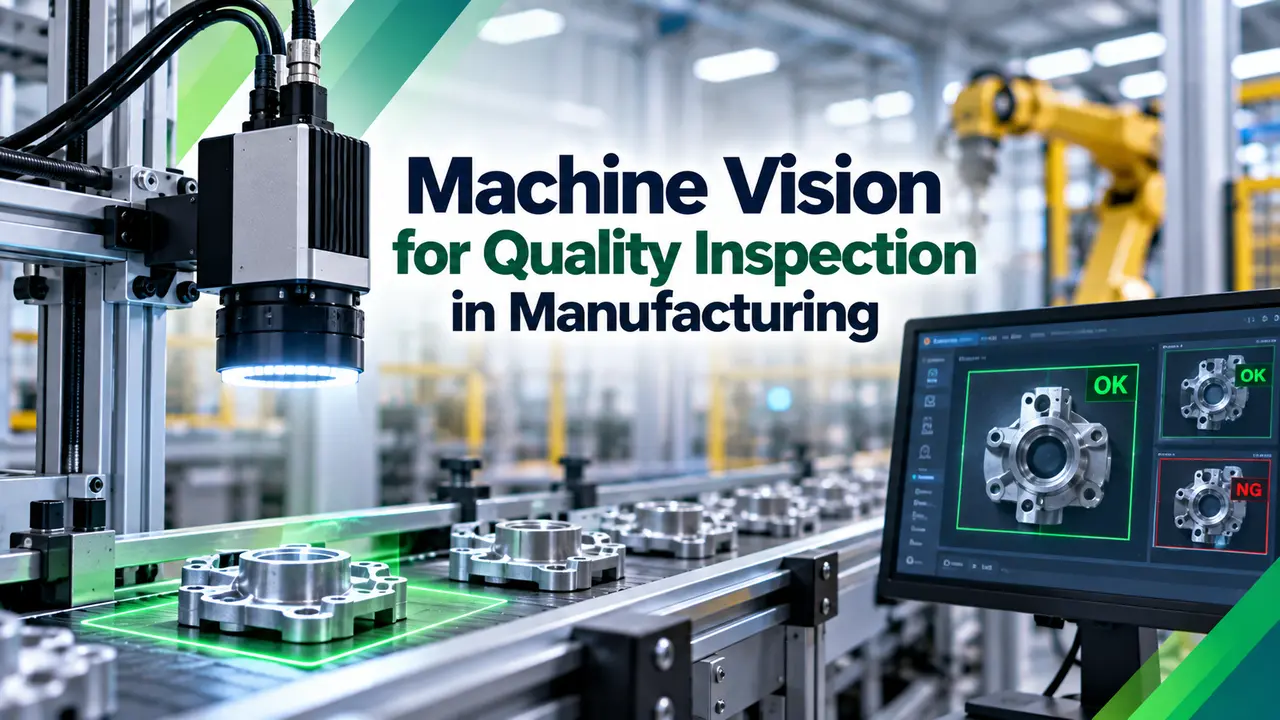
What Machine Vision for Quality Inspection Actually Does
The setup places one or more industrial cameras above or around a moving part, captures an image at exactly the right moment, and runs that image through software that decides whether the part passes or fails.
That decision typically feeds straight into the line's PLC, triggering a reject mechanism or a diverter within milliseconds, so a defective part never reaches the next station or, worse, a customer.
Why Lighting Is Often the Hardest Part to Get Right
A camera can only see what the lighting reveals, and inconsistent or ambient light changes contrast and shadow in ways that confuse even a well trained inspection algorithm.
Backlighting silhouettes a part for precise edge measurement, a ring light gives even general purpose illumination, a dome light diffuses glare off curved or reflective surfaces, and structured light projects a pattern used for 3D height and volume measurement.
Cameras, Lenses, and System Choices
Lens focal length, working distance, and resolution all have to match the part size and the field of view, and getting this wrong leaves an inspection either too coarse to catch a small defect or too tight to fit the whole part in frame.
Mounting and Vibration Considerations
A camera mounted on a structure that flexes or vibrates with the line can introduce motion blur that no amount of software correction will fully undo, so a rigid, isolated mounting point matters just as much as the camera specification itself.
Running a fixture check periodically, confirming the camera and lighting have not drifted from their qualified position, catches this kind of slow degradation before it starts showing up as an unexplained rise in false rejects.
How Deep Learning Changed Vision Inspection
Traditional rule based vision relies on blob analysis, edge detection, and pattern matching, all of which excel at consistent, well defined features but need an explicit rule written for every single defect type.
A cosmetic scratch, a texture anomaly, or a stain on an organic material varies naturally in shape and location, and writing a hard rule for every possible variation quickly becomes impractical.
Learning From Labeled Examples Instead of Fixed Rules
A deep learning model trained on hundreds or thousands of labeled good and defective images learns the statistical signature of a defect rather than following a fixed geometric rule, letting it generalize to variations it has never seen before.
Most modern inspection systems actually combine both approaches, using rule based logic for precise dimensional checks and a trained model for the cosmetic or high variation defects that rules alone tend to miss.
Typical Inspection Tasks on a Production Line
| Task | What the System Checks |
|---|---|
| Dimensional measurement | Gaps, flush fit, and gauging against a tolerance band |
| Surface defect detection | Scratches, dents, contamination, and pinholes |
| Presence and absence check | Missing fasteners, components, or completeness of assembly |
| Label and code reading | Barcode, date code, and optical character verification |
| Color and shade sorting | Grading parts by color match against a reference standard |
Fitting Inspection Into the Line's Cycle Time
Every inspection, decision, and reject signal has to complete within the line's takt time, and on a fast moving line that window can be a matter of milliseconds synchronized to an encoder or trigger signal.
The vision system usually reports its pass or fail result to the PLC over discrete input and output wiring or over an industrial Ethernet protocol, depending on how much additional data the line control needs beyond a simple pass or fail flag.
Where This Shows Up Across Industries
Rule Based Vision vs AI Powered Vision
Rule Based Vision
Fast, deterministic, and easy to validate for precise dimensional and geometric checks.
AI Powered Vision
Catches subtle, high variation cosmetic defects, but needs training data and periodic retraining.
Choosing between the two is rarely all or nothing, most production lines end up layering an AI model over a rule based foundation rather than replacing one approach entirely with the other.
Rolling Out a New Inspection Station
A new station usually starts with a data collection phase, gathering sample images of both good parts and every known defect type before any inspection logic gets written or any model gets trained.
Running the new station in a monitor only mode alongside the existing process, comparing its calls against human inspectors for a trial period, catches configuration mistakes before the station is trusted to actually reject parts on its own.
Ongoing Ownership After Go Live
A vision station is never really finished, someone on the maintenance or quality team needs ownership of retraining schedules, fixture checks, and reviewing edge cases the system flags as uncertain rather than confidently right or wrong.
Building that ownership into a standard operating procedure from day one avoids the common failure mode where a station's accuracy quietly degrades over months with nobody officially responsible for noticing.
Common Pitfalls to Avoid
Watch: Advanced Machine Vision Made Easy
Machine Vision for Quality Inspection FAQs
Related Articles on This Site
- Artificial Intelligence and Machine Learning
- AI in PLC, SCADA, and DCS
- Predictive Maintenance vs Preventive Maintenance
- Digital Twin in Industrial Automation
- Signals in Instrumentation, AI, AO, DI, DO
External References
What We Learn Today
- Machine vision for quality inspection pairs cameras and lighting with software that decides pass or fail.
- Lighting choice often matters more than camera resolution for a reliable inspection result.
- Deep learning catches subtle cosmetic defects that fixed rule based logic tends to miss.