PLC Objective Questions and Answers: 50 Ultimate MCQs to Test Your Knowledge

Share:
Interview Questions & Answers / PLC and Automation
PLC Objective Questions and Answers: 50 Ultimate MCQs to Test Your Knowledge

Test your PLC objective questions and answers knowledge with 50 interactive multiple choice questions covering fundamentals, ladder logic, timers, counters, I/O wiring, networking, and safety. Click an answer and get instant feedback.

50 MCQs Instant Feedback Live Score Tracker Beginner to Advanced

About This PLC Objective Questions and Answers Quiz

This is not just another list of questions with answers printed underneath. Click an option below and you will immediately see whether you got it right, with a short explanation for every question.

These 50 PLC objective questions and answers are grouped into six topic areas: fundamentals, ladder logic and programming, timers and counters, I/O and hardware, communication and networking, and advanced topics including safety and troubleshooting.
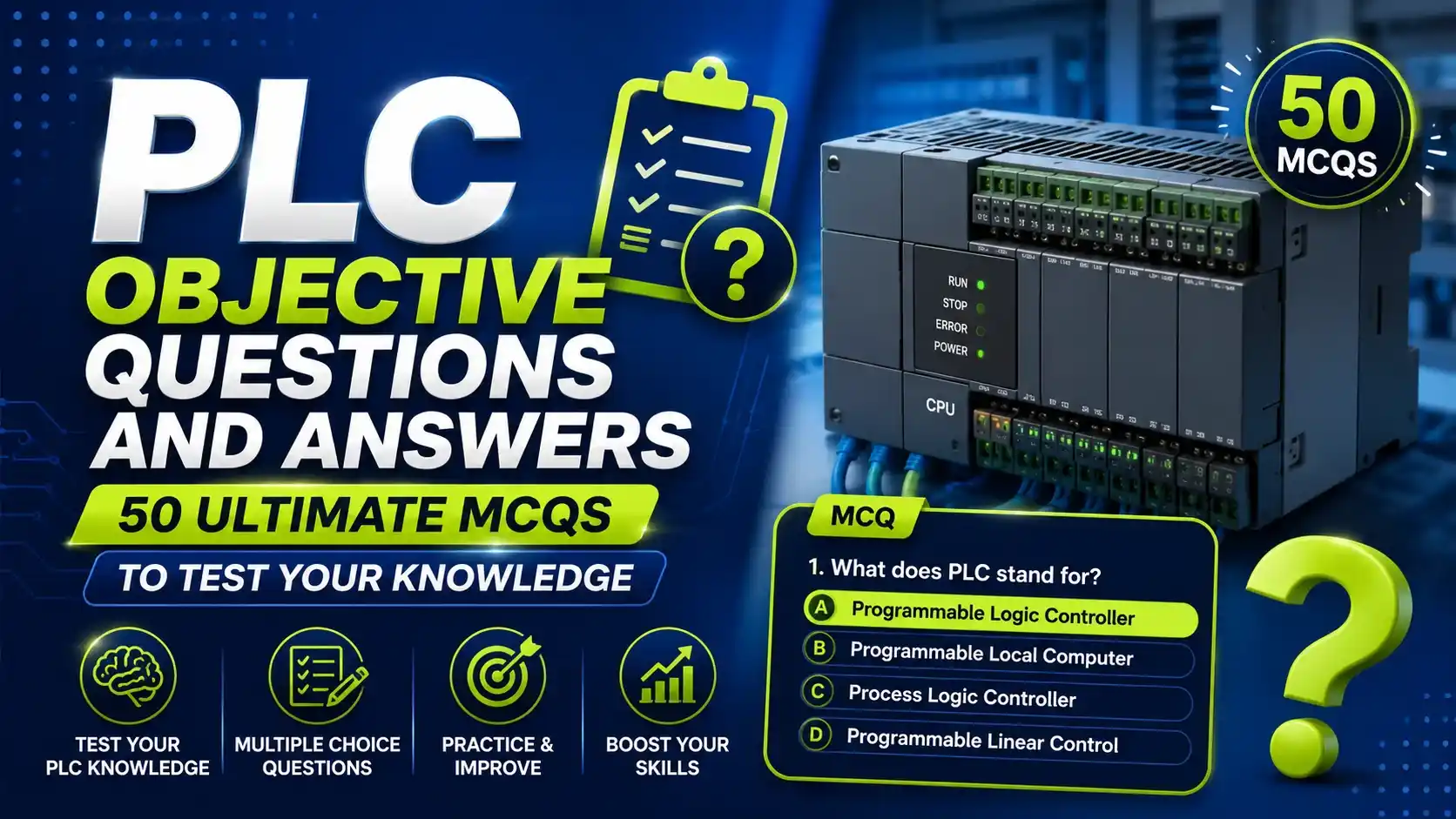
PLC objective questions and answers

If a question stumps you, several of our detailed guides cover these exact topics in depth, including ladder logic for beginners, PLC timer instructions, PLC counter instructions, and PLC shift registers.

Your score updates live as you answer, right in the tracker below. Try to get through all 50 without peeking at the explanations first.

Advertisement
Advertisement
Allen-Bradley ControlLogix PLC rack with CPU, power supply, and I/O modules
Image credit: TCI Supply, Allen-Bradley ControlLogix PLC Rack Parts Guide
🎯
Your Score
0 / 50

50 PLC Objective Questions and Answers

Click any option to answer. Correct answers turn green, incorrect ones turn red, and the right answer is always revealed.

PLC Fundamentals Questions

1
What does PLC stand for?
2
Which company is credited with building the first PLC, the Modicon 084?
3
What was the PLC originally designed to replace?
4
Which of these is NOT a standard part of a PLC's basic hardware architecture?
5
What does the PLC's CPU do during each scan cycle?
6
Which memory type retains PLC program data even after power loss?
7
What is the typical range of a standard analog current signal used in PLC systems?
8
Which IEC standard defines the five programming languages for PLCs?
9
A digital input module on a PLC is designed to read:

PLC Ladder Logic and Programming Questions

10
In ladder logic, what does a normally open (NO) contact represent?
11
What is the primary purpose of a seal-in (latching) contact in ladder logic?
12
What does the term "rung" refer to in ladder logic programming?
13
Which IEC 61131-3 language uses text based, high level syntax similar to Pascal?
14
What happens to outputs on a rung if the rung's overall logic evaluates to false?
15
What is the function of a Jump (JMP) instruction in ladder logic?
Advertisement
Advertisement
16
What is a Sequential Function Chart (SFC) best suited for programming?
17
Which best describes an internal or marker bit in a PLC program?
18
In an SHL (Shift Left) instruction, where does new data typically enter the bit array?

PLC Timer and Counter Questions

19
Which timer instruction delays an output turning ON after its input becomes true?
20
Which timer type retains its accumulated value even after the input goes false, needing a separate reset instruction?
21
A TOF (Timer Off-Delay) instruction energizes its output:
22
What does a CTU instruction do on each rising edge of its count input?
23
What is required for a counter instruction to register a count?
24
If a CTU counter's preset is 10 and its accumulated value reaches 10, what happens to its done bit?
25
What is the primary difference between a PLC timer and a PLC counter?
26
What is the purpose of a RES (Reset) instruction paired with an RTO or a counter?

PLC I/O, Wiring and Hardware Questions

27
What is the main purpose of an isolation module in a PLC I/O system?
28
A sinking (NPN style) digital input switches to which voltage level when active?
29
What is the function of a snubber across a relay coil driven by a PLC output?
30
What does an inductive proximity sensor typically use to detect a metal object without contact?
31
Why are shielded cables commonly recommended for analog signal wiring?
32
What is the purpose of a fused terminal block in a PLC I/O wiring cabinet?
33
What does a "hot swappable" I/O module mean in a PLC system?
34
Why should high voltage power wiring be separated from low voltage signal wiring in a control panel?

PLC Communication and Networking Questions

Advertisement
Advertisement
35
Which serial communication protocol is one of the most widely used open standards in industrial automation?
36
What does HART stand for in instrumentation communication?
37
In Modbus terminology, what is the device that initiates communication requests called?
38
Which fieldbus protocol provides both loop power and digital communication on the same two wires?
39
What is the main advantage of Ethernet/IP over traditional serial communication in a PLC network?
40
What does SCADA stand for?
41
What is the main functional difference between a PLC and a DCS?

PLC Safety and Troubleshooting Questions

42
What is a Safety Instrumented System (SIS) primarily designed to do?
43
What does SIL stand for in the context of functional safety?
44
What is a "watchdog timer" used for in a PLC's CPU?
45
A PLC output shows correct voltage on a multimeter but the field device does not activate. What is a likely first troubleshooting step?
46
What is "contact bounce" and why does it matter in PLC input wiring?
47
What does "forcing" an I/O point in a PLC typically allow a technician to do?
48
Why is it risky to leave forced I/O points active on a PLC during normal production?
49
What is the benefit of using a PLC simulator during program development?
50
Which of the following is a best practice for documenting a PLC program?

Quiz Complete!

You answered all 50 PLC objective questions and answers.

Advertisement
Advertisement

Study Resources for PLC Objective Questions and Answers

These two official reference manuals cover the underlying instructions behind many of the questions above in full technical detail.

PDF

Logix 5000 Controllers General Instructions Reference Manual

Official Rockwell Automation reference covering timers, counters, and program control instructions

PDF

The PLC Handbook

Free eBook from AutomationDirect covering PLC fundamentals, wiring, and ladder logic structure

Watch: How Programmable Logic Controllers Really Work

If any fundamentals questions above tripped you up, this refresher video covers exactly how a PLC processes inputs and drives outputs.

FAQs on PLC Objective Questions and Answers

Are these PLC objective questions and answers useful for interview preparation?
Yes. These 50 questions cover the same core topics that come up in most PLC and automation technician or engineer interviews, from fundamentals through safety and troubleshooting.
Can I retake this PLC quiz more than once?
Yes. Use the Reset Quiz button in the score tracker at the top to clear all your answers and start again from question 1.
What score should I aim for on this PLC objective questions and answers quiz?
A score of 35 out of 50 or higher generally reflects a solid working knowledge of PLC fundamentals. Scoring above 45 suggests advanced, well-rounded knowledge across all six topic areas.
Do I need prior PLC experience to attempt this quiz?
No. The questions are grouped from fundamentals through advanced topics, so beginners can learn from the explanations while experienced technicians can jump straight to the harder sections.

External References

What we learn today

  • PLC objective questions and answers cover six core areas: fundamentals, ladder logic, timers and counters, I/O and hardware, communication, and safety and troubleshooting.
  • Understanding the difference between timers and counters, and between fixed and adjustable instructions, comes up repeatedly across all PLC interview questions.
  • Communication protocols like Modbus, HART, and Foundation Fieldbus each solve a different problem in the automation stack.
  • Safety concepts like SIS, SIL, and watchdog timers are just as important to know as programming syntax.
  • Practicing with instant feedback, rather than reading a static answer key, helps concepts stick far better.
"I hope you like above blog. There is no cost associated in sharing the article in your social media. Thanks for reading!! Happy Learning!!"

Leave a Reply

Your email address will not be published. Required fields are marked *