
Weigh Feeder Working Principle: Loss-in-Weight vs Belt Feeder Explained
A conveyor scale doesn't ask how much material is on the belt. It asks how much weight passed by, per foot, thousands of times a minute, and integrates the answer into a running total.
A weigh feeder continuously measures and controls the mass flow rate of dry bulk solids, using either a loss-in-weight or belt-based approach. This guide explains both technologies, the core weighing formulas, and a clear comparison to help you choose the right one.
What is a Weigh Feeder?
A weigh feeder is a continuous gravimetric feeding device that measures and controls the rate at which dry bulk solid material is delivered into a process, expressed as weight per unit time rather than volume per unit time. Because gravimetric feeding is based on mass, not volume, it remains accurate even when a material's bulk density changes due to moisture, particle size, or settling, something a purely volumetric feeder cannot compensate for on its own.
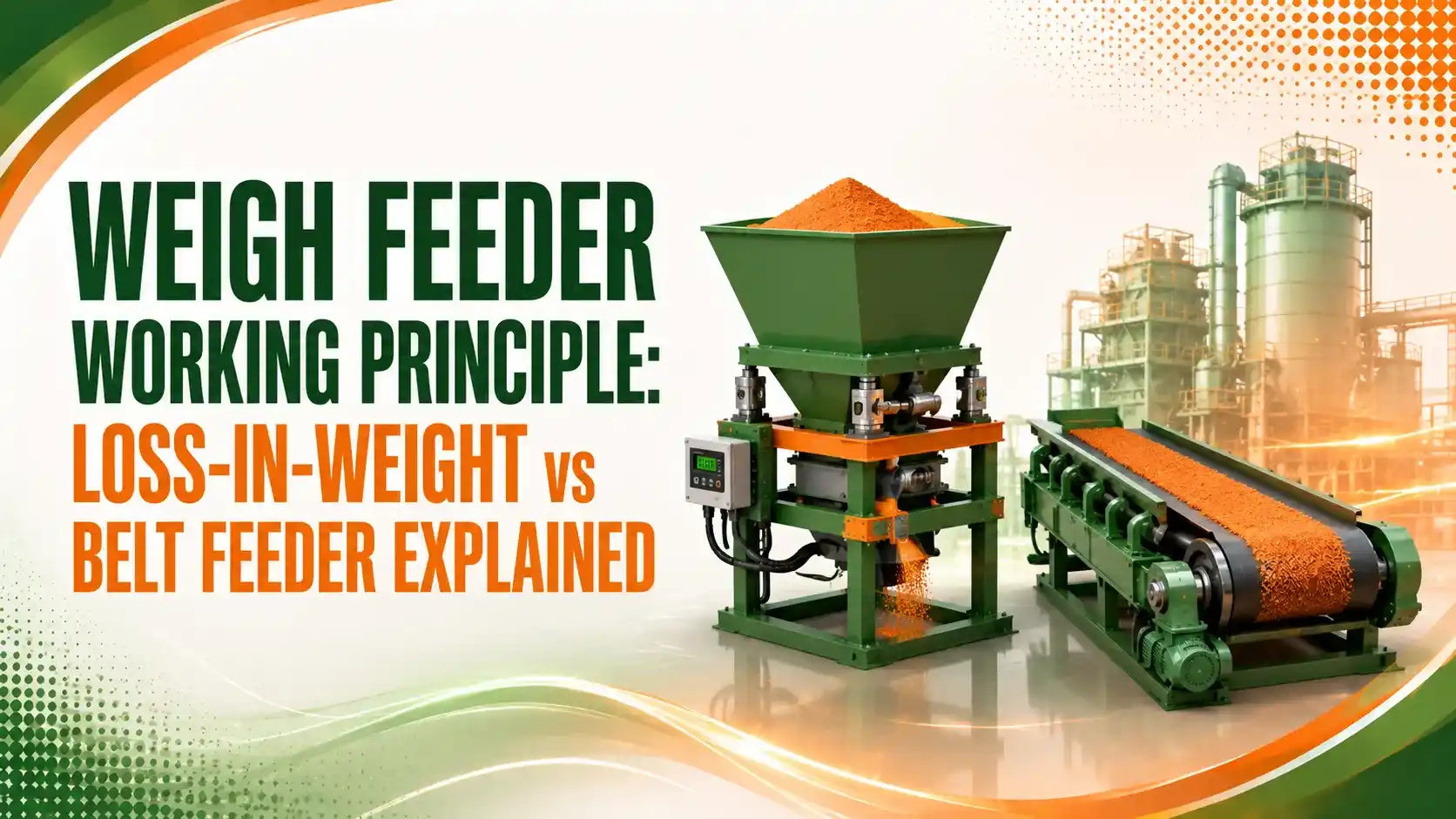
Two main technologies dominate industrial gravimetric feeding: the loss-in-weight (LIW) feeder and the weigh belt feeder (WBF), each built around a load cell sensing element but using a fundamentally different measurement strategy.
Real Life Example
Think of a loss-in-weight feeder like watching a kitchen scale under a bag of flour with a small hole in the bottom, timing exactly how fast the bag's weight drops as flour trickles out. A weigh belt feeder is more like a supermarket conveyor scale at checkout: it weighs whatever's currently sitting on a short section of moving belt and multiplies by how fast that belt is moving, to figure out how much total product is passing by per minute. Both answer the same question, "how much material per unit time," just by watching a different physical quantity change.
Loss-in-Weight vs Weigh Belt Feeder
⚖️ Loss-in-Weight Feeder
Continuously weighs the entire hopper, feeding mechanism, and contained material. Feed rate is controlled by the measured rate of weight loss over time. Excellent accuracy (±0.25 to 1%), but struggles with very large particle sizes in screw-type designs.
🎢 Weigh Belt Feeder
A load cell measures the weight of material on a fixed-length belt section; a tachometer measures belt speed. Handles large particles (rocks, limestone, cornhusks) and higher throughput ranges more easily than screw-type LIW designs.
Weigh Belt Feeder Formula
Comparison Table
| Factor | Loss-in-Weight (LIW) | Weigh Belt Feeder (WBF) |
|---|---|---|
| Typical Accuracy | ±0.25% to 1% of set rate | Comparable in overlapping ranges |
| Large Particle Handling | Limited (screw feeder pinch points) | Excellent (rocks, aggregate, cornhusks) |
| Refill Interruption | Brief switch to volumetric mode during refill | No refill interruption, continuous belt feed |
| Space Footprint | Self-contained, own support structure | Requires separate support stand |
| Best For | Fine powders, precise dosing, small particle sizes | High-throughput, large or difficult materials |
Applications
Cement and Aggregate
Belt feeders handle coarse raw materials at high throughput rates reliably.
Pharmaceutical Dosing
LIW feeders provide the fine powder precision pharmaceutical formulation requires.
Food Processing
Both technologies support accurate ingredient dosing in food batching lines.
Plastics and Polymer Compounding
LIW feeders precisely dose additives and colorants into extrusion processes.
Mining and Minerals
Belt scales totalize bulk ore and mineral transport across conveyor systems.
Animal Feed Manufacturing
Gravimetric feeders ensure accurate ingredient ratios in feed formulation.
Loss-in-Weight Feeder: Video Walkthrough
Frequently Asked Questions
- Merrick Industries, Weigh Belt or Loss-in-Weight: Choosing the Correct Feeder Technology
- Thayer Scale, Gravimetric Feeder
- Belt-Way Scales, Application and Operating Principles of Conveyor Belt Scales
What We Learn Today
- Weigh feeders control mass flow rate of bulk solids gravimetrically, unaffected by bulk density changes
- Loss-in-weight feeders track the rate at which a weighed hopper's total weight decreases
- Weigh belt feeders combine belt-section weight and belt speed to calculate mass flow directly
- LIW feeders offer excellent precision for fine powders; belt feeders handle large particles and higher throughput
- Inclined belt scales require angle compensation, since gravity's effect on the load cell reduces with incline angle