
Viscosity Measurement Explained: Types of Viscometers and Working Principles
Honey and water both flow. One does it in slow, thick ribbons and the other in a rush, and viscosity is simply the number that captures exactly how much a fluid resists that flow.
Viscosity measures a fluid's internal resistance to flow, a property that governs everything from lubrication to product quality in countless industrial processes. This guide explains dynamic vs kinematic viscosity, the main viscometer types, and where each is best applied.
What is Viscosity?
Viscosity is a measure of a fluid's internal resistance to flow, essentially how "thick" or "thin" it behaves when sheared or poured. Dynamic (or absolute) viscosity, measured in Pascal-seconds (Pa·s) or centipoise (cP), quantifies the actual force needed to shear the fluid. Kinematic viscosity, measured in stokes or centistokes (cSt), is dynamic viscosity divided by fluid density, describing how the fluid flows under gravity alone.
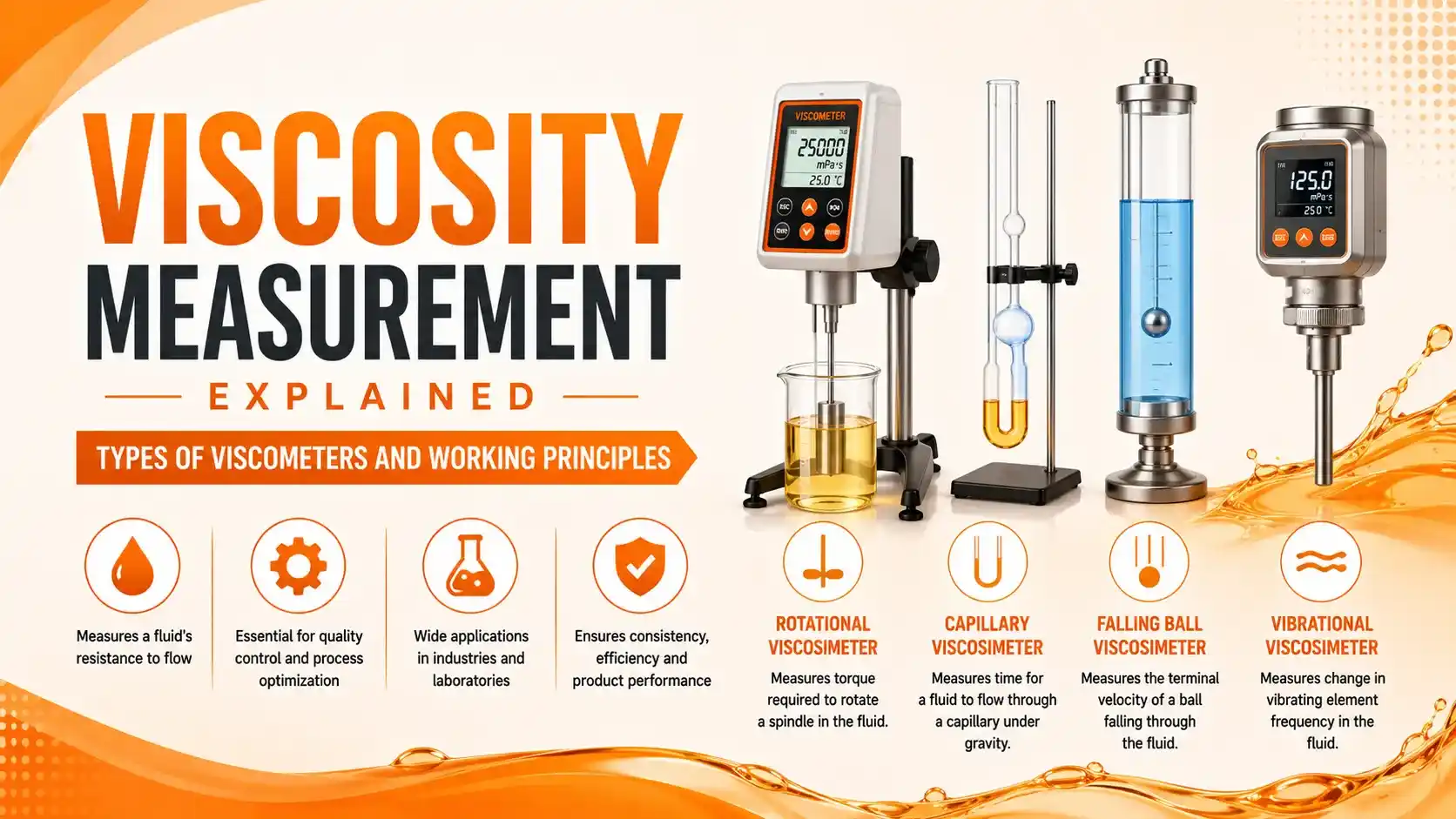
Viscosity matters enormously in industrial process control, from lubricating oil quality to flow meter selection, since some flow measurement technologies are far more sensitive to fluid viscosity than others. A viscometer is the instrument used to measure it, and different viscometer designs suit different fluid types and viscosity ranges.
Real Life Example
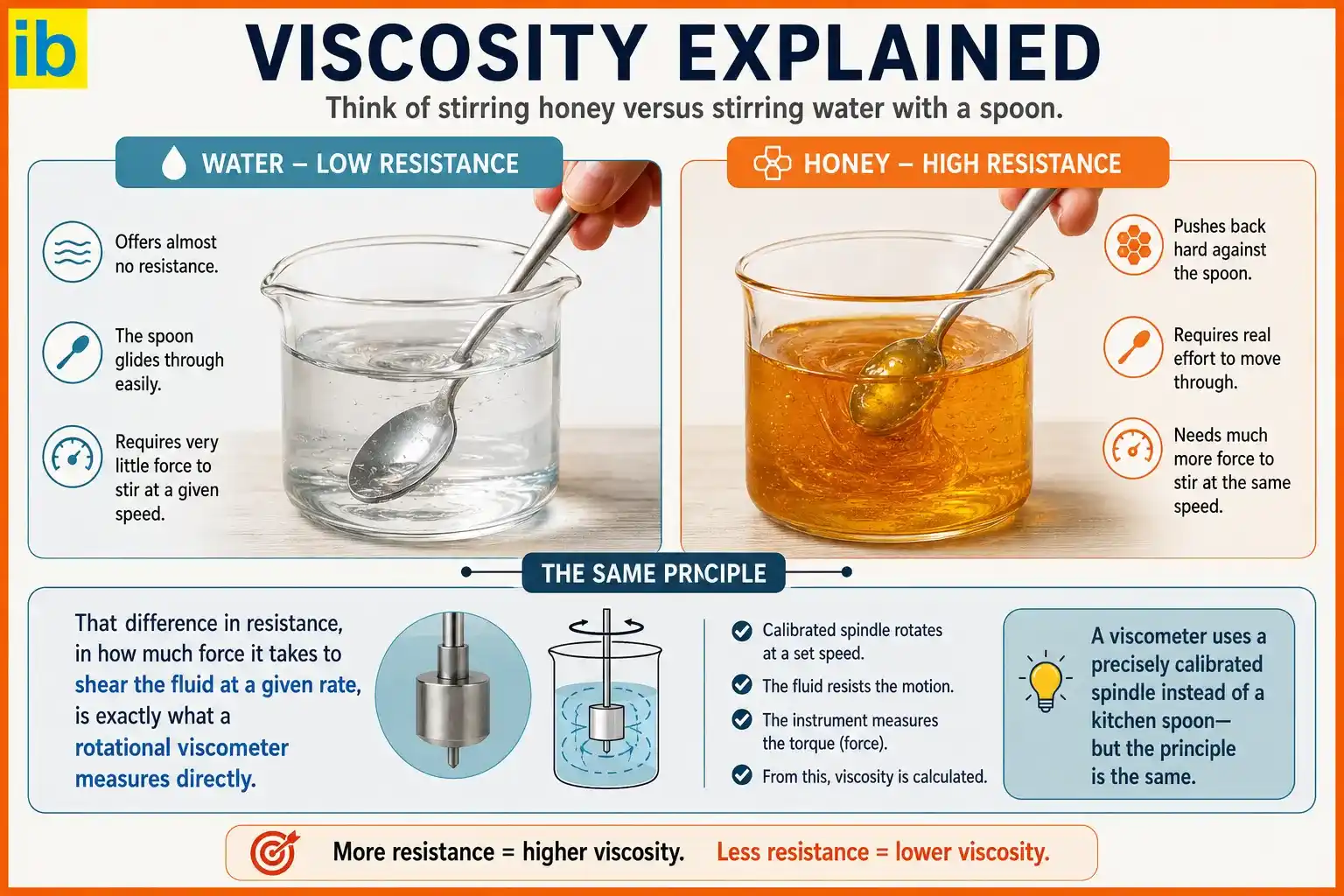
Think of stirring honey versus stirring water with a spoon. Water offers almost no resistance, the spoon glides through easily. Honey pushes back hard against the spoon, requiring real effort to move through it at the same speed. That difference in resistance, in how much force it takes to shear the fluid at a given rate, is exactly what a rotational viscometer measures directly, just with a precisely calibrated spindle instead of a kitchen spoon.
Types of Viscometers
Capillary Viscometer
Measures the time a fixed volume of fluid takes to flow through a narrow tube, based on Poiseuille's law. Simple, inexpensive, but limited to translucent, Newtonian fluids.
Falling Ball Viscometer
Times a ball falling through the fluid under gravity, based on Stokes' law. Simple and economical, but not suited to opaque or highly viscous fluids.
Rotational Viscometer
Measures torque needed to rotate a spindle in the fluid, or the change in speed under constant torque. Handles a wide viscosity range and both Newtonian and non-Newtonian fluids.
Vibrational Viscometer
Measures the damping of a vibrating probe, tuning fork, or quartz crystal, immersed in the fluid. No moving parts to wear, well suited to continuous in-line process monitoring.
Dynamic vs Kinematic Viscosity
Dynamic viscosity describes the actual internal friction of the fluid, independent of density. Kinematic viscosity, since it factors out density, is what actually governs how the fluid flows under gravity, which is why it's the more common specification for engine oils and other gravity-fed lubrication systems.
Comparison Table
| Viscometer Type | Best For | Limitation |
|---|---|---|
| Capillary | Precise lab measurement of transparent Newtonian fluids | No single tube covers all viscosities; hard to clean |
| Falling Ball | Simple, low-cost lab measurement | Not suited to opaque or very viscous fluids |
| Rotational | Wide viscosity range, non-Newtonian fluids, industrial process control | Higher cost, needs regular calibration |
| Vibrational | Continuous in-line process monitoring, no consumables | Reduced accuracy at very high viscosity |
Applications
Lubricant Quality Control
Engine and machine oils are graded and tested by kinematic viscosity at standard temperatures.
Paints and Coatings
Viscosity control ensures proper application, leveling, and film thickness.
Food and Beverage
Viscosity affects mouthfeel, processing, and quality consistency across batches.
Pharmaceuticals
Viscosity control is critical for injectable formulations and topical products.
Crude Oil and Refining
In-line viscometers monitor product quality across pipeline transfer and blending.
Cosmetics and Personal Care
Product texture and stability depend heavily on maintaining target viscosity.
Viscosity Measurement: Video Walkthrough
Frequently Asked Questions About Viscosity Measurement
- Wikipedia, Viscometer
- Just Measure It, Understanding the Basics of Viscometers
- Automation Forum, Viscometer and Its Types with Working Principle and Applications
What We Learn Today
- Viscosity measures a fluid's internal resistance to flow, expressed as dynamic or kinematic viscosity
- Capillary, falling ball, rotational, and vibrational viscometers each measure viscosity through a different physical principle
- Rotational viscometers dominate industrial applications due to their wide range and non-Newtonian fluid capability
- Non-Newtonian fluids require measurement across multiple shear rates, not a single viscosity value
- Viscosity directly affects lubrication performance, product quality, and even flow meter selection and accuracy