
NPSH and Cavitation Explained: NPSHa, NPSHr, and How to Prevent Pump Damage
A pump that sounds like it's grinding gravel isn't imagining things. It's boiling its own fluid at the suction inlet, one imploding bubble at a time, and every implosion takes a tiny bite out of the impeller.
Net Positive Suction Head, or NPSH, is the single most overlooked parameter in pump selection, and getting it wrong causes cavitation, a destructive process that can ruin an impeller in hours. This guide explains NPSHa vs NPSHr, the calculation, and a live cavitation risk calculator.
What is NPSH and Cavitation?
Net Positive Suction Head (NPSH) is the pressure, expressed as a head of liquid, available at a pump's suction inlet above the fluid's vapor pressure at that temperature. When this available pressure drops below the fluid's vapor pressure, the liquid boils right at the pump inlet, forming vapor bubbles. As these bubbles travel into the higher-pressure region of the impeller, they collapse violently, a phenomenon called cavitation.
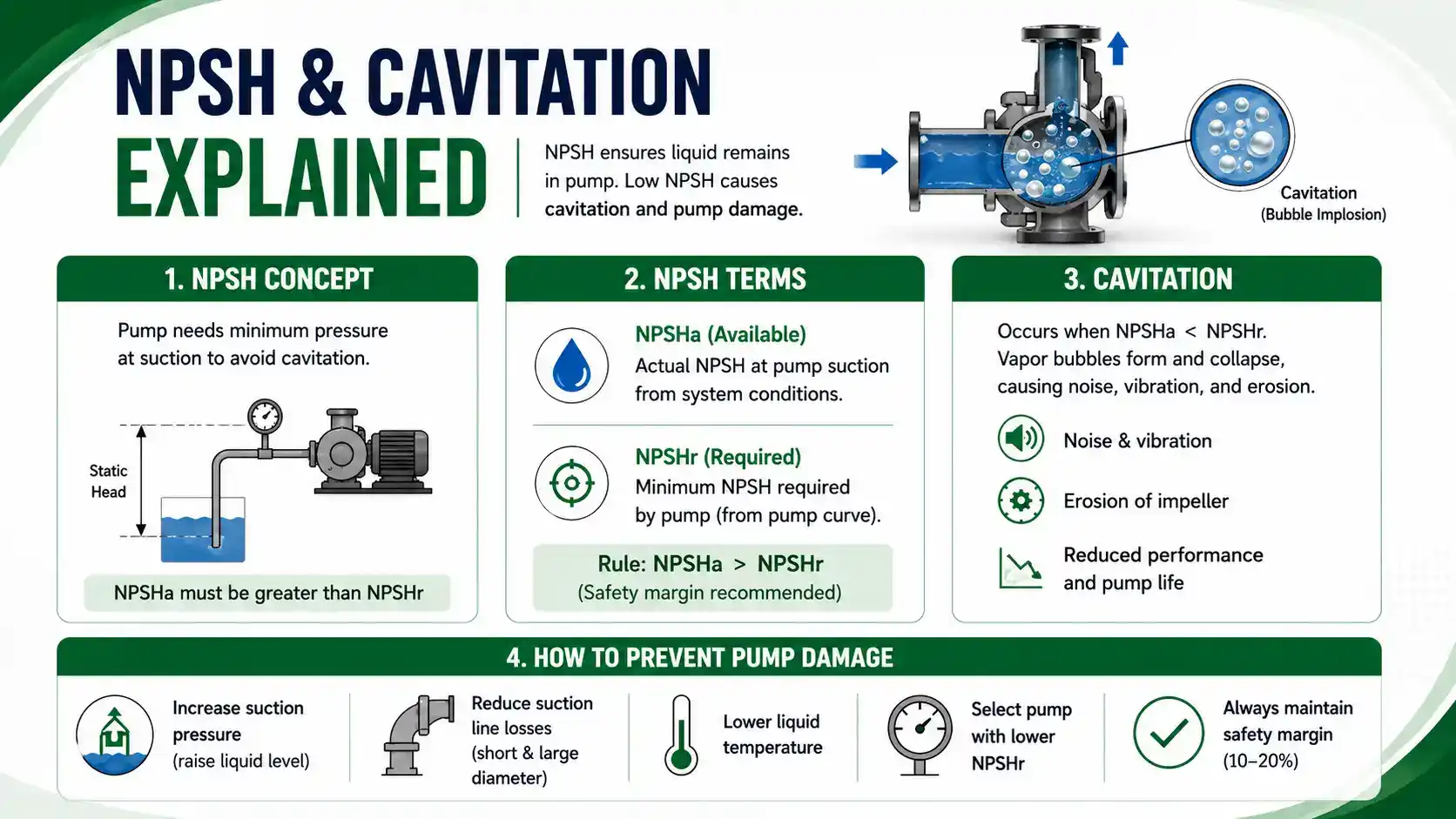
Cavitation is responsible for destroying a large share of prematurely failed pump impellers across industry. Each bubble collapse creates a tiny, localized shockwave and micro-jet of liquid that erodes metal surfaces, and over time this repeated micro-erosion pits and destroys the impeller, damages seals and bearings, and can severely reduce pump efficiency long before total failure.
Difference between NPSHa and NPSHr
Net Positive Suction Head (NPSH) is an important concept in pump systems. It helps pumps operate smoothly and prevents cavitation, which can damage the pump over time. There are two important terms you need to understand:
NPSH Available (NPSHa) is the actual pressure available at the pump inlet
NPSH Required (NPSHr) is the minimum pressure the pump needs to operate without cavitation.
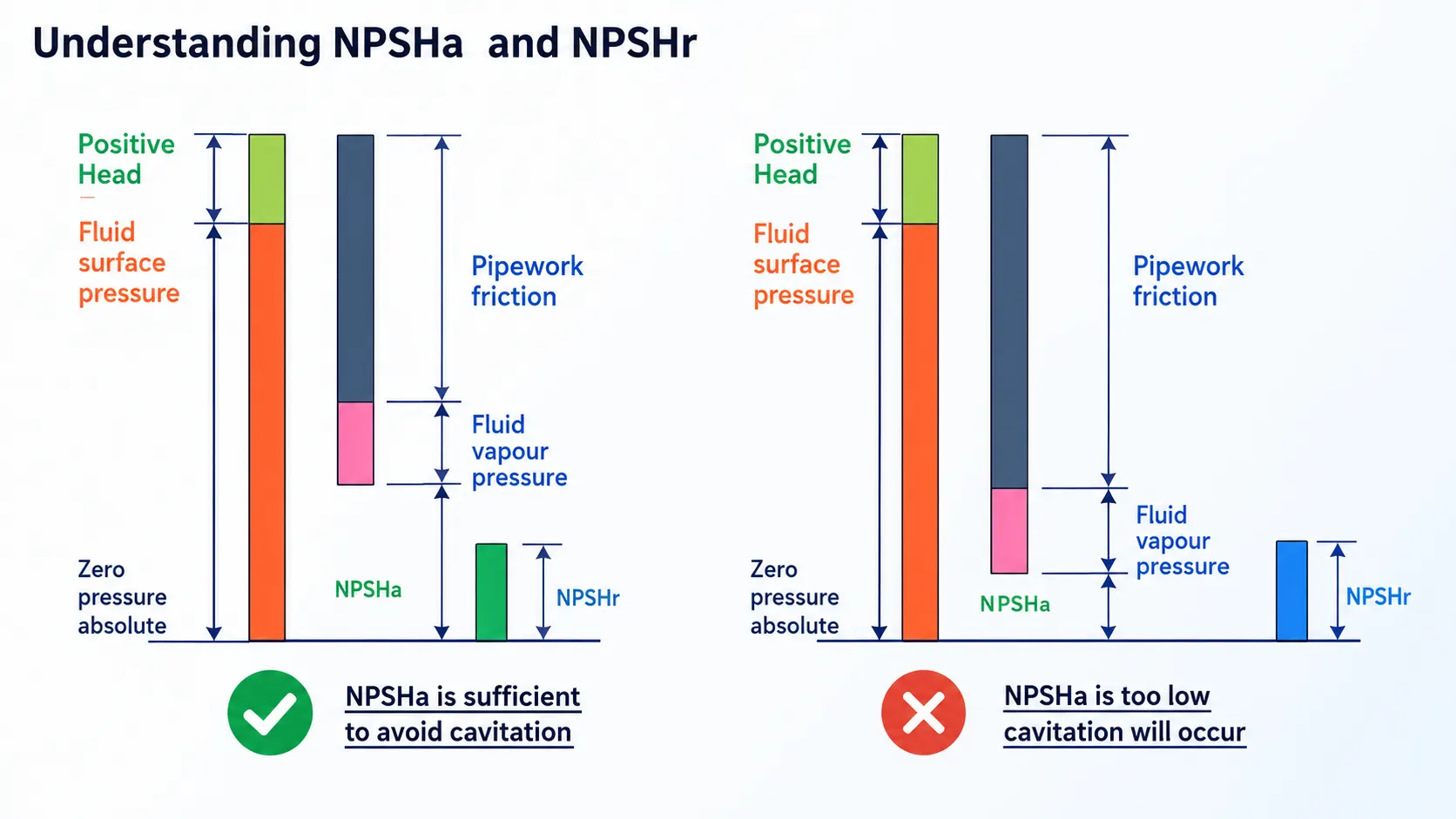
Organizations such as the National Fire Protection Association (NFPA) and ASTM International provide guidelines for calculating and applying NPSH in fire protection and industrial pumping systems. This article explains NPSHa and NPSHr in simple terms and discusses their importance based on these standards.
Real Life Example
Think of sipping a thick milkshake through a straw that's slightly too long or too narrow. Suck hard enough, and the pressure drop inside the straw can actually pull dissolved gas out of solution, creating little bubbles partway up, even though the milkshake itself never technically boils.
A pump facing insufficient NPSH does something very similar to the liquid entering its suction line, just violently enough that those bubbles collapse with real destructive force once they reach the higher pressure zone inside the impeller.
NPSH Available Formula
Hz = static elevation of liquid surface above (+) or below (-) pump centerline.
Hf = friction losses in the suction line.
Hvp = vapor pressure head of the liquid at operating temperature.
All terms expressed as head, in meters or feet of liquid.
Hz = +3 m (tank above pump),
Hf = 0.8 m, Hvp = 0.32 m (water at 25°C)
NPSH Margin Calculator
NPSHa vs NPSHr Cavitation Risk Calculator
All values in meters of liquid headEffects of Cavitation
Noise and Vibration
Cavitation produces a distinctive crackling sound, often described as pumping gravel.
Impeller Erosion
Repeated bubble collapse pits and erodes impeller surfaces over time.
Reduced Efficiency
Damaged impeller surfaces reduce the pump's ability to generate head and flow.
Seal and Bearing Failure
Excess vibration shortens the life of mechanical seals and bearings dramatically.
Overheating
Repeated flashing and bubble collapse generates localized heat inside the pump.
Higher Maintenance Cost
Unplanned downtime and impeller replacement drive up total cost of ownership.
Preventing Cavitation
✅ Do This
- Keep at least a 0.5 to 1.0 m (or 10%) margin between NPSHa and NPSHr
- Increase suction pipe diameter to reduce friction losses
- Shorten the suction line and minimize elbows and fittings
- Account for worst-case fluid temperature, not just design temperature, when checking Hvp
❌ Avoid This
- Assuming NPSHa margin calculated at design conditions holds true year-round
- Ignoring that NPSHr rises with pump speed and flow rate
- Placing the pump farther from the liquid source than necessary
- Overlooking that NPSHr is already defined at the onset of cavitation (3% head drop)
NPSH and Cavitation: Video Walkthrough
Frequently Asked Questions About NPSH and Cavitation
- Michael Smith Engineers, Useful Information on NPSH, NPSHA and NPSHR
- KSB, Cavitation and NPSH
- Rotech Pumps, NPSH in Centrifugal Pumps: Causes, Effects and Prevention
What We Learn Today
- NPSH determines whether a pump's suction pressure stays safely above the fluid's vapor pressure
- NPSHa is a system property, NPSHr is a pump property set by the manufacturer's testing
- Cavitation occurs when NPSHa drops below NPSHr, causing bubble formation and violent collapse inside the pump
- A safety margin of 0.5 to 1.0 m above NPSHr is standard practice, more for critical services
- Rising fluid temperature increases vapor pressure and can trigger cavitation even when the rest of the system is unchanged