
IEC 61131-3 Programming Languages Compared: Ladder Logic vs Structured Text vs Function Block Diagram vs SFC
One standard, four completely different ways to tell a PLC what to do. Picking the right one for the job matters as much as writing the logic itself.
IEC 61131-3 defines the programming languages nearly every PLC on the market supports. This guide compares Ladder Diagram, Structured Text, Function Block Diagram, and Sequential Function Chart, so you know which one to reach for and why mixing languages in one project is normal, not a mistake.
What is IEC 61131-3?
IEC 61131-3 is the international standard that defines how PLCs are programmed. First published in 1993 and substantially revised since, it standardizes a common data model, program organization units, and a set of programming languages so that logic written for one compliant PLC platform is at least conceptually portable to another. Before this standard, every PLC vendor used its own proprietary programming approach, which locked engineers into whichever brand they learned first.
The original standard defined five languages. Edition 4.0, published in May 2025, formally removed Instruction List (IL), leaving four official languages: Ladder Diagram, Function Block Diagram, Structured Text, and Sequential Function Chart. Most vendor tools still support IL for legacy compatibility, but new projects should not be built in it.
Real Life Example
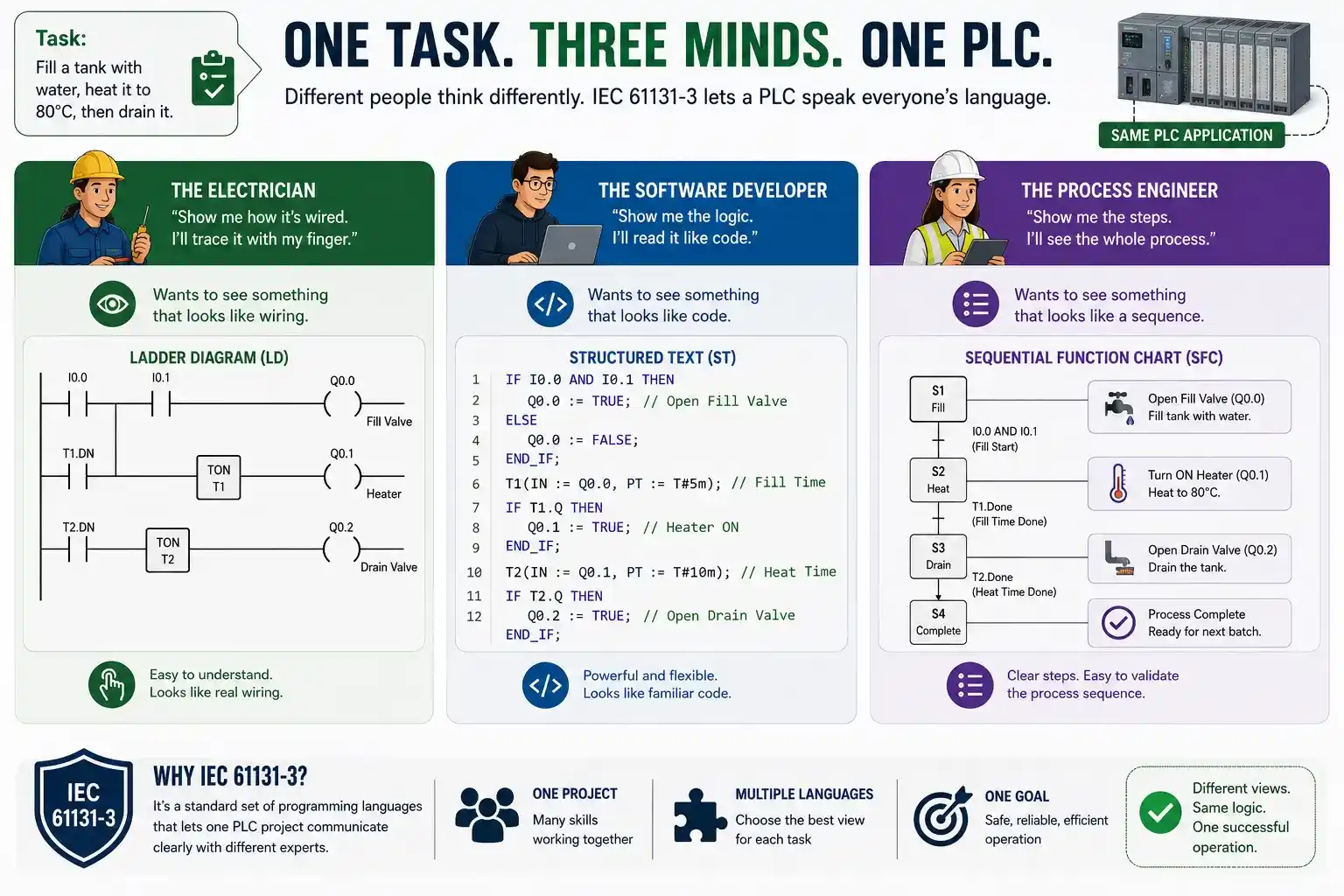
Imagine explaining a task to three different people: an electrician, a software developer, and a process engineer. The electrician wants a wiring-style diagram they can trace with a finger. The developer wants something that looks like the code they already know, with loops and IF statements. The process engineer wants to see the batch recipe as a sequence of steps. IEC 61131-3 exists precisely because a single PLC often needs to speak to all three audiences within the same project.
The Four IEC 61131-3 Languages
🪜 Ladder Diagram (LD)
📝 Structured Text (ST)
🔗 Function Block Diagram (FBD)
🔄 Sequential Function Chart (SFC)
Comparison Table
Which Language Should You Use?
| Task | Recommended Language |
|---|---|
| Motor start/stop interlocks | Ladder Diagram |
| Safety circuits and E-stops | Ladder Diagram |
| Complex math or string manipulation | Structured Text |
| Recipe and formula calculations | Structured Text |
| PID and cascade control loops | Function Block Diagram |
| Analog signal scaling and processing | Function Block Diagram |
| Batch fill and empty sequences | Sequential Function Chart |
| Auto/manual mode state machines | Sequential Function Chart |
Common Mistakes When Choosing a Language
✅ Do This
- Mix languages within a project, using each for what it does best
- Keep safety-critical logic in Ladder Diagram for maximum troubleshooting clarity
- Encapsulate complex Structured Text inside well-named function blocks
- Write for the person who maintains the code, not just for yourself
❌ Avoid This
- Writing an entire project in Structured Text if maintenance staff only read Ladder
- Assuming "IEC 61131-3 compliant" code ports cleanly between vendors without changes
- Learning Instruction List for new projects, since it was removed in Edition 4.0
- Using deeply nested ST expressions where a simple ladder rung would trace faster
Ladder Logic vs Structured Text: Video Walkthrough
Frequently Asked Questions
- Wikipedia, IEC 61131-3
- PLCopen, IEC 61131-3 and PLCopen
- RealPars, Ladder Logic vs Other Programming Languages: A Comparison
What We Learn Today
- IEC 61131-3 standardizes PLC programming across vendors, now defining four official languages after IL's removal in Edition 4.0
- Ladder Diagram remains the most widely used language, favored for discrete logic and troubleshooting clarity
- Structured Text handles complex math and data manipulation far more compactly than graphical languages
- Function Block Diagram suits continuous control, while Sequential Function Chart models step-by-step sequences
- Most professional PLC projects mix multiple languages, choosing each based on the specific task at hand