
Table of Contents
ToggleType of Pressure Transmitters: Introduction
Pressure transmitters are among the most widely used instruments in industrial automation and process control. Understanding different types of pressure transmitters is very important.
They are used in monitoring and controlling pressure in pipelines, tanks, boilers, compressors, and flow systems.
A pressure transmitter senses pressure and converts it into an electrical signal, typically 4–20 mA, which is then sent to PLCs, DCS, or SCADA systems for monitoring and control.
Based on the type of pressure reference used, pressure transmitters are broadly classified into four main categories:
1) Gauge,
2) Absolute,
3) Differential
4) Multivariable
Each type serves a specific purpose and is selected according to the application requirements.
Before going ahead please see below image illustrating different types of pressure.
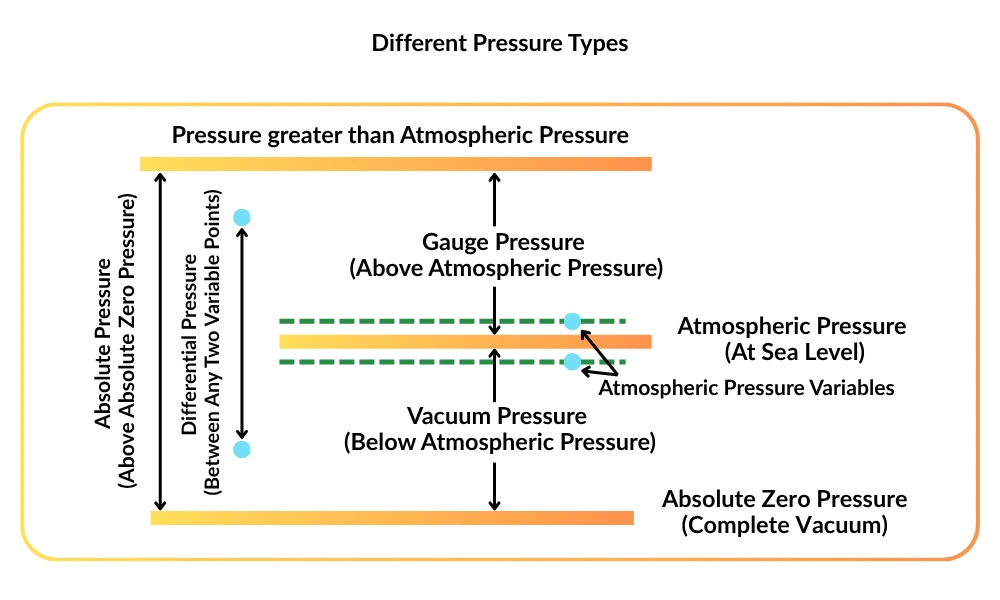
Let us understand different types of Pressure Transmitters.
1. Gauge Pressure Transmitter
Gauge pressure transmitters measure pressure with respect to the surrounding atmospheric pressure. In this type of measurement, atmospheric pressure is treated as the zero reference point. The transmitter only measures the pressure that is above (or below) atmospheric pressure.
In industrial environments, most pressure measurements are made relative to atmospheric pressure, which is why gauge pressure transmitters are the most commonly used type. These transmitters are extensively used in systems involving liquids and gases where pressure needs to be continuously monitored to keep the process safe and stable.
From a working principle point of view, one side of the sensing element is exposed to the process pressure, while the other side is vented to the atmosphere. The pressure difference causes a small deflection in the sensing element, which is converted into an electrical output signal by the transmitter’s electronics.
Gauge pressure transmitters are widely used in water supply systems, air compressors, hydraulic machines, chemical pipelines, cooling systems, and gas distribution networks.
For example, when a pressure gauge reads 6 bar on a gauge transmitter installed on a pump discharge line, it means the pressure is 6 bar higher than atmospheric pressure.
The main advantages of gauge pressure transmitters are their simple design, cost-effectiveness, ease of installation, and suitability for most industrial pressure ranges. However, their accuracy can be influenced by changes in atmospheric pressure, and they are not suitable for true vacuum or ultra-precision applications.
2. Absolute Pressure Transmitter
An absolute pressure transmitter measures pressure with respect to a perfect vacuum. Unlike a gauge pressure transmitter, it does not use atmospheric pressure as a reference. It has a sealed vacuum chamber inside the sensor which acts as the zero-pressure reference point. Because of this design, the transmitter always measures the true pressure of the process.
Absolute pressure transmitters are selected when very high accuracy and stability are required, especially in applications where atmospheric pressure variations can affect measurement results. Since their reference is a fixed vacuum, changes in weather or altitude do not impact their readings.
In terms of operation, one side of the sensing diaphragm is sealed under vacuum, while the process pressure acts on the other side. The resulting deflection is precisely converted into an electrical signal that represents the absolute pressure.
These transmitters are commonly used in vacuum systems, semiconductor manufacturing, aerospace applications, leak testing systems, meteorological stations, and scientific laboratories. They are also widely used in altitude measurement because atmospheric pressure varies with elevation.
The key benefits of absolute pressure transmitters include exceptional accuracy, immunity to atmospheric pressure fluctuations, and excellent long-term stability. On the downside, they are more expensive than gauge transmitters and are not always necessary for standard industrial processes.
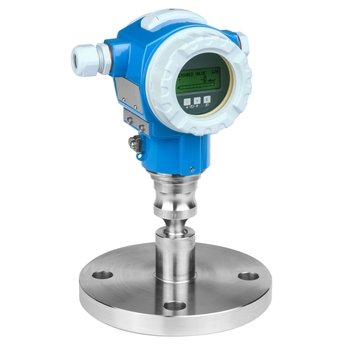
You can also read my article: Difference between Absolute Pressure and Gauge Pressure.
3. Differential Pressure Transmitter
Differential pressure transmitters, commonly called DP transmitters, are designed to measure the difference between two pressure points. They are equipped with two pressure ports: a high-pressure (HP) port and a low-pressure (LP) port. The transmitter calculates the pressure difference between these two points and converts it into an output signal.
DP transmitters are among the most versatile instruments in the process industry. Although they measure pressure difference, they are extensively used for flow measurement, level measurement, and condition monitoring.
The working principle is based on the deflection of a sensing diaphragm caused by the pressure difference across it. This deflection is proportional to the differential pressure and is converted into an electrical signal by the transmitter electronics.
In flow measurement, DP transmitters are used with primary flow elements such as orifice plates, venturi tubes, and pitot tubes. According to Bernoulli’s principle, the differential pressure developed across these elements is directly related to the flow velocity.
By measuring this differential pressure, the flow rate can be accurately calculated.
In level measurement, DP transmitters are used in pressurized tanks. One side of the transmitter senses the pressure at the bottom of the tank, while the other side senses the pressure at the top. The difference between these two pressures is proportional to the liquid level.
You can read my article: DP Transmitter Level Measurement
Typical applications of differential pressure transmitters include flow measurement in pipelines, level measurement in closed vessels, filter clogging detection, heat exchanger monitoring, and pump performance analysis.
DP transmitters are known for their high reliability, rugged construction and suitability for high-pressure and high-temperature processes. However, they require impulse lines, which can block in dirty or viscous services, and they require careful installation and periodic maintenance to ensure accuracy.
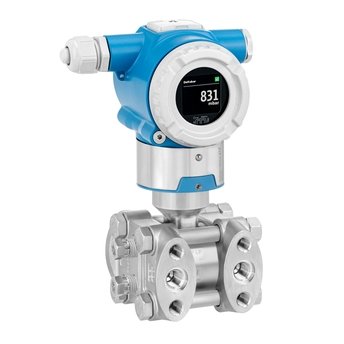
4. Multivariable Pressure Transmitter
Multivariable pressure transmitters are advanced instruments that can measure more than one process variable at the same time using a single device. These transmitters typically measure differential pressure, static pressure, and temperature simultaneously. Using these three variables, they directly calculate volumetric flow, mass flow, and even energy flow.
These transmitters are widely used in modern plants where accurate flow and energy measurement are critical, especially for steam, compressed air, and natural gas systems. By combining multiple sensors into one unit, they reduce the need for separate transmitters and simplify installation.
From a functional standpoint, the multivariable transmitter uses individual sensing elements for pressure and temperature. The measured signals are processed by an onboard microprocessor, which performs real-time compensation and calculations.
The transmitter then sends fully compensated values directly to the control system through digital communication protocols such as HART, Modbus, or Fieldbus.
Multivariable pressure transmitters are commonly used in power plants, boiler systems, turbine flow monitoring, natural gas custody transfer, and energy management systems. Their biggest advantage lies in their ability to deliver highly accurate mass flow and energy flow data with fewer field instruments.
Multivariable transmitters offer significant performance and installation benefits, their initial cost is higher, and they require skilled configuration and commissioning.
Therefore, they are normally used in high-value and high-accuracy applications rather than in simple process lines.
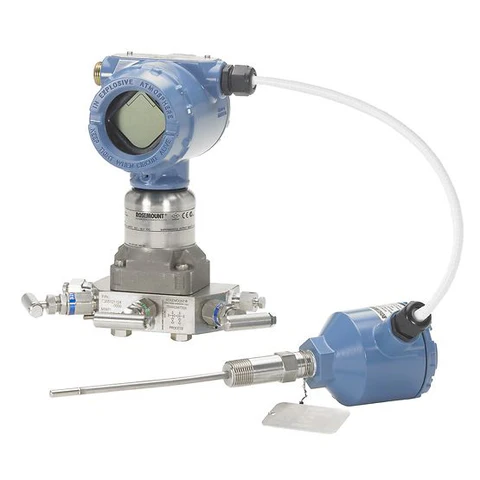
Comparison of the Four Types of Pressure Transmitters
Gauge Pressure Transmitter: Measures pressure relative to atmospheric pressure; used in general industrial services.
Absolute Pressure Transmitter: Measures pressure relative to a perfect vacuum; used in high-precision and vacuum applications.
Differential Pressure Transmitter: Measures the difference between two pressures; commonly used for flow and level measurement.
Multivariable Pressure Transmitter: Measures pressure, temperature, and calculates flow and energy; used in advanced energy and steam systems.
Key Points to Consider While Selecting a Pressure Transmitter
Selecting the correct pressure transmitter is critical for measurement accuracy and plant safety. The following factors must always be considered before selection:
1) Type of pressure to be measured (gauge, absolute, differential, or multivariable)
2) Maximum and minimum operating pressure
3) Process temperature
4) Nature of the process fluid (liquid, gas, steam, corrosive media)
5) Required accuracy and response time
6) Environmental conditions such as vibration, dust, and humidity
7) Hazardous area classification and explosion-proof requirements
8) Output signal and communication protocol
What we learn today?
The four main types of pressure transmitters => gauge, absolute, differential, and multivariable.
Each type serve a distinct and critical role in industrial measurement.
Gauge pressure transmitters dominate general-purpose applications, absolute pressure transmitters deliver true pressure measurement with high accuracy, differential pressure transmitters form the backbone of flow and level measurement, and multivariable transmitters enable advanced gas, steam and energy measurement.
A clear understanding of these transmitter types helps engineers, technicians, and students choose the right device for each application, ensuring accurate measurement, safe operation, and efficient plant performance.


I hope you like above blog. There is no cost associated in sharing the article in your social media. Thanks for Reading !! Happy Learning