

Table of Contents
ToggleIn oil & gas, chemicals, LPG, LNG, water and other utility industries, the term “Custody Transfer” comes up quite often.
But what does it really mean?
Why does everyone take it so seriously? And what makes custody transfer different from normal flow measurement?
Let us understand it.
What is Custody Transfer?
Custody Transfer refers to the official handover of a product such as crude oil, natural gas, refined fuels, chemicals, steam, or water from one party to another.
This handover could happen between:
- A supplier and a buyer
- Two companies
- Two divisions within the same company
- A pipeline operator and a customer
- A storage terminal and a tanker/rail wagon
Whenever money is involved, measurement accuracy becomes extremely important.
That is the heart of custody transfer:
Custody Transfer = Product + Money + Accurate Measurement + Legally Approved Instruments
Even a 0.1% error in flow measurement can result in huge financial losses, especially in high-value products like crude oil, LNG, or natural gas.
This transfer is 1:1
Why Custody Transfer Measurement Matters?
It affects:
1. Financial Settlements
All billing is based on the quantity transferred. If the measurement is wrong, the invoice is wrong and disputes begin.
2. Legal & Contractual Compliance
Countries and industries follow strict rules for custody transfer. Measurements must be traceable, calibrated, and certified.
3. Trust Between Buyer and Seller
Accurate builds trust. Poor accuracy breaks partnerships.
4. Loss Prevention
Precise measurement helps avoid:
- Short delivery
- Overage
- System losses
- Unaccounted fuel
5. Safety and Operational Control
Accurate measurement helps in:
- Pipeline balancing
- Storage management
- Leak detection
- Energy accounting
Where Custody Transfer Is Used (Common Applications)
Custody transfer is everywhere in the energy and process industry, such as:
1) Crude oil loading/unloading
2) Natural gas pipeline handovers
3) LPG/LNG truck and tanker filling
4) Fuel depot to tanker truck transfer
5) Petrochemical feedstock transfer
6) Water supply agreement between companies
7) Steam or compressed air billing
8) Hydrogen transfer (rapidly growing area)
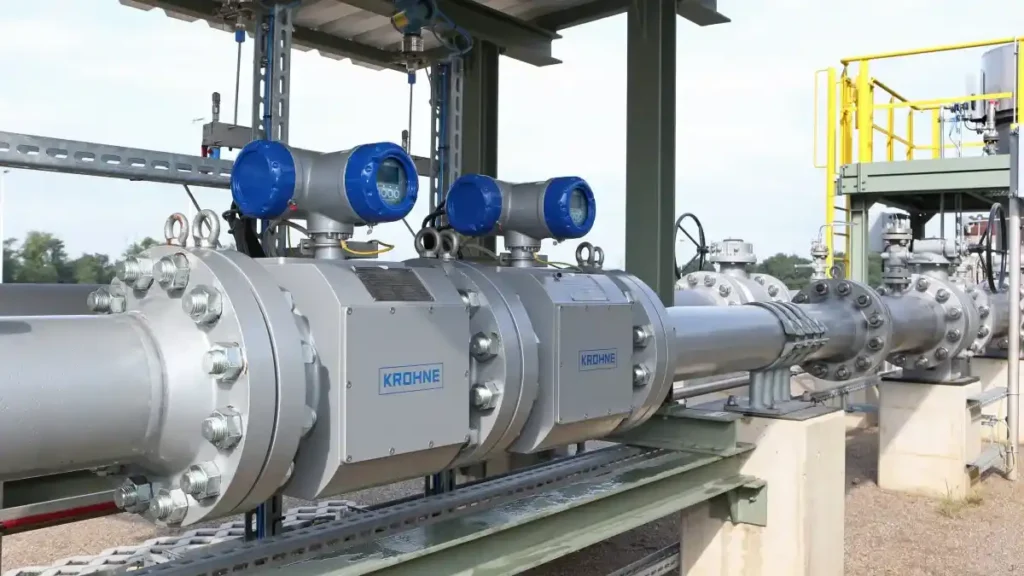
Key Requirements for Custody-Transfer Measurement
To qualify flow meter or instrument must have:
1. High Accuracy
Typical accuracy required:
- 0.1% to 0.5% for liquids
- ±1% or better for gases
- ±0.2% to 0.5% for mass flow meters
2. Repeatability
The meter must give the same result every time under the same conditions.
3. Traceability
Calibration must be traceable to a national or international standard, such as:
- NIST (USA)
- PTB (Germany)
- NPL (UK)
4. Approvals and Certifications
Flow meters should meet global standards such as:
- OIML R117
- API MPMS
- ISO 5167
- AGA standards for gas
5. Tamper-Proof Design
The meter must be sealed to prevent manipulation.
6. Temperature & Pressure Compensation
Because density and volume change with temperature and pressure, it requires:
- Pressure compensation
- Temperature compensation
- Sometimes compressibility correction
7. Auditability and Data Logging
Long-term storage of:
- Totalized flow
- Timestamps
- Alarm logs
- Calibration history
Common Flow Technologies Used
1. Coriolis Mass Flow Meters
Applications: Crude oil, refined fuels, chemicals, LNG (liquid), LPG (liquid).
Advantages:
- Direct mass flow
- High accuracy (0.05% possible)
- Density measurement included
- Very popular in modern custody transfer skids
2. Ultrasonic Flow Meters (Transit-Time)
Applications: Natural gas pipelines
Advantages:
- High accuracy
- No pressure drop
- Low maintenance
3. Differential Pressure (DP) Flow with Orifice Plates
Applications: Natural gas pipelines, steam
Advantages:
- Proven, low cost
- Widely accepted in industry
Limitations:
- Lower accuracy compared to ultrasonic
- Wear & tear
Complies with:
- ISO 5167
- AGA 3
4. Turbine Flow Meters
Applications: Aviation fuel, LPG, refined fuels
Advantages:
- High accuracy and repeatability
- Good for clean liquids
Limitations:
- Mechanical wear
- Needs upstream/downstream straight lengths
5. Positive Displacement (PD) Meters
Applications: Truck filling, oil & diesel loading bays
Advantages:
- Very accurate for viscous liquids
- Simple and rugged
Types:
- Rotary
- Oval gear
- Bi-rotor
Custody Transfer Vs Normal Flow Measurement
| Feature | Normal Flow Measurement | Custody-Transfer Measurement |
|---|---|---|
| Purpose | Monitoring | Legal/Commercial Billing |
| Accuracy | Moderate | Very High (0.1–0.5%) |
| Calibration | Periodic | Mandatory and traceable |
| Data Logging | Basic | Detailed & auditable |
| Standards | Not essential | Must meet API, OIML, AGA |
| Legal Compliance | Not required | Required |
| Meter Cost | Lower | Higher |
Standards Governing CT
Liquid Measurement
- API MPMS (Manual of Petroleum Measurement Standards): Most important standard
- OIML R117: International legal metrology regulation
- ISO 2714 / ISO 5168: Uncertainty calculations
Gas Measurement
- AGA 3: Orifice measurement
- AGA 7: Turbine meters
- AGA 8: Compressibility
- AGA 9: Ultrasonic meters
- ISO 5167: DP meters
Custody-Transfer is a financial, legal and technical process that ensures fairness between two parties. It demands high accuracy, reliable instruments, proper calibration, and compliance with global standards.
Whether it is crude oil, natural gas, steam, or water, accurate custody transfer measurement protects both the buyer and the seller, ensures transparency, and keeps the industry running smoothly.
Custody Transfer is 1:1
2 Comments