
Table of Contents
TogglePressure instruments such as gauges and transmitters are often installed directly on process lines. Under normal conditions, this works well. But in many industrial environments, the process media or operating conditions are far from ideal. High temperature, corrosive chemicals, viscous fluids, or frequent clogging can quickly damage pressure instruments and lead to inaccurate readings or early failure.
This is where a diaphragm seal becomes a critical accessory. It allows pressure to be measured safely and reliably, even when the process conditions are harsh or incompatible with the measuring instrument.
In this article, we explain diaphragm working principle, why they are used and where they are commonly applied suitable for engineers, technicians, and students.
What Is a Diaphragm Seal?
A diaphragm seal is a mechanical isolation device installed between the process and a pressure measuring instrument.
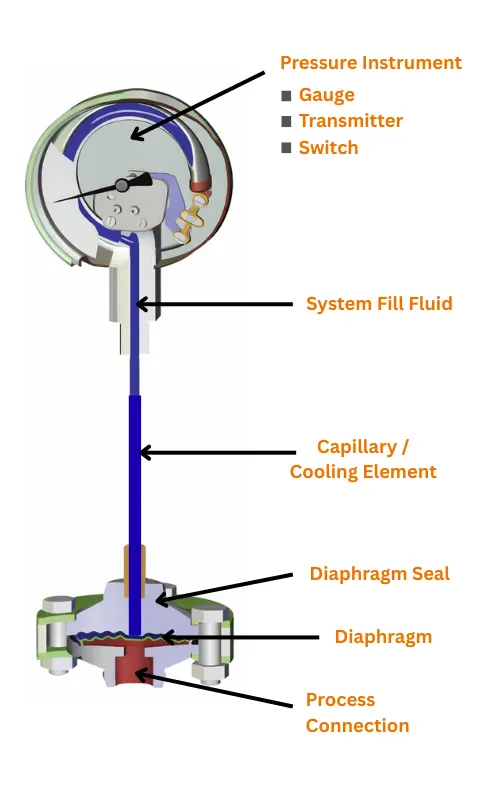
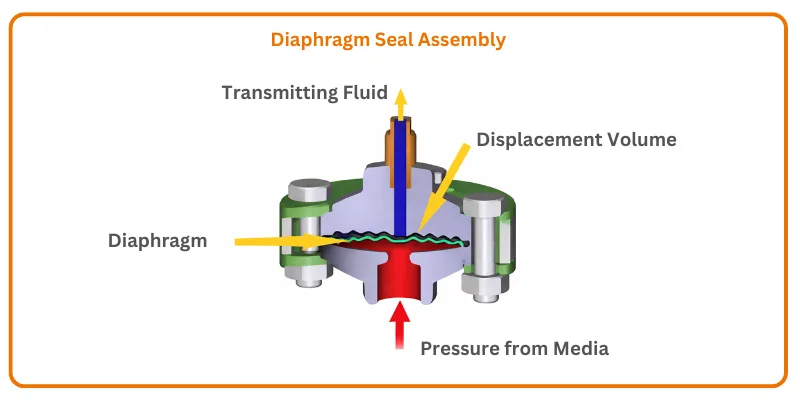
It consists of a thin, flexible metallic diaphragm that directly contacts the process media. Behind this diaphragm is a sealed cavity filled with a system (fill) fluid. When the process pressure acts on the diaphragm, the diaphragm deflects and transmits the pressure hydraulically through the fill fluid to the pressure gauge, pressure transmitter, or pressure switch.
In simple words, the diaphragm seal:
Separates the process media from the pressure instrument
Transfers pressure accurately without allowing direct contact
Basic Working Principle of a Diaphragm Seal
The working principle of a diaphragm seal is purely mechanical and hydraulic.
Process pressure acts on the exposed diaphragm surface
The diaphragm flexes proportionally to the applied pressure
The sealed fill fluid transfers this pressure to the measuring element
The pressure instrument displays or transmits the corresponding value
Corrugations on the diaphragm increase its effective surface area. This improves sensitivity and ensures accurate pressure transmission, especially at low-pressure ranges.
Because the process media never enters the instrument, the internal sensing element remains clean, protected, and stable over time.
Why Diaphragm-Seals Are Used in Pressure Measurement
Direct mounting of pressure instruments is not always practical or safe. Diaphragm seals are used whenever process conditions can harm the instrument or affect measurement reliability.
1. Protection Against Aggressive Media
Many industrial fluids are corrosive, toxic, abrasive, or chemically incompatible with standard instrument materials. The diaphragm acts as a protective barrier.
2. Prevention of Clogging and Solidification
Viscous, sticky, or crystallizing media can clog pressure ports and impulse lines. A diaphragm seal eliminates internal cavities where deposits can build up.
3. High and Low Temperature Isolation
Extreme temperatures can damage pressure sensors or distort readings. Diaphragm seals allow the instrument to be isolated or remotely mounted away from heat or cold.
4. Improved Instrument Lifetime
By isolating the sensing element from harsh conditions, diaphragm seals significantly extend the service life of pressure gauges and transmitters.
5. Measurement in Difficult Installations
When space is limited or the process connection is awkward, diaphragm seals enable flexible mounting options, including remote installation with capillaries.
Key Benefits of Using a Diaphragm-Seal
A properly selected diaphragm-seal offers multiple operational advantages.
Improved safety when handling hazardous or toxic media
Reduced maintenance and cleaning requirements
Stable and repeatable pressure measurements
Protection against corrosion and erosion
Compatibility with demanding industrial environments
Importantly, when engineered correctly, a diaphragm seal introduces minimal measurement error while providing maximum protection.
Diaphragm Seal with Capillary – Remote Mounting
In many applications, the pressure instrument cannot be mounted directly at the process connection.
A diaphragm seal can be connected to the instrument using a capillary tube filled with system fluid.
This arrangement allows:
Remote mounting of the pressure instrument
Protection from vibration, heat, or ambient extremes
Easier access for reading, calibration, or maintenance
Capillary length, diameter, and routing must be carefully selected to minimize temperature-induced errors and response delays.

Common Diaphragm Seal Designs
Different process requirements demand different diaphragm seal constructions.
1. Threaded Diaphragm-Seals
Used for standard pipe connections in general industrial services.
2. Flanged Diaphragm-Seals
Suitable for higher pressures, larger pipe sizes, and critical applications.
3. Flush Diaphragm-Seals
Designed so the diaphragm is flush with the process wall, ideal for viscous or slurry-type media.
4. In-Line Diaphragm-Seals
Installed directly in the pipeline where continuous flow conditions are required.
Each design ensures optimal pressure transmission while matching the mechanical and process constraints.
You can also read our article:
Materials and System Fill Fluids
Material selection plays a major role in diaphragm seal performance and longevity.
Diaphragm Materials
Common materials include:
Stainless steel alloys
Special corrosion-resistant alloys
Coated diaphragms for aggressive media
System Fill Fluids
The fill fluid must remain stable across the operating temperature range and be compatible with the application.
Standard industrial fluids for general service
Food-grade fluids for hygienic applications
Special fluids for oxygen or ultra-pure processes
The correct combination of diaphragm material and fill fluid ensures safety, accuracy, and compliance with industry standards.
Typical Applications of Diaphragm-Seals
Diaphragm seals are widely used across many industries due to their versatility.
Chemical and petrochemical processing
Oil and gas production and refining
Power plants and steam systems
Food and beverage manufacturing
Pharmaceutical and biotechnology plants
Water and wastewater treatment
Fertilizer and specialty chemical production
In all these applications, the diaphragm seal ensures reliable pressure measurement where direct instrument contact is not possible or advisable.
Accuracy Considerations with Diaphragm-Seals
A common concern is whether diaphragm seals affect measurement accuracy.
In practice:
Properly engineered diaphragm seals introduce only minimal error
Accuracy depends on diaphragm stiffness, fill fluid properties, and temperature stability
Correct selection ensures long-term measurement reliability
For critical applications, temperature effects and capillary influences must be considered during system design.
What we learn today?
A diaphragm-seal is not just an accessory but it is a important component for safe and reliable pressure measurement in challenging process conditions.
By isolating the pressure instrument from aggressive media, extreme temperatures, and clogging risks, diaphragm seals protect equipment, improve measurement stability, and reduce maintenance costs.
When selected and installed correctly, diaphragm seals allow pressure instruments to perform accurately and consistently, even in the most demanding industrial environments.


I hope you like above blog. There is no cost associated in sharing the article in your social media. Thanks for Reading !! Happy Learning