
Table of Contents
Toggle2oo3 Voting Logic in Safety Systems
In industrial plants, safety systems must take the right decision at the right time.
A wrong signal can unnecessarily shut down a plant, while a missed signal can lead to serious accidents.
This creates a challenge how to make systems both safe and reliable.
To solve this problem, industries use a concept called 2oo3 Voting Logic.
Understanding 2oo3 Voting Logic in simple terms
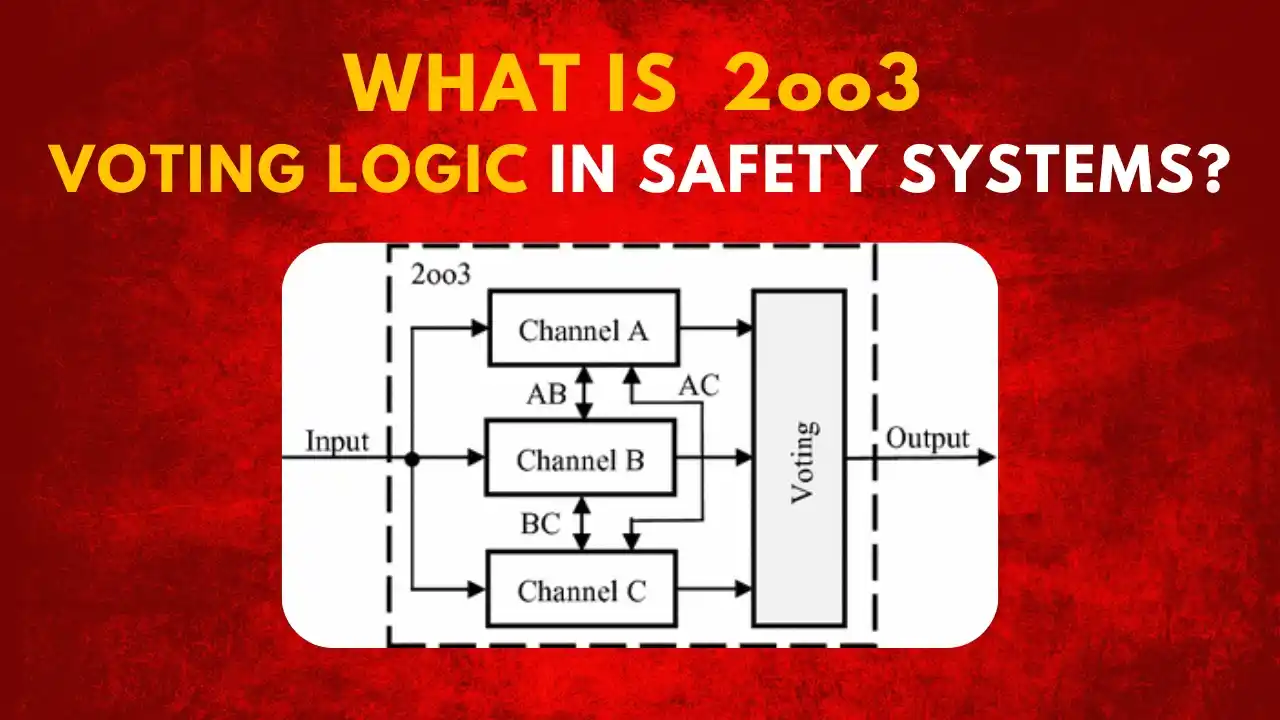
The term 2oo3 Voting Logic means Two out of Three.
In this method, three sensors are used to measure the same parameter, and the system takes action only when at least two sensors agree.
This simple idea helps the system avoid wrong decisions caused by a single faulty sensor.
How 2oo3 Voting Logic works in real systems
Let’s take a practical example of pressure measurement.
In a process line, three pressure transmitters are installed:
1. PT-1
2. PT-2
3. PT-3
All three transmitters continuously measure the same pressure.
Now, the safety system is configured using 2oo3 Voting Logic:
1. If two transmitters detect high pressure, the system will trigger a shutdown
2. If only one transmitter detects high pressure, the system will ignore it
This ensures that one faulty signal does not affect the entire process.
Practical example of 2oo3 Voting Logic
Consider a pressure trip set point of 100 bar.
Now observe the readings:
1. PT-1 → 105 bar
2. PT-2 → 103 bar
3. PT-3 → 92 bar
In this situation:
1. Two transmitters show pressure above the limit
2. One transmitter shows normal pressure
Since 2 out of 3 sensors detect high pressure, the system considers it a real condition.
The system will trip.
Why 2oo3 Voting Logic is widely used in industries
The main reason industries prefer 2oo3 Voting Logic is because it provides a balance between safety and plant availability.
1. Reduction of false trips
A single faulty sensor cannot shut down the plant, which avoids unnecessary production loss.
2. Improved safety reliability
Even if one sensor fails or gives incorrect data, the remaining sensors can still detect a dangerous condition.
3. Better maintenance flexibility
One sensor can be under maintenance, and the system can still operate safely with the remaining sensors.
Where 2oo3 Voting Logic is used
You will commonly find 2oo3 Voting Logic in critical safety systems such as:
1. Emergency Shutdown Systems (ESD)
2. Burner Management Systems (BMS)
3. High Integrity Pressure Protection Systems (HIPPS)
4. Reactor protection systems
These are applications where both safety and reliability are extremely important.
Key understanding of 2oo3 Voting Logic
To summarize the concept:
1. One sensor fails → system continues to operate safely
2. Two sensors detect danger → system takes action
3. System avoids unnecessary shutdowns while ensuring protection
FAQs on 2oo3 Voting Logic
1. What is 2oo3 Voting-Logic?
2oo3 Voting Logic means the system takes action only when two out of three sensors agree.
2. Why is 2oo3 Voting-Logic important?
It helps reduce false trips and improves safety in industrial systems.
3. What happens if one sensor fails?
The system will still work properly because the other two sensors can make the correct decision.
4. Where is 2oo3 Voting-Logic used?
It is used in safety systems like ESD, BMS, HIPPS, and reactor protection systems.
5. What is the main benefit of 2oo3 Voting-Logic?
It provides a balance between safety and system availability, which is very important in industrial processes.
What we learn today?
2oo3 Voting-Logic ensures that a plant does not trip because of one bad sensor, but it will definitely trip when there is a real dangerous condition.


I hope you like above blog. There is no cost associated in sharing the article in your social media. Thanks for Reading !! Happy Learning