

Table of Contents
ToggleValve Actuator Types: Introduction
Valves are everywhere in industrial plants controlling flow, pressure, temperature, and direction of fluids.
But a valve alone cannot operate by itself. It needs a driving mechanism to open, close, or position it accurately. This driving mechanism is known as a valve actuator.
Valve actuators convert energy from air, electricity, hydraulic fluid, or manual effort into mechanical motion. Choosing the right actuator directly affects process safety, response time, accuracy, and reliability.
In this article, we explain the most common valve actuator types, how they work, and where they are used in real industrial applications.
What Is a Valve Actuator?
A valve actuator is a device that moves a valve to a required position. The movement can be linear (up and down) or rotary (quarter-turn or multi-turn).
Actuators allow valves to be operated automatically, remotely, or safely in locations where manual operation is not practical.
In modern plants, actuators are essential for automation, safety interlocks, emergency shutdown systems, and precise flow control.
Why Valve Actuator Selection Matters
Selecting the wrong actuator can cause slow response, control instability, or even equipment damage. Actuator selection depends on several factors:
Valve type and size
Required torque or thrust
Speed of operation
Fail-safe requirements
Hazardous or non-hazardous area
Availability of air, power, or hydraulic supply
Understanding actuator types helps engineers and technicians avoid costly mistakes during design and maintenance.
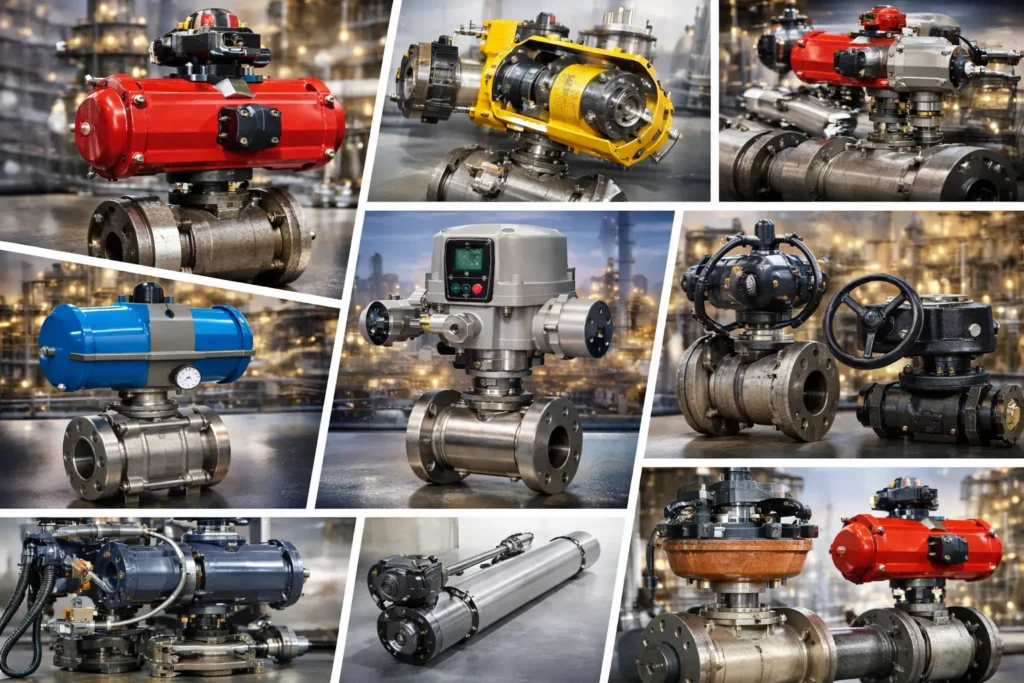
1. Pneumatic Actuator
Power Source: Compressed air
Pneumatic actuators use air pressure to move a piston or diaphragm. When air is applied, it creates force that produces linear or rotary motion.
These actuators are popular because compressed air is widely available in industrial plants. They offer fast response and simple construction.
Common Applications:
Fast-acting on/off valves, control valves, oil & gas plants, chemical industries, water treatment systems, hazardous environments where electrical equipment is restricted.
2. Hydraulic Actuator
Power Source: Pressurized hydraulic fluid
Hydraulic actuators operate using incompressible fluid, which allows them to generate extremely high force. A hydraulic piston moves when pressurized fluid enters the cylinder.
They are ideal for large valves where pneumatic actuators cannot provide enough torque or thrust.
Common Applications:
Heavy-duty valves, offshore platforms, marine systems, power plants, large pipeline isolation valves.
3. Electric Actuator
Power Source: Electricity
Electric actuators use an electric motor combined with gears or screw mechanisms to move the valve. They provide precise positioning and are easy to integrate with control systems.
Unlike pneumatic actuators, electric actuators do not require air supply, making them suitable for remote locations.
Common Applications:
HVAC systems, water distribution networks, automated manufacturing plants, remote valve operation, precise throttling control.
4. Manual Actuator
Power Source: Human effort
Manual actuators are operated using handwheels, levers, or gearboxes. They are simple, reliable, and do not require external power.
Although automation is common, manual actuators remain important for backup and isolation purposes.
Common Applications:
Utility pipelines, emergency operation, infrequently operated valves, maintenance bypass lines.
5. Spring Return Actuator
Power Source: Pneumatic, hydraulic, or electric with spring
Spring return actuators include an internal spring that automatically moves the valve to a predefined position when power or air supply fails.
This fail-safe action is critical in safety-related applications.
Common Applications:
Emergency shutdown valves, fire-safe systems, fuel gas isolation, safety instrumented systems (SIS).
6. Scotch Yoke Actuator
Power Source: Pneumatic or hydraulic
Scotch yoke actuators convert linear piston motion into rotary motion using a yoke mechanism. They deliver very high torque at the start and end of valve travel.
This torque characteristic makes them ideal for large quarter-turn valves.
Common Applications:
Large ball valves, butterfly valves, pipeline isolation, oil & gas transmission lines.
7. Rack and Pinion Actuator
Power Source: Pneumatic or hydraulic
In rack and pinion actuators, pistons drive a rack that rotates a pinion gear. This design provides smooth and balanced rotary motion.
They are compact, lightweight, and easy to install.
Common Applications:
Small to medium-sized ball valves, plug valves, butterfly valves in automated process lines.
8. Linear Actuator
Power Source: Electric, pneumatic, or hydraulic
Linear actuators move the valve stem in a straight-line motion. They are commonly used with valves that require lifting or pushing action rather than rotation.
They provide accurate positioning and stable control.
Common Applications:
Control valves, globe valves, gate valves, level control applications in process industries.
9. Rotary Actuator
Power Source: Electric, pneumatic, or hydraulic
Rotary actuators produce rotational motion. They can be quarter-turn or multi-turn depending on valve requirements.
They are widely used in automated valve systems.
Common Applications:
Ball valves, plug valves, butterfly valves in industrial automation and utilities.
10. Electro-Hydraulic Actuator
Power Source: Electricity and hydraulic fluid
Electro-hydraulic actuators combine electric motors with hydraulic systems. The motor generates hydraulic pressure internally, eliminating the need for external hydraulic lines.
They offer both high force and precise control.
Common Applications:
Offshore platforms, remote oil & gas installations, emergency shutdown valves, critical isolation duties.
11. Diaphragm Actuator
Power Source: Pneumatic or hydraulic
Diaphragm actuators use a flexible diaphragm to convert pressure into linear motion. They provide smooth and stable operation, especially for control applications.
They are commonly paired with control valves.
Common Applications:
Chemical processing, pharmaceutical plants, food and beverage industries, low-pressure control systems.
Top 20 Valve Actuator Manufacturers Worldwide
| No. | Manufacturer Name | Country | Actuator Types |
|---|---|---|---|
| 1 | Emerson | USA | Pneumatic, Electric, Hydraulic |
| 2 | Flowserve | USA | Electric, Pneumatic, Hydraulic |
| 3 | Rotork | UK | Electric, Pneumatic, Hydraulic |
| 4 | AUMA | Germany | Electric Actuators |
| 5 | Siemens | Germany | Electric Actuators |
| 6 | Schneider Electric | France | Electric Actuators |
| 7 | Bettis | USA | Pneumatic, Hydraulic |
| 8 | Kinetrol | UK | Pneumatic (Vane Type) |
| 9 | Bray | USA | Pneumatic, Electric |
| 10 | Bernard Controls | France | Electric Actuators |
| 11 | SMC | Japan | Pneumatic Actuators |
| 12 | Festo | Germany | Pneumatic, Electric |
| 13 | Neles | Finland | Pneumatic, Electric |
| 14 | Limitorque | USA | Electric Actuators |
| 15 | Honeywell | USA | Electric, Pneumatic |
| 16 | Pentair | USA | Pneumatic, Electric |
| 17 | IMI | UK | Pneumatic Actuators |
| 18 | Emme Technology | Italy | Pneumatic, Electric |
| 19 | Valbia | Italy | Electric Actuators |
| 20 | OMAL | Italy | Pneumatic Actuators |
These manufacturers represent the most widely used valve actuator solutions across oil & gas, power, water, chemical, and industrial automation sectors.
Linear vs Rotary Actuators
Linear actuators move the valve stem straight up and down, making them suitable for globe and gate valves. Rotary actuators rotate the valve shaft, making them ideal for ball, butterfly, and plug valves.
Choosing between linear and rotary depends mainly on valve design and required control action.
Pneumatic vs Electric vs Hydraulic Actuators
Pneumatic actuators are fast, simple, and safe for hazardous areas. Electric actuators offer precise control and easy automation. Hydraulic actuators provide the highest force for heavy-duty applications.
Each type has its place, and no single actuator fits all applications.
Common Mistakes in Actuator Selection
One common mistake is undersizing the actuator, which can cause incomplete valve operation. Another issue is ignoring fail-safe requirements, especially in safety-critical systems. Environmental conditions such as temperature, corrosion, and hazardous area classification are also often overlooked.
Proper actuator selection improves reliability and reduces maintenance costs.
What We Learn Today?
Valve actuators are a critical part of any industrial control system. Understanding different valve actuator types, their working principles, and applications helps engineers, technicians, and students make informed decisions.
From simple manual actuators to advanced electro-hydraulic systems, each actuator type serves a specific purpose. Selecting the right actuator ensures safe operation, precise control, and long-term reliability of valves in any industrial process.


I hope you like above blog. There is no cost associated in sharing the article in your social media. Thanks for Reading !! Happy Learning