
Table of Contents
ToggleInstrumentation is the backbone of any industrial process. It helps measure and control important process parameters such as pressure, temperature, flow, level, and chemical properties.
Without proper instrumentation, it is not possible to operate plants safely, efficiently, and consistently.
Understanding the types of instrumentation is important for students, technicians, and engineers who work with industrial systems.
Each instrument has a specific purpose and application, and selecting the right one makes a big difference in accuracy, safety, and performance.
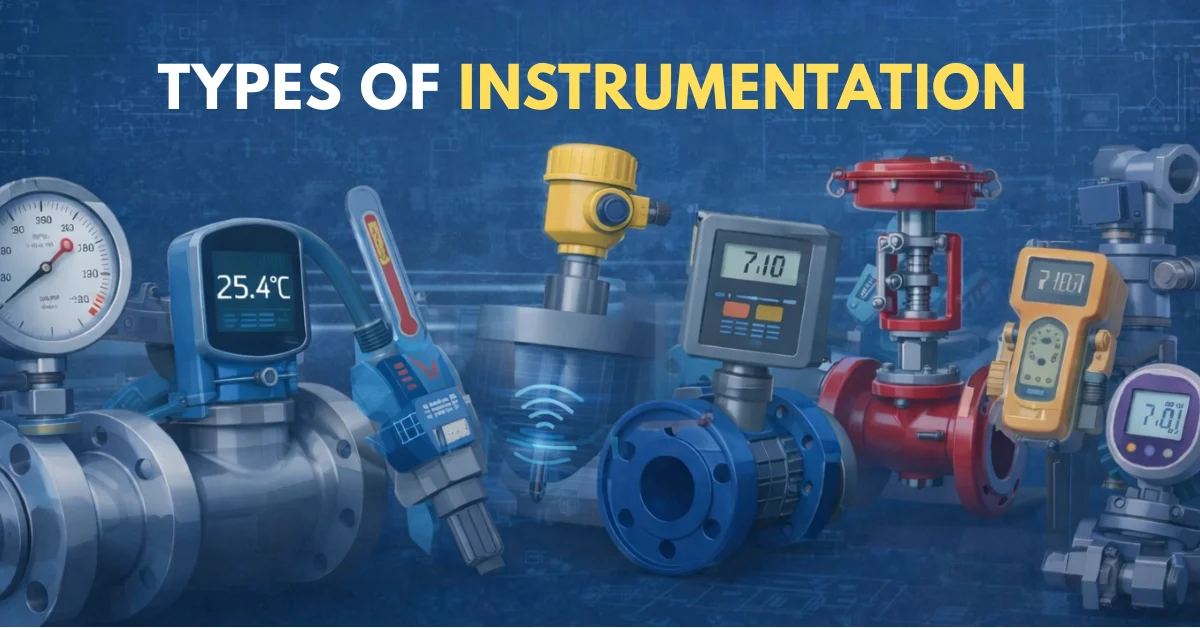
In this article, we will explore the major types of instrumentation used in industries and explain where and why they are commonly applied.
Types of Instrumentation
Pressure Instruments
Pressure instruments are used to measure the force exerted by liquids or gases on a surface. They are widely used in process industries to ensure safe operation, protect equipment, and maintain process control.
1. Pressure Gauges
Pressure gauges are mechanical devices that indicate pressure locally using a pointer and dial. They work by converting applied pressure into mechanical movement, which is displayed as a pressure value.
They are commonly used on pumps, compressors, pipelines, boilers, and hydraulic systems for routine pressure monitoring.
2. Bourdon Tube Pressure Gauges
Bourdon tube pressure gauges work on the principle that a curved metal tube tends to straighten when pressure is applied inside it. The movement of the tube is mechanically linked to a pointer on the dial.
These gauges are widely used for medium and high-pressure applications such as steam lines, compressed air systems, and industrial utilities.
3. Diaphragm Pressure Gauges
Diaphragm pressure gauges use a thin, flexible diaphragm that deflects when pressure is applied. The diaphragm movement is transferred to a pointer or sensor for indication.
They are suitable for low-pressure applications and for measuring corrosive, viscous, or dirty fluids in chemical, food, pharmaceutical, and wastewater industries.
4. Capsule Pressure Gauges
Capsule pressure gauges consist of two thin diaphragms sealed together to form a capsule. When pressure changes, the capsule expands or contracts, causing pointer movement.
These gauges are mainly used for very low pressure and vacuum applications such as HVAC systems, air handling units, and laboratory setups.
5. Absolute Pressure Gauges
Absolute pressure gauges measure pressure relative to a perfect vacuum instead of atmospheric pressure. They use a sealed reference chamber inside the instrument.
These gauges are used in vacuum systems, distillation columns, and processes where atmospheric pressure variations can affect measurement accuracy.
6. Differential Pressure Gauges
Differential pressure gauges measure the pressure difference between two points in a system. They typically use diaphragms or bellows exposed to both pressures.
They are commonly used to monitor pressure drop across filters, strainers, heat exchangers, and flow elements.
7. Digital Pressure Gauges
Digital pressure gauges use electronic pressure sensors to convert pressure into an electrical signal and display the value digitally.
They are widely used for calibration, testing, troubleshooting, and applications requiring higher accuracy and easy readability.
8. Vacuum Gauges
Vacuum gauges are designed to measure pressures below atmospheric pressure. Different sensing technologies are used depending on the vacuum range.
They are used in vacuum pumps, packaging machines, vacuum distillation systems, and laboratory equipment.
9. Compound Gauges
Compound gauges can measure both vacuum and positive pressure in a single instrument. They combine the functions of vacuum and pressure gauges.
These gauges are commonly used in refrigeration systems, compressors, and vacuum-assisted processes.
10. Pressure Transmitters
Pressure transmitters convert pressure into a standardized electrical signal, typically 4–20 mA, for remote monitoring. They use sensing elements such as piezoresistive or capacitive sensors.
They are essential for automation systems like PLC, DCS, and SCADA in modern process plants.
11. Gauge Pressure Transmitters
Gauge pressure transmitters measure pressure relative to atmospheric pressure. The sensing element is vented to the atmosphere.
They are widely used in pump discharge lines, compressed air systems, hydraulic circuits, and utility services.
12. Absolute Pressure Transmitters
Absolute pressure transmitters measure pressure relative to an internal vacuum reference. This eliminates the effect of atmospheric pressure changes.
They are used in vacuum processes, meteorological measurements, and sensitive chemical applications.
13. Differential Pressure Transmitters
Differential pressure transmitters measure the pressure difference between two process points using dual pressure ports.
They are commonly used for flow measurement, level measurement in closed tanks, and filter condition monitoring.
14. Pressure Switches
Pressure switches provide an ON/OFF output when a preset pressure limit is reached. They work using mechanical or electronic sensing mechanisms.
They are used for alarms, pump start-stop control, compressor protection, and safety interlocks.
15. Mechanical Pressure Switches
Mechanical pressure switches use springs, diaphragms, or bellows to actuate electrical contacts. They do not require external power to sense pressure.
These switches are used in simple control and safety applications where rugged and reliable operation is required.
16. Electronic Pressure Switches
Electronic pressure switches use electronic sensors and microprocessors for pressure detection and switching.
They provide higher accuracy, adjustable setpoints, and digital outputs, making them suitable for modern automation systems.
17. Differential Pressure Switches
Differential pressure switches activate when the pressure difference exceeds a set value. They work using dual pressure connections and a sensing diaphragm.
They are commonly used for filter clogging detection, flow proving, and ventilation system monitoring.
18. Pressure Accessories
Pressure accessories include manifolds, siphons, snubbers, and diaphragm seals. These components protect pressure instruments from vibration, pulsation, high temperature, and corrosive media.
They improve measurement accuracy, extend instrument life, and ensure safe and reliable operation.
Flow Instruments
Flow instruments are used to measure the rate at which liquids, gases, or steam flow through a pipe or channel. Accurate flow measurement is important for process control, energy monitoring, custody transfer, and overall plant efficiency.
1. Differential Pressure Flow Meters
Differential pressure flow meters work on the principle that flow increases when fluid passes through a restriction, causing a pressure drop. The flow rate is calculated from the measured pressure difference.
They are widely used in oil & gas, power plants, chemical industries, and steam applications.
2. Orifice Plate Flow Meters
Orifice plate flow meters use a thin plate with a hole installed in the pipeline to create a pressure drop. The pressure difference across the plate is proportional to the flow rate.
They are commonly used for liquid, gas, and steam flow measurement due to their simple design and low cost.
3. Venturi Tube Flow Meters
Venturi flow meters use a converging-diverging tube to create a pressure difference with lower permanent pressure loss.
They are used in large pipelines, water treatment plants, and applications where energy loss must be minimized.
4. Flow Nozzles
Flow nozzles work similarly to orifice plates but with a smoother profile, reducing wear and pressure loss.
They are mainly used for high-velocity and high-temperature steam flow measurement in power plants.
5. Pitot Tubes
Pitot tubes measure flow velocity by sensing the difference between static and dynamic pressure.
They are commonly used for air and gas flow measurement in ducts, stacks, and ventilation systems.
6. Averaging Pitot Tubes
Averaging pitot tubes measure flow by taking multiple pressure readings across the pipe cross-section.
They are used in large ducts and pipes where better accuracy than single-point pitot tubes is required.
7. Positive Displacement Flow Meters
Positive displacement flow meters measure flow by trapping a fixed volume of fluid and counting how many times it passes through the meter.
They are ideal for viscous liquids such as oils, fuels, syrups, and chemical additives.
8. Oval Gear Flow Meters
Oval gear flow meters use rotating oval gears to measure volumetric flow accurately.
They are widely used in fuel measurement, lubrication systems, and batching applications.
9. Rotary Vane Flow Meters
Rotary vane flow meters measure flow using rotating vanes driven by the fluid movement.
They are used in low to medium viscosity liquid applications and dosing systems.
10. Turbine Flow Meters
Turbine flow meters measure flow velocity by detecting the rotational speed of a turbine placed in the fluid path.
They are commonly used for clean liquids and gases such as water, fuel, and natural gas.
11. Vortex Flow Meters
Vortex flow meters work on the principle of vortex shedding, where vortices are formed behind a bluff body placed in the flow stream.
They are widely used for steam, gas, and liquid applications, especially where temperature and pressure vary.
12. Electromagnetic Flow Meters
Electromagnetic flow meters measure flow using Faraday’s law of electromagnetic induction.
They are used for conductive liquids such as water, wastewater, slurries, and chemicals.
13. Ultrasonic Flow Meters
Ultrasonic flow meters measure flow by analyzing the travel time or frequency shift of ultrasonic waves passing through the fluid.
They are used for clean liquids, large pipes, and applications requiring non-intrusive measurement.
14. Coriolis Mass Flow Meters
Coriolis flow meters measure mass flow directly using the Coriolis effect caused by vibrating tubes.
They are used in high-accuracy applications such as custody transfer, batching, and chemical processing.
15. Thermal Mass Flow Meters
Thermal mass flow meters measure flow based on heat transfer from a heated sensor to the flowing fluid.
They are mainly used for gas flow measurement, compressed air monitoring, and leak detection.
16. Variable Area Flow Meters (Rotameters)
Variable area flow meters measure flow by the position of a float inside a tapered tube.
They are commonly used for local indication in laboratories, utilities, and low-flow applications.
17. Open Channel Flow Meters
Open channel flow meters measure flow in partially filled channels using level measurement and flow equations.
They are widely used in water treatment plants, sewage systems, and irrigation channels.
18. Weirs and Flumes
Weirs and flumes control and measure open channel flow by creating a known restriction.
They are used in wastewater treatment, environmental monitoring, and surface water measurement.
Level Instruments
Level instruments are used to measure the level of liquids or solids inside tanks, vessels, silos, and open channels. Accurate level measurement is essential for inventory control, process safety, and preventing overflows or dry running.
1. Sight Glass Level Gauges
Sight glass level gauges provide direct visual indication of liquid level through a transparent tube or window.
They are commonly used on tanks, boilers, and vessels where local level observation is required.
2. Magnetic Level Indicators
Magnetic level indicators use a float with a magnet inside a chamber, which drives an external indicator.
They are used in high-pressure and high-temperature applications where direct visual contact with the process fluid is not possible.
3. Float Level Gauges
Float level gauges work on buoyancy, where a float rises or falls with the liquid level.
They are used in storage tanks, sumps, and simple level monitoring applications.
4. Float Level Switches
Float level switches provide an ON/OFF signal when a preset level is reached.
They are widely used for pump control, high-level alarms, and low-level protection.
5. Displacer Level Transmitters
Displacer level transmitters work based on Archimedes’ principle, where buoyant force changes with liquid level.
They are commonly used in stable density applications such as boilers, separators, and process vessels.
6. Differential Pressure Level Transmitters
Differential pressure level transmitters measure level by sensing the pressure difference between the bottom and top of a tank.
They are widely used in closed vessels and pressurized tanks with constant density liquids.
7. Submersible Level Transmitters
Submersible level transmitters measure hydrostatic pressure at the bottom of a tank or well.
They are commonly used in wells, sumps, reservoirs, and water storage tanks.
8. Ultrasonic Level Sensors
Ultrasonic level sensors emit sound waves toward the surface and measure the echo time.
They are used for non-contact level measurement in tanks, open channels, and wastewater applications.
9. Radar Level Sensors
Radar level sensors use electromagnetic waves to measure the distance to the liquid or solid surface.
They are suitable for high-temperature, high-pressure, and dusty environments.
10. Guided Wave Radar Level Sensors
Guided wave radar sensors transmit microwave signals along a probe and measure the reflected signal.
They are used for accurate level measurement in narrow tanks, high-pressure vessels, and interface applications.
11. Capacitance Level Sensors
Capacitance level sensors measure changes in capacitance caused by variations in level.
They are used for both liquid and solid level measurement, especially in powders, granules, and chemicals.
12. Conductivity Level Switches
Conductivity level switches detect level by sensing electrical conductivity between electrodes.
They are commonly used in water and aqueous solutions for pump control and alarm systems.
13. Vibrating Fork Level Switches
Vibrating fork level switches work by detecting changes in vibration frequency when covered by material.
They are used as reliable point level switches for liquids and bulk solids.
14. Optical Level Switches
Optical level switches detect level changes using light reflection or refraction.
They are used in compact tanks, leak detection systems, and clean liquid applications.
15. Nuclear (Gamma) Level Measurement
Nuclear level measurement uses gamma radiation to detect level without contacting the process.
It is used in extreme applications involving high temperature, high pressure, or highly corrosive materials.
Temperature Instruments
Temperature instruments are used to measure the thermal condition of a process, equipment, or environment. Accurate temperature measurement is essential for product quality, process safety, energy efficiency, and equipment protection.
1. Thermocouples
Thermocouples work on the principle that a voltage is generated when two dissimilar metals are joined and exposed to temperature.
They are widely used for high-temperature applications such as furnaces, kilns, boilers, and exhaust systems.
2. RTDs (Resistance Temperature Detectors)
RTDs measure temperature by detecting changes in electrical resistance of a metal, usually platinum.
They are used in applications requiring high accuracy and stability, such as chemical plants, power plants, and laboratories.
3. Thermistors
Thermistors are temperature-sensitive resistors that show a large change in resistance with temperature.
They are used for precise temperature measurement in HVAC systems, medical devices, and electronic equipment.
4. Bimetal Thermometers
Bimetal thermometers use two bonded metals that expand at different rates when heated.
They are commonly used for local temperature indication on pipelines, tanks, and heating systems.
5. Gas-Filled Thermometers
Gas-filled thermometers measure temperature based on pressure changes of a gas inside a sealed bulb.
They are used for remote temperature indication in industrial and marine applications.
6. Liquid-Filled Thermometers
Liquid-filled thermometers work on the expansion of a liquid when temperature changes.
They are used for simple, local temperature measurement in utilities and general industrial services.
7. Infrared Thermometers
Infrared thermometers measure temperature without contact by detecting infrared radiation from an object.
They are used for moving objects, hot surfaces, and applications where contact measurement is not possible.
8. Pyrometers
Pyrometers are specialized non-contact temperature sensors designed for very high temperatures.
They are widely used in steel plants, glass industries, and high-temperature furnaces.
9. Thermal Cameras
Thermal cameras detect temperature distribution over a surface and display it as a thermal image.
They are used for condition monitoring, electrical inspections, and predictive maintenance.
10. Temperature Transmitters
Temperature transmitters convert sensor signals into a standard electrical output, typically 4–20 mA.
They are used for remote temperature monitoring and integration with PLC, DCS, and SCADA systems.
11. Head-Mounted Temperature Transmitters
Head-mounted transmitters are installed directly in the sensor head to reduce signal noise.
They are commonly used in field installations where long cable runs are present.
12. Rail-Mounted Temperature Transmitters
Rail-mounted transmitters are installed inside control panels on DIN rails.
They are used in centralized control systems for monitoring multiple temperature signals.
13. Field-Mounted Temperature Transmitters
Field-mounted transmitters are housed in rugged enclosures suitable for harsh environments.
They are used in outdoor and hazardous area applications.
14. Thermowells
Thermowells protect temperature sensors from process pressure, flow, and corrosion.
They allow sensors to be replaced without shutting down the process.
15. Temperature Switches
Temperature switches provide an ON/OFF output when a preset temperature is reached.
They are used for alarms, heater control, cooling system activation, and safety shutdowns.
Analytical Instruments
Analytical instruments are used to measure the chemical and physical properties of liquids and gases. They play a key role in maintaining product quality, process safety, and environmental compliance in many industries.
1. pH Analyzers
pH analyzers measure the acidity or alkalinity of a solution by sensing hydrogen ion activity.
They are widely used in water treatment, chemical processing, food & beverage, and pharmaceutical industries.
2. ORP Analyzers
ORP analyzers measure the oxidation-reduction potential of a solution.
They are commonly used in water disinfection processes, wastewater treatment, and chemical dosing control.
3. Conductivity Analyzers
Conductivity analyzers measure the ability of a solution to conduct electricity, which depends on ion concentration.
They are used in water treatment, boiler feed water monitoring, and chemical concentration measurement.
4. Toroidal Conductivity Sensors
Toroidal conductivity sensors use inductive measurement instead of direct electrode contact.
They are ideal for high-conductivity, dirty, or corrosive liquids in industrial processes.
5. Total Dissolved Solids (TDS) Meters
TDS meters estimate the total dissolved solids in a liquid based on conductivity.
They are commonly used to monitor water purity in RO systems, drinking water, and cooling towers.
6. Dissolved Oxygen Analyzers
Dissolved oxygen analyzers measure the amount of oxygen present in a liquid.
They are essential in wastewater treatment, aquaculture, and biological treatment processes.
7. Turbidity Meters
Turbidity meters measure the cloudiness of a liquid caused by suspended particles.
They are widely used in water treatment plants and environmental monitoring.
8. Chlorine Analyzers
Chlorine analyzers measure free or total chlorine levels in water.
They are used in drinking water treatment, swimming pools, and disinfection systems.
9. Ozone Analyzers
Ozone analyzers measure ozone concentration in water or air.
They are used in advanced water treatment and industrial sterilization applications.
10. Gas Analyzers
Gas analyzers measure the concentration of specific gases such as oxygen, carbon dioxide, hydrogen, and carbon monoxide.
They are used in combustion control, safety monitoring, and process optimization.
11. Moisture Analyzers
Moisture analyzers measure the amount of water vapor or moisture in gases and solids.
They are commonly used in compressed air systems, dryers, and material processing.
12. Density Meters
Density meters measure the mass per unit volume of a fluid.
They are used in chemical processing, blending, and quality control applications.
13. Viscosity Meters
Viscosity meters measure a fluid’s resistance to flow.
They are widely used in oil & gas, food, paint, and polymer industries.
14. Refractometers
Refractometers measure concentration by analyzing how light bends through a fluid.
They are commonly used for sugar concentration, coolant monitoring, and chemical solutions.
15. Spectrophotometers
Spectrophotometers analyze a sample by measuring light absorption at different wavelengths.
They are used in laboratories, pharmaceuticals, and chemical analysis.
Control Valves
Control valves are final control elements used to regulate flow, pressure, level, or temperature in a process. They work by adjusting the flow of fluids based on signals received from controllers in automation systems.
1. Globe Control Valves
Globe control valves regulate flow using a movable plug and a stationary seat.
They provide precise control and are widely used in applications requiring accurate throttling, such as steam and process control systems.
2. Ball Control Valves
Ball control valves use a rotating ball with a hole to control fluid flow.
They are commonly used for on-off and fast shutoff applications in oil & gas, water, and utility services.
3. Butterfly Control Valves
Butterfly control valves use a rotating disc to regulate flow.
They are lightweight, compact, and widely used in large pipelines for water, air, and HVAC systems.
4. Diaphragm Control Valves
Diaphragm control valves use a flexible diaphragm to control flow.
They are suitable for corrosive, abrasive, and hygienic applications such as chemical and food processing.
5. Plug Valves
Plug valves control flow using a cylindrical or tapered plug with a flow passage.
They are used in applications requiring tight shutoff and simple operation.
6. Needle Valves
Needle valves use a slender, tapered needle to finely control flow.
They are used in instrumentation lines, sampling systems, and laboratory applications where precise adjustment is needed.
7. On-Off Valves
On-off valves operate in fully open or fully closed positions without throttling.
They are used for isolation, safety shutdown, and basic process control.
8. Pneumatic Actuators
Pneumatic actuators use compressed air to move the valve.
They are widely used due to fast response, reliability, and suitability for hazardous areas.
9. Electric Actuators
Electric actuators use electric motors to control valve movement.
They are used where compressed air is not available or precise positioning is required.
10. Hydraulic Actuators
Hydraulic actuators use pressurized fluid to generate high force.
They are used in high-pressure and heavy-duty applications such as oil & gas pipelines.
11. Valve Positioners
Valve positioners ensure the valve reaches and maintains the correct position based on the control signal.
They improve accuracy, speed, and stability of valve operation.
12. I/P Converters
I/P converters convert electrical control signals into pneumatic signals.
They are used when control systems provide electrical outputs but valves require pneumatic actuation.
13. Solenoid Valves
Solenoid valves use an electromagnetic coil to open or close the valve.
They are commonly used for quick switching, safety interlocks, and automation control.
14. Limit Switch Boxes
Limit switch boxes provide feedback on valve position such as open or closed status.
They are used for monitoring, interlocking, and safety systems.
Signal Conditioning Instruments
Signal conditioning instruments are used to process raw signals from field sensors before they are sent to control systems. They improve signal quality, accuracy, and compatibility with PLC, DCS, and SCADA systems.
1. Signal Isolators
Signal isolators electrically separate input and output signals to prevent ground loops and electrical noise.
They are used to protect control systems and improve measurement reliability.
2. Signal Converters
Signal converters change one type of signal into another, such as voltage to current or frequency to current.
They are commonly used to interface different instruments and control systems.
3. I/P Converters
I/P converters convert electrical signals, typically 4–20 mA, into pneumatic pressure signals.
They are used in control valve applications where pneumatic actuation is required.
4. P/I Converters
P/I converters convert pneumatic signals into electrical signals.
They are used in systems where pneumatic transmitters need to communicate with electronic controllers.
5. Signal Amplifiers
Signal amplifiers increase weak signals from sensors to usable levels.
They are used in low-level signal applications such as thermocouples and strain gauges.
6. Signal Filters
Signal filters remove noise and unwanted frequencies from measurement signals.
They are used to improve signal stability and accuracy in electrically noisy environments.
7. Loop Power Supplies
Loop power supplies provide power to two-wire instruments such as transmitters.
They are commonly used in 4–20 mA current loop systems.
8. Zener Barriers
Zener barriers limit electrical energy to protect equipment in hazardous areas.
They are used in intrinsically safe systems to prevent ignition.
9. Galvanic Isolators
Galvanic isolators provide electrical isolation without a direct conductive path.
They are used in hazardous and non-hazardous areas to ensure safety and signal integrity.
10. Signal Splitters
Signal splitters duplicate one signal into multiple outputs.
They are used when the same measurement needs to be sent to more than one control or monitoring system.
11. Signal Repeaters
Signal repeaters strengthen and retransmit signals over long distances.
They are used in large plants where signal loss may occur due to long cable runs.
Recording & Display Instruments
Recording and display instruments are used to show process values and store measurement data over time. They help operators monitor process conditions, analyze trends, and maintain records for quality and compliance.
1. Chart Recorders
Chart recorders continuously record process values on paper using a pen or stylus.
They are used in applications where a permanent hardcopy record of temperature, pressure, or flow is required.
2. Strip Chart Recorders
Strip chart recorders record data on a moving strip of paper over time.
They are commonly used for continuous monitoring in laboratories and process plants.
3. Circular Chart Recorders
Circular chart recorders record data on a rotating circular chart.
They are used for daily or weekly recording of process variables in critical applications.
4. Data Loggers
Data loggers store measurement data electronically for later analysis.
They are used in environmental monitoring, energy audits, and process performance analysis.
5. Digital Displays
Digital displays show process values in numeric form.
They are widely used in control panels, field installations, and monitoring stations for quick reading.
6. Local Indicators
Local indicators provide on-site visual indication of process parameters.
They are used where operators need immediate access to measurement values.
7. Panel Indicators
Panel indicators are mounted on control panels and display signals from transmitters.
They are commonly used in PLC and DCS panels for centralized monitoring.
8. Remote Displays
Remote displays show measurement values at a location away from the sensor.
They are used when instruments are installed in inaccessible or hazardous areas.
9. Graphic Displays
Graphic displays present process data using charts, bars, or trends.
They are used in control rooms for better visualization of process conditions.
10. Trend Recorders
Trend recorders store and display historical data in graphical form.
They are used for process analysis, troubleshooting, and performance optimization.
Digital & Analog Instruments
Digital and analog instruments are classified based on how they display or transmit measurement values. Both types are widely used in industrial systems depending on accuracy, readability, and application needs.
1. Analog Instruments
Analog instruments display measurements as a continuous value, usually using a pointer and scale.
They are simple, rugged, and commonly used for local indication of pressure, temperature, and flow.
2. Analog Pressure Gauges
Analog pressure gauges use mechanical movement to indicate pressure on a dial.
They are widely used in utilities, hydraulic systems, and general industrial applications.
3. Analog Temperature Indicators
Analog temperature indicators display temperature using mechanical or fluid-based sensing elements.
They are used where power supply is not available or simplicity is preferred.
4. Digital Instruments
Digital instruments display measurements in numerical form.
They offer higher accuracy, better readability, and easy integration with control systems.
5. Digital Pressure Gauges
Digital pressure gauges use electronic sensors to display pressure values.
They are commonly used for calibration, testing, and precision measurement.
6. Digital Temperature Indicators
Digital temperature indicators display temperature values electronically.
They are used in control panels and monitoring systems.
7. Digital Flow Indicators
Digital flow indicators display flow rate or totalized flow values.
They are used in process monitoring and batching applications.
8. Digital Multimeters
Digital multimeters measure electrical parameters such as voltage, current, and resistance.
They are widely used for maintenance, troubleshooting, and commissioning work.
9. Panel Meters
Panel meters are mounted on control panels to display electrical or process signals.
They are used in PLC and DCS panels for centralized monitoring.
10. Smart Instruments
Smart instruments use digital communication protocols for configuration and diagnostics.
They are used in modern automation systems for advanced monitoring and asset management.
Safety Instruments
Safety instruments are used to protect people, equipment, and the environment by detecting abnormal or hazardous conditions. They play a critical role in preventing accidents and ensuring safe plant operation.
1. Gas Detectors
Gas detectors sense the presence of hazardous or combustible gases in the environment.
They are widely used in oil & gas, chemical plants, refineries, and confined spaces.
2. Toxic Gas Detectors
Toxic gas detectors measure harmful gases such as hydrogen sulfide and carbon monoxide.
They are used to protect personnel in industrial and laboratory environments.
3. Combustible Gas Detectors
Combustible gas detectors detect flammable gases and vapors.
They are used to prevent explosions in hazardous areas.
4. Flame Detectors
Flame detectors identify the presence of fire by detecting ultraviolet or infrared radiation.
They are used in high-risk areas such as fuel handling and process units.
5. Smoke Detectors
Smoke detectors sense smoke particles generated during fire.
They are used in buildings, control rooms, and electrical panels.
6. Fire Detectors
Fire detectors combine multiple sensing methods to detect fire conditions.
They are used in industrial plants and safety-critical installations.
7. Pressure Relief Valves
Pressure relief valves automatically release excess pressure from a system.
They are used to protect equipment from overpressure and potential failure.
8. Safety Valves
Safety valves are designed to open fully at a set pressure to quickly relieve excess pressure.
They are widely used in boilers, pressure vessels, and steam systems.
9. Rupture Discs
Rupture discs are non-reclosing devices that burst at a predefined pressure.
They are used as emergency pressure protection in critical systems.
10. Emergency Shutdown Systems (ESD)
Emergency shutdown systems automatically stop processes during unsafe conditions.
They are used in oil & gas, chemical plants, and power generation facilities.
11. Safety Instrumented Systems (SIS)
Safety instrumented systems monitor critical parameters and take corrective actions.
They are designed to reduce risk and meet functional safety requirements.
12. High Integrity Pressure Protection Systems (HIPPS)
HIPPS prevent overpressure by isolating the source instead of venting.
They are used when conventional relief systems are not feasible.
Vibration & Condition Monitoring Instruments
Vibration and condition monitoring instruments are used to assess the health of rotating and mechanical equipment. They help detect early signs of faults and support predictive maintenance strategies.
1. Vibration Sensors
Vibration sensors measure vibration levels in machinery.
They are used to detect imbalance, misalignment, and mechanical wear in rotating equipment.
2. Accelerometers
Accelerometers measure acceleration caused by vibration.
They are widely used in motors, pumps, compressors, and turbines.
3. Velocity Sensors
Velocity sensors measure vibration velocity, which is a key indicator of machine health.
They are commonly used in condition monitoring systems.
4. Proximity Probes
Proximity probes measure shaft displacement without contact.
They are used in high-speed rotating machinery such as turbines and compressors.
5. Shaft Vibration Monitors
Shaft vibration monitors continuously track shaft movement.
They are used in critical rotating equipment to prevent catastrophic failures.
6. Bearing Condition Monitors
Bearing condition monitors detect bearing faults by analyzing vibration patterns.
They are used to prevent unexpected bearing failures.
7. Machine Health Monitoring Systems
Machine health monitoring systems combine multiple sensors and analytics.
They are used for predictive maintenance and reliability improvement.
8. Acoustic Emission Sensors
Acoustic emission sensors detect high-frequency stress waves generated by defects.
They are used for early fault detection in mechanical systems.
9. Temperature and Vibration Combined Sensors
These sensors measure both temperature and vibration simultaneously.
They are used to improve fault diagnosis in rotating equipment.
10. Online Condition Monitoring Systems
Online condition monitoring systems provide continuous real-time monitoring.
They are used in critical assets where downtime is costly.
Industrial Control Systems
Industrial control systems are used to monitor, control, and automate industrial processes. They collect data from field instruments and execute control actions to ensure safe, efficient, and reliable plant operation.
1. PID Controllers
PID controllers regulate process variables using proportional, integral, and derivative control actions.
They are widely used for controlling pressure, temperature, flow, and level in industrial processes.
2. Single Loop Controllers
Single loop controllers control one process variable at a time.
They are commonly used in standalone control applications such as temperature or pressure control.
3. Multi-Loop Controllers
Multi-loop controllers control multiple process variables within a single device.
They are used in compact systems where multiple control loops are required.
4. Programmable Logic Controllers (PLC)
PLCs are industrial computers designed for real-time control and automation.
They are widely used in manufacturing, packaging, material handling, and process industries.
5. Distributed Control Systems (DCS)
DCS systems distribute control functions across multiple controllers connected through a network.
They are used in large continuous process plants such as refineries, power plants, and chemical industries.
6. Supervisory Control and Data Acquisition (SCADA)
SCADA systems provide centralized monitoring and supervisory control over large geographical areas.
They are commonly used in water distribution, pipelines, power transmission, and utilities.
7. Human Machine Interface (HMI)
HMI systems allow operators to interact with machines and processes through graphical screens.
They are used in control rooms and local panels for real-time monitoring and control.
8. Operator Stations
Operator stations are dedicated workstations for plant operators.
They provide access to alarms, trends, and process displays in control systems.
9. Engineering Workstations
Engineering workstations are used for system configuration, programming, and maintenance.
They are essential for setup and modification of PLC, DCS, and SCADA systems.
10. Control Network Systems
Control networks connect field devices, controllers, and supervisory systems.
They enable reliable data exchange in modern industrial automation environments.
Instrumentation is the foundation of safe, efficient and reliable industrial operations.
From measuring basic parameters like pressure, temperature, flow, and level to advanced analytical, safety, and control systems, each type of instrumentation plays a specific and important role in process industries.
Understanding the different types of instrumentation helps engineers, technicians, and students make better decisions during design, installation, operation, and troubleshooting.
Selecting the right instrument improves measurement accuracy, reduces downtime, enhances safety, and ensures long-term plant performance.
As industries continue to move toward automation and digitalization, a strong understanding of instrumentation remains an essential skill for anyone working in the field.


I hope you like above blog. There is no cost associated in sharing the article in your social media. Thanks for Reading !! Happy Learning