
Table of Contents
ToggleAllen Bradley PLCs: Introduction
Programmable Logic Controllers are the backbone of modern industrial automation. Whether it is a small packaging machine or a large refinery, PLCs continuously monitor inputs, execute logic and control outputs to keep processes running safely and efficiently.
Among the many PLC brands used worldwide, Allen Bradley, a flagship brand of Rockwell Automation, is one of the most widely installed and trusted platforms across industries.
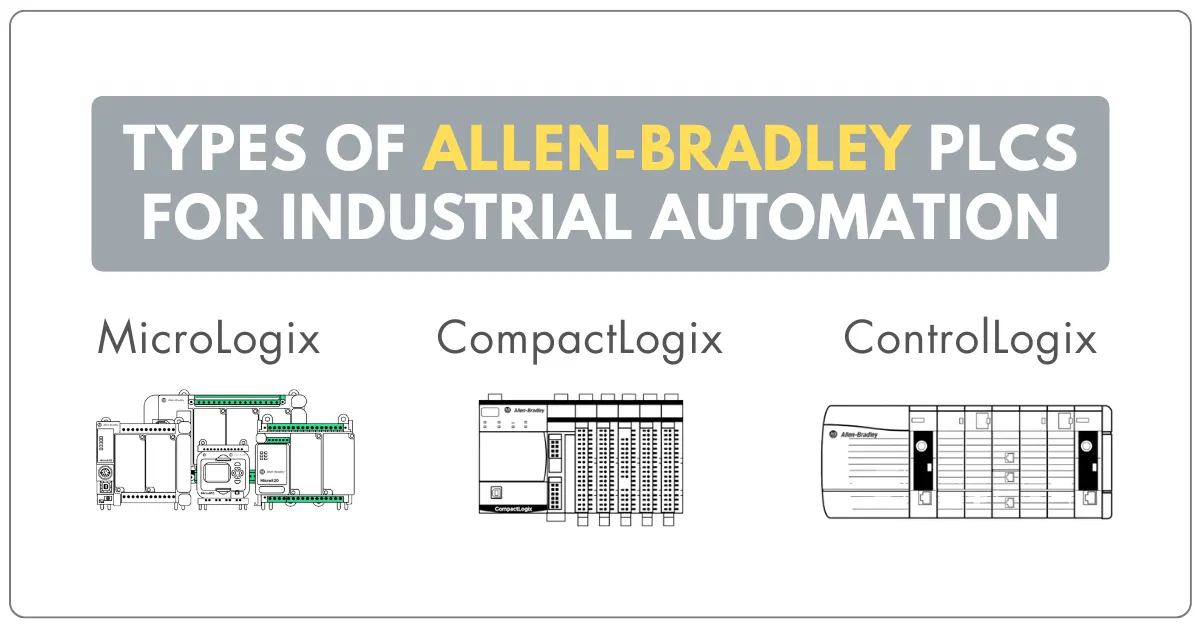
Allen-Bradley does not offer a single PLC model. Instead, it provides different PLC families, each designed for a specific level of automation complexity.
In this article, we will clearly explain three important Allen-Bradley PLC families used in industry:
MicroLogix
CompactLogix
ControlLogix
Understanding Allen Bradley PLC families
Allen-Bradley PLC families are structured to match different automation requirements. The differences are not just about size, but also about performance, scalability, software environment, and long-term system capability.
When selecting a PLC family, engineers typically evaluate:
Size and complexity of the automation system
Number of digital and analog I/O points
Communication and networking needs
Requirement for motion control or safety
Future expansion and lifecycle support
Each Allen-Bradley PLC family is optimized to perform best within a specific range of these requirements.
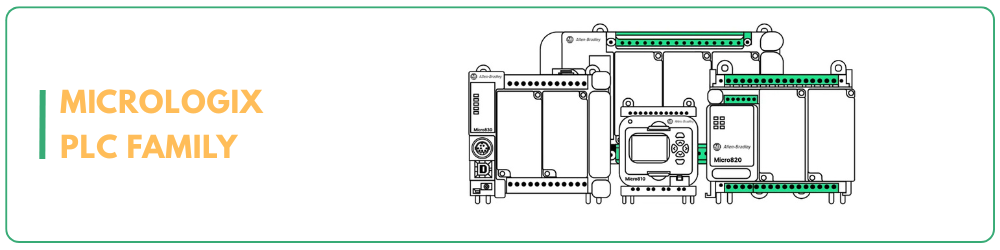
MicroLogix PLC family overview
The MicroLogix PLC family was developed for small automation systems and machine-level control. These PLCs gained massive popularity due to their compact design, reliability, and ease of use.
Even though many MicroLogix models are now classified as legacy products, they are still widely used and maintained in existing industrial plants.
Key characteristics of MicroLogix PLCs
Compact “brick-type” controller where CPU, power supply, and I/O are integrated
Limited processing power suitable for basic logic and control tasks
Fixed I/O with limited expansion capability depending on model
Programming done using RSLogix 500 software
Communication options vary by model and may include Ethernet and serial ports
MicroLogix PLCs follow a traditional, file-based programming structure, which is familiar to many technicians and maintenance engineers.
Typical applications of MicroLogix PLCs
Small conveyors and material handling systems
Standalone machines with limited I/O
Simple batching and mixing processes
Legacy automation panels in older plants
MicroLogix PLCs are still effective for maintaining existing systems, but they are generally not recommended for new, scalable automation projects.
CompactLogix PLC family overview
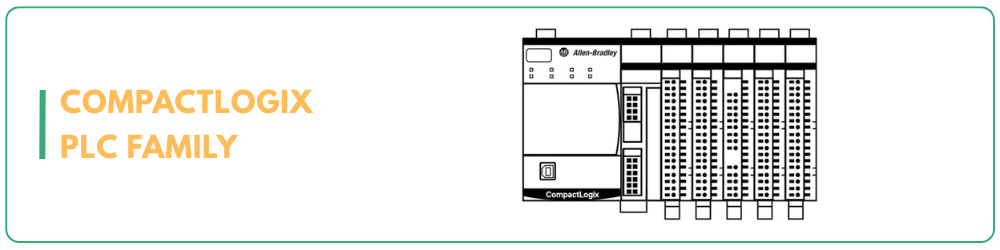
CompactLogix PLCs are designed for modern mid-range automation systems where higher performance and flexibility are required. They are part of the Logix platform and use a modern, tag-based programming approach.
CompactLogix is often considered the natural upgrade path from MicroLogix for new projects.
Key characteristics of CompactLogix PLCs
Modular controller design with expandable I/O
Higher processing speed compared to entry-level PLCs
Tag-based programming environment for easier diagnostics
Native EtherNet/IP communication
Programming using Studio 5000 Logix Designer
Support for integrated motion and safety in selected models
CompactLogix PLCs allow engineers to design systems that can grow over time without replacing the entire controller.
Typical applications of CompactLogix PLCs
Packaging, filling, and labeling lines
Skid-mounted process units
Material handling and conveyor systems
Small to medium manufacturing plants
OEM machine automation
CompactLogix PLCs offer an excellent balance between performance, scalability, and cost.
ControlLogix PLC family overview
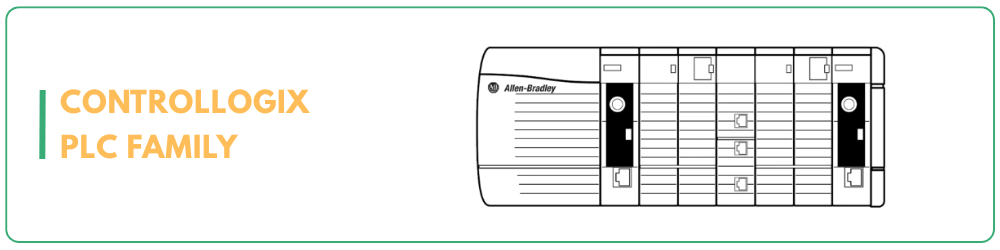
ControlLogix PLCs represent the highest level of automation capability within the Allen-Bradley PLC portfolio. These controllers are designed for large, complex, and mission-critical systems.
ControlLogix PLCs are built around a rack-based, modular architecture and can manage very large I/O counts across distributed networks.
Key characteristics of ControlLogix PLCs
High-performance processors for complex logic and fast scan times
Fully modular rack system with separate power supply, CPU, and I/O
Support for thousands of I/O points across large facilities
Programming using Studio 5000 Logix Designer
Advanced networking and distributed I/O capabilities
Integrated safety, motion, and process control
Support for controller and system redundancy
ControlLogix PLCs are specifically designed for systems where reliability and availability are critical.
Typical applications of ControlLogix PLCs
Oil and gas production and processing facilities
Power generation plants
Chemical and petrochemical industries
Water and wastewater treatment plants
Steel, cement, and heavy manufacturing industries
In such environments, unplanned downtime can result in significant financial and safety risks.
Watch this video: PLC Hardware Explained | Allen Bradley AB ControlLogix LOGIX 5500
Key differences between MicroLogix, CompactLogix, and ControlLogix
Although all three PLC families perform control functions, they are designed for very different system scales.
MicroLogix focuses on basic control and legacy systems
CompactLogix targets scalable machine-level and mid-range automation
ControlLogix is built for large, distributed, and high-availability systems
Understanding these differences helps engineers avoid over-engineering small systems or under-designing critical plant automation.
| Parameter | MicroLogix | CompactLogix | ControlLogix |
|---|---|---|---|
| Typical application size | Small machines and basic automation systems | Medium-size machines and small to mid-scale plants | Large plants and complex automation systems |
| Target users | OEMs, small panels, legacy installations | Machine builders and system integrators | Large system integrators and plant automation teams |
| Controller architecture | Compact “brick” type PLC | Modular controller with local and distributed I/O | Fully modular rack-based controller system |
| Programming software | RSLogix 500 | Studio 5000 Logix Designer | Studio 5000 Logix Designer |
| Programming approach | File-based, fixed data tables | Tag-based, modern Logix architecture | Tag-based, advanced Logix architecture |
| I/O scalability | Limited and model-dependent | Moderate to high I/O scalability | Very high I/O scalability across large systems |
| Motion & safety capability | Very limited | Supported with specific models and modules | Fully supported with advanced options |
| Networking capability | Basic networking, model-dependent | Strong EtherNet/IP integration | Extensive networking for distributed systems |
| Redundancy support | Not supported | Not typically used for redundancy | Dedicated redundancy solutions available |
| Lifecycle direction | Mostly legacy / maintenance phase | Actively used and recommended for new projects | Long-term strategic platform for large systems |
Software platforms and programming approach
Software selection plays a major role in PLC standardization and long-term maintenance.
MicroLogix PLCs use RSLogix 500 with file-based logic
CompactLogix PLCs use Studio 5000 with tag-based programming
ControlLogix PLCs also use Studio 5000 with advanced system features
Using the same software environment for CompactLogix and ControlLogix simplifies training, troubleshooting, and future upgrades.
Watch this video: Allen Bradley RSLogix 5000 PLC Tutorial
How to choose the right Allen-Bradley PLC
Selecting the right PLC is not about choosing the biggest controller. It is about choosing the right-sized controller for the application.
Small standalone machines benefit from simpler PLCs
Growing machines and production lines require scalable controllers
Large plants need high-performance, redundant systems
Lifecycle support and future expansion must always be considered
A well-chosen PLC improves system reliability, reduces engineering effort, and lowers total lifecycle cost.
Watch this video to learn how to take a backup of a PLC
What We Learn Today?
Allen Bradley PLCs offer a structured and scalable automation platform suitable for almost every industrial application.
MicroLogix PLCs continue to support legacy systems and basic control needs. CompactLogix PLCs deliver modern, flexible automation for machines and mid-scale plants. ControlLogix PLCs provide high-performance control for large, complex, and critical industrial operations.
Understanding these PLC families helps engineers, technicians, and students design automation systems that are reliable, maintainable, and future-ready.


I hope you like above blog. There is no cost associated in sharing the article in your social media. Thanks for Reading !! Happy Learning