
Table of Contents
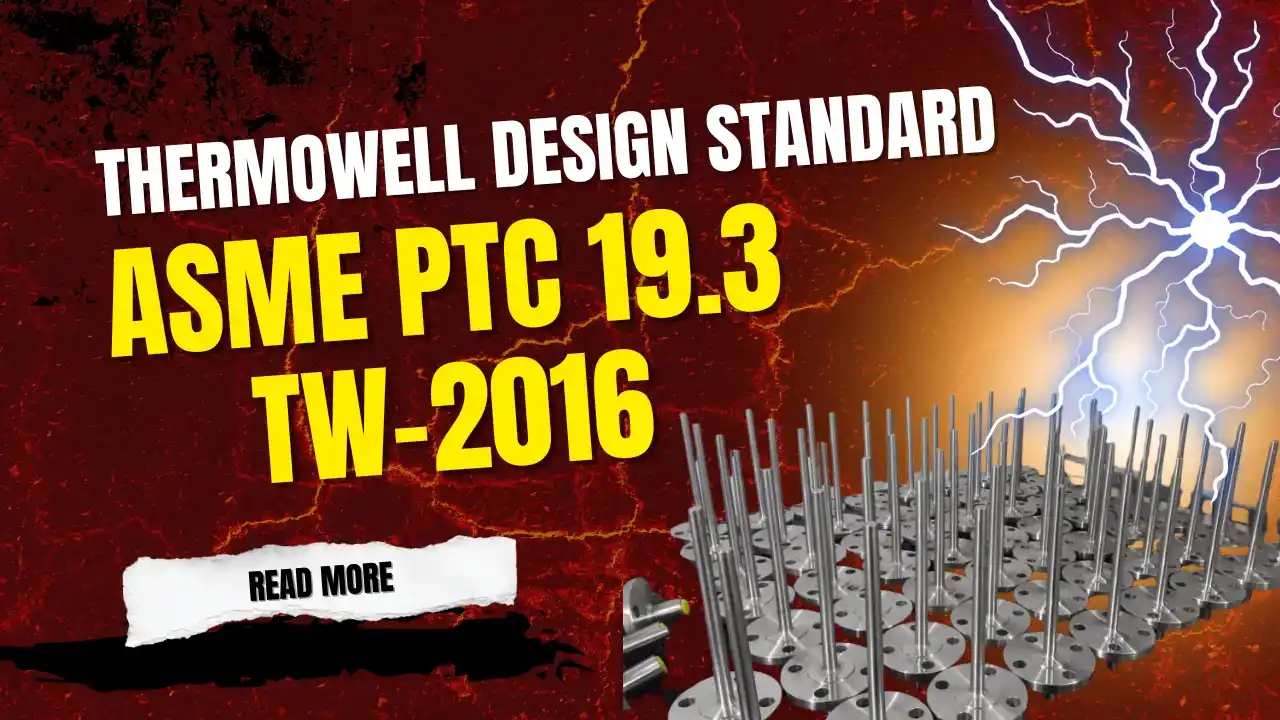
ToggleThermowell Design Standard ASME PTC 19.3 TW-2016 – Complete Guide for Engineers
Thermowells are very important components in temperature measurement systems.
In almost every process industry like oil and gas, chemical, power, or water treatment, you will find thermowells installed along with temperature sensors like RTDs or thermocouples.
A thermowell is a critical safety component. If a thermowell fails, it can lead to serious consequences such as leakage, equipment damage, or even plant shutdown.
That is why proper thermowell design is extremely important.
To ensure safety and reliability, industries follow a globally accepted standard called ASME PTC 19.3 TW-2016. This standard provides detailed guidelines for designing thermowells that can safely operate under real process conditions.
In this article, we will understand this standard in a simple and practical way.
What is ASME PTC 19.3 TW-2016
ASME PTC 19.3 TW-2016 is a design standard developed by the American Society of Mechanical Engineers.
It specifically focuses on the mechanical design of thermowells.
Earlier, thermowell failures were common because designs were based only on pressure and temperature. However, engineers later realized that flow-induced vibration is one of the biggest reasons for thermowell failure.
This standard was introduced to address that problem.
It provides guidelines to check whether a thermowell can safely withstand:
1. Fluid velocity
2. Vibration forces
3. Resonance conditions
4. Mechanical stress
In simple words, this standard helps engineers answer one important question:
Will this thermowell survive in the process line or not?
Why Thermowell Design is So Important
Many people underestimate thermowell design. But in real plants, it is one of the most critical aspects of instrumentation.
A poorly designed thermowell can fail due to vibration. When this happens, the broken thermowell may enter the pipeline and damage equipment like pumps or turbines.
In high-pressure systems, failure can even lead to process leakage.
That is why industries strictly follow ASME standards.
Proper thermowell design ensures:
1. Safe operation
2. Accurate temperature measurement
3. Long service life
4. Reduced maintenance
Main Objectives of ASME PTC 19.3 TW-2016
The standard focuses on making thermowells safe and reliable.
The first objective is safety. It ensures that thermowells do not fail under real process conditions.
The second objective is performance. A well-designed thermowell provides stable and accurate temperature readings without excessive vibration.
The third objective is standardization. It creates a uniform design approach so that all engineers follow the same method.
This helps avoid confusion and ensures consistency across projects.
Scope of the Standard
ASME PTC 19.3 TW-2016 covers complete thermowell design from start to finish.
It includes material selection. The material must be strong enough to handle temperature, pressure, and corrosion.
It defines dimensional requirements. The size and shape of the thermowell must be accurate to avoid mechanical issues.
It provides testing methods. Engineers must verify the design using calculations and analysis.
It also gives installation guidelines. Even a good thermowell can fail if installed incorrectly.
Understanding Wake Frequency and Why It Matters
One of the most important concepts in thermowell design is wake frequency, also known as Strouhal frequency.
When fluid flows across a thermowell, it creates small vortices behind it. These vortices generate forces that act on the thermowell in a repeating pattern.
This repeating force is called wake frequency.
Now here is the important part.
Every thermowell has its own natural frequency. If the wake frequency becomes equal to the natural frequency, resonance occurs.
Resonance means very high vibration.
And high vibration means failure.
This is the main reason why thermowell calculations are done.
ASME PTC 19.3 TW-2016 ensures that the thermowell operates safely away from resonance conditions.
Frequency Ratio and Safe Design
In thermowell design, engineers calculate something called the frequency ratio.
It is the ratio between wake frequency and natural frequency.
If this ratio is too high, the thermowell may enter resonance.
The standard provides limits to keep the design safe.
In simple terms:
1. Lower ratio means safer design
2. Higher ratio means higher risk
Engineers always try to keep this ratio within safe limits defined by the standard.
Types of Thermowell Designs
Thermowell shape plays a big role in its performance.
The straight thermowell has the same diameter throughout its length. It is simple and low-cost, but not suitable for high velocity applications.
The tapered thermowell has a reduced diameter towards the tip. This design is stronger and offers better resistance to vibration. It is the most commonly used design in industries.
The stepped thermowell has two different diameters. It provides faster response time and is used in specific applications.
In most high-velocity or critical services, engineers prefer tapered thermowells because they are more reliable.
Material Selection in Thermowell Design
Material selection is another key factor.
The thermowell must withstand:
1. High temperature
2. High pressure
3. Corrosive fluids
Common materials used include:
1. Stainless steel
2. Inconel
3. Monel
4. Hastelloy
The selection depends on the process conditions.
For example, in chemical plants, corrosion resistance is very important. In power plants, high temperature strength is more critical.
Mechanical Strength and Vibration Resistance
Thermowells are exposed to continuous fluid flow. This creates forces on the surface of the thermowell.
If the design is weak, it can bend or break.
ASME PTC 19.3 TW-2016 includes detailed calculations to check:
1. Bending stress
2. Fatigue stress
3. Vibration limits
These checks ensure that the thermowell remains stable during operation.
Testing and Validation
Design alone is not enough. It must be validated.
The standard includes various testing methods such as:
1. Pressure testing
2. Vibration analysis
3. Fatigue analysis
These tests confirm that the thermowell can perform safely in actual conditions.
Practical Applications in Industries
Thermowells designed as per ASME PTC 19.3 TW-2016 are used in almost all major industries.
In oil and gas, thermowells are exposed to high pressure and high velocity fluids. Proper design ensures safety and reliability.
In chemical plants, aggressive chemicals can damage materials. The standard helps in selecting the right material.
In power plants, accurate temperature measurement is essential for efficiency. A stable thermowell ensures correct readings.
In all these industries, thermowell failure is not acceptable. That is why strict adherence to standards is followed.
Installation Best Practices
Even the best design can fail if installation is wrong.
Proper insertion length is important. Too long length increases vibration risk.
Correct orientation also matters. In many cases, thermowells are installed perpendicular to flow.
Proper flange tightening and sealing must be ensured.
Following installation guidelines helps in achieving long life and stable performance.
Installation Guidelines for Thermowells
Proper installation of a thermowell is equally important as its design. Even a thermowell designed as per American Society of Mechanical Engineers standards can fail if installation is not done correctly.
In real plants, many failures are due to poor installation rather than design issues.
Insertion Length Selection
The thermowell should be inserted deep enough into the process fluid to measure the correct temperature. However, too long insertion increases vibration risk. Always balance accuracy and mechanical safety.
Correct Location in Pipeline
Avoid installing thermowells near elbows, valves, or reducers. These areas create turbulence and high vibration. Always prefer a straight pipe section with stable flow.
Proper Orientation
Thermowells are generally installed perpendicular to flow for better heat transfer. In high-velocity lines, angled installation may be considered to reduce vibration impact.
Mechanical Support and Strength
Long thermowells without support are more prone to vibration. In such cases, use tapered design or reduce insertion length.
Flange and Thread Installation
Ensure proper alignment during flange mounting and tighten bolts evenly. For threaded thermowells, avoid over-tightening to prevent damage.
Leak-Proof Sealing
Always use correct gasket or sealing method. Leakage at thermowell connection can lead to serious safety issues in high-pressure services.
Inspection and Maintenance
Regularly check for vibration, corrosion, or loosening. Early detection helps avoid unexpected failures.
Industry Insight
In projects, thermowell design is taken very seriously.
Most EPC companies do not approve a thermowell without proper calculation as per ASME PTC 19.3 TW-2016.
Many companies also require calculation reports before installation.
This shows how important this standard is in today’s industry.
FAQs
What is ASME PTC 19.3 TW-2016 used for?
It is used for designing thermowells to ensure they can safely withstand process conditions like flow, pressure, and vibration.
Why do thermowells fail in industries?
Most failures happen due to vibration and resonance caused by fluid flow.
Which thermowell design is best?
Tapered thermowells are generally preferred because they provide better strength and vibration resistance.
What is wake frequency in thermowell?
It is the vibration force created by fluid flow around the thermowell.
Why is frequency ratio important?
It helps determine whether the thermowell will operate safely without entering resonance.
Where is this standard commonly used?
It is widely used in oil and gas, chemical, power, and process industries.
What we learn today?
Thermowells may look simple, but their design is highly critical.
The introduction of ASME PTC 19.3 TW-2016 has significantly improved thermowell safety and reliability.
By focusing on vibration, wake frequency, and mechanical strength, this standard ensures that thermowells can safely operate in demanding process conditions.
For instrumentation engineers, understanding this standard is very important. It not only improves design knowledge but also helps in selecting the right thermowell for the right application.
In modern industries, following proper thermowell design practices is recommended.


I hope you like above blog. There is no cost associated in sharing the article in your social media. Thanks for Reading !! Happy Learning