
Table of Contents
TogglePressure Gauge and Pressure Transmitter: Introduction
If you are working in industrial instrumentation, one of the most common and important questions is:
What is the Difference between Pressure Gauge and Pressure Transmitter?
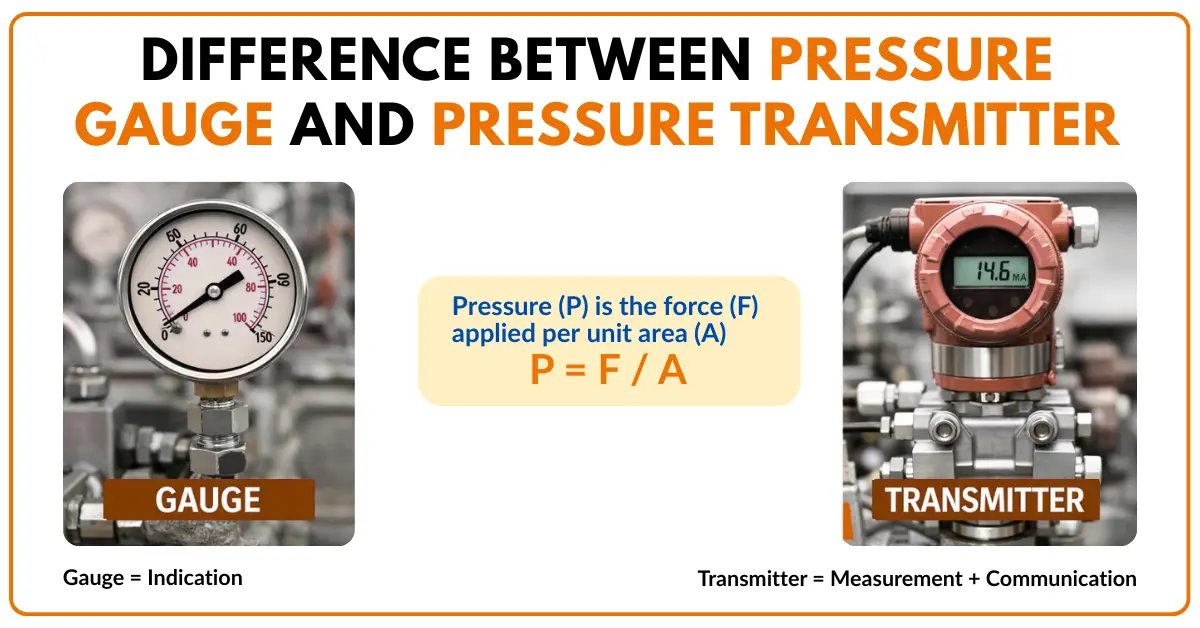
Many beginners think both instruments do the same job because both measure pressure. However, the Difference between Pressure Gauge and Pressure Transmitter goes far beyond simple measurement.
Understanding the Difference between Pressure Gauge and Pressure Transmitter is essential for:
Proper instrument selection
Designing automation systems
Improving plant safety
Ensuring accurate process control
In this article, we will explain the Difference between Pressure Gauge and Pressure Transmitter with practical industrial examples.
What is Pressure in Industrial Systems?
Before understanding the Difference between Pressure Gauge and Pressure Transmitter, we must understand pressure itself.
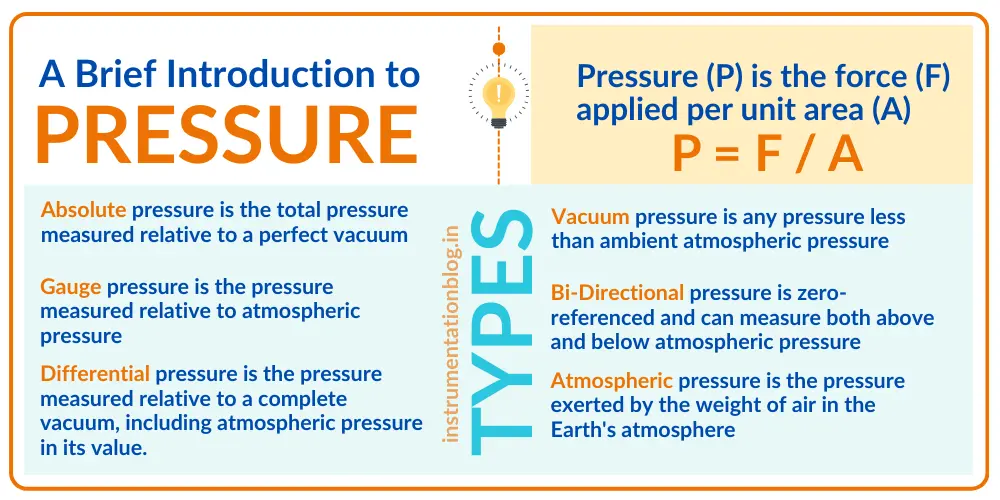
Pressure is the force exerted by a liquid or gas per unit area. In industries, pressure is measured in:
- Bar
- PSI
- kPa
- MPa
Pressure measurement is critical in:
- Oil & Gas plants
- Water treatment systems
- Boilers and steam lines
- Chemical reactors
- Hydraulic systems
Without accurate pressure monitoring, equipment can fail and safety risks increase.
What is a Pressure Gauge?
A Pressure Gauge is a mechanical device used to display pressure locally.
It works using a Bourdon tube or similar mechanical sensing element. When pressure enters the gauge, the sensing element deforms. This movement rotates a needle over a calibrated dial.
A Pressure Gauge:
Shows pressure locally
Does not require power
Does not send signals to a control room
Is mainly used for visual monitoring
The key role of a Pressure Gauge is indication only.
When discussing the Difference between Pressure Gauge and Pressure Transmitter, this “local indication” aspect is very important.
What is a Pressure Transmitter?
A Pressure Transmitter is an electronic instrument that measures pressure and converts it into an electrical signal.
Most commonly, the output is 4–20 mA. It can also be:
- HART
- Modbus
- Digital protocol
A Pressure Transmitter:
Sends signals to PLC or DCS
Allows remote monitoring
Enables alarms and interlocks
Supports automation
The main Difference between Pressure Gauge and Pressure Transmitter is that a transmitter does not just show pressure — it communicates pressure data.
Major Difference Between Pressure Gauge and Pressure Transmitter
Let us clearly define the Difference between Pressure Gauge and Pressure Transmitter in practical terms.
A Pressure Gauge is for local indication.
A Pressure Transmitter is for measurement plus signal transmission.
But there are deeper technical differences.
Output Signal
Pressure Gauge provides visual output only.
Pressure Transmitter provides electrical output such as 4–20 mA.
This output difference is the core Difference between Pressure Gauge and Pressure Transmitter.
Automation Capability
Pressure Gauge cannot be connected to PLC.
Pressure Transmitter integrates fully into control systems.
Modern automated plants rely heavily on transmitters.
Accuracy and Stability
Pressure Transmitters generally provide higher accuracy and better long-term stability.
Pressure Gauges are suitable for general monitoring but not for tight process control.
Remote Monitoring
With a Pressure Gauge, someone must physically go and read it.
With a Pressure Transmitter, pressure can be monitored from the control room.
This operational difference strongly defines the Difference between Pressure Gauge and Pressure Transmitter.
Industrial Example for Better Understanding
Imagine a steam boiler.
If you install only a Pressure Gauge:
An operator must constantly check pressure manually.
If pressure rises suddenly, human reaction time is required.
If you install a Pressure Transmitter:
Pressure is continuously monitored.
High-pressure alarm activates automatically.
Safety valve can open automatically.
Boiler trip system can activate.
This real-world example clearly shows the Difference between Pressure Gauge and Pressure Transmitter.
Comparison Table for Quick Reference
| Parameter | Pressure Gauge | Pressure Transmitter |
|---|---|---|
| Type | Mechanical | Electronic |
| Output | Dial Indication | 4–20 mA / Digital |
| Automation | No | Yes |
| Power Supply | Not Required | Required |
| Data Logging | Not Possible | Possible |
| Remote Access | No | Yes |
| Accuracy | Moderate | High |
This table simplifies the Difference between Pressure Gauge and Pressure Transmitter for quick understanding.
Can Pressure Gauge and Pressure Transmitter Be Installed Together?
Yes, and this is common practice.
Many industries install both instruments at the same tapping point.
Why?
Because the Difference between Pressure Gauge and Pressure Transmitter means they complement each other.
The gauge gives local backup reading.
The transmitter provides system data.
This combination improves reliability and troubleshooting efficiency.
When Should You Choose a Pressure Gauge?
Choose a Pressure Gauge when:
- Process does not require automation
- Budget is limited
- Local monitoring is sufficient
- Environment is non-critical
Typical applications include:
- Air compressors
- Hydraulic units
- Water pumps
- Utility lines
When Should You Choose a Pressure Transmitter?
Choose a Pressure Transmitter when:
- Automation is required
- Remote monitoring is needed
- Safety interlocks are involved
- High accuracy is critical
- Data recording is required
Industries such as oil & gas, power plants, and chemical plants depend heavily on transmitters
Frequently Asked Questions (FAQs)
What is the main difference between Pressure Gauge and Pressure Transmitter?
The main Difference between Pressure Gauge and Pressure Transmitter is that a Pressure Gauge provides a local visual indication of pressure, while a Pressure Transmitter converts pressure into an electrical signal (usually 4–20 mA) and sends it to a control system for remote monitoring and automation.
Can a Pressure Gauge replace a Pressure Transmitter?
No, a Pressure Gauge cannot replace a Pressure Transmitter in automated systems. A Pressure Gauge only displays pressure locally and cannot transmit signals to PLC or DCS systems. If automation, alarms, or data logging are required, a Pressure Transmitter is necessary.
Why do industries use both Pressure Gauge and Pressure Transmitter together?
Industries often install both because the Difference between Pressure Gauge and Pressure Transmitter means they serve different purposes. The Pressure Gauge provides local backup indication, while the Pressure Transmitter feeds real-time data to the control system for monitoring and safety.
Which is more accurate: Pressure Gauge or Pressure Transmitter?
Generally, a Pressure Transmitter is more accurate than a Pressure Gauge. Transmitters use electronic signal processing and temperature compensation, which improves precision and stability. Pressure Gauges are suitable for general monitoring but not for highly critical control applications.
Does a Pressure Gauge require power supply?
No, a Pressure Gauge does not require power supply because it operates using mechanical components like a Bourdon tube. In contrast, a Pressure Transmitter requires electrical power to generate and transmit output signals.
What signal does a Pressure Transmitter send?
A Pressure Transmitter typically sends a 4–20 mA analog signal. Some advanced transmitters also support digital communication protocols such as HART, Modbus, or Fieldbus for advanced diagnostics and remote configuration.
When should I choose a Pressure Transmitter instead of a Pressure Gauge?
You should choose a Pressure Transmitter when your process requires remote monitoring, automatic control, safety interlocks, data logging, or high measurement accuracy. If only local indication is required and automation is not needed, a Pressure Gauge is sufficient.
What we learn today?
The Difference between Pressure Gauge and Pressure Transmitter is fundamentally about function and system integration.
A Pressure Gauge shows pressure to a human.
A Pressure Transmitter sends pressure data to a control system.
Understanding the Difference between Pressure Gauge and Pressure Transmitter ensures correct instrument selection, safer processes, and better automation performance.
If you are a student or technician, remember this clearly:
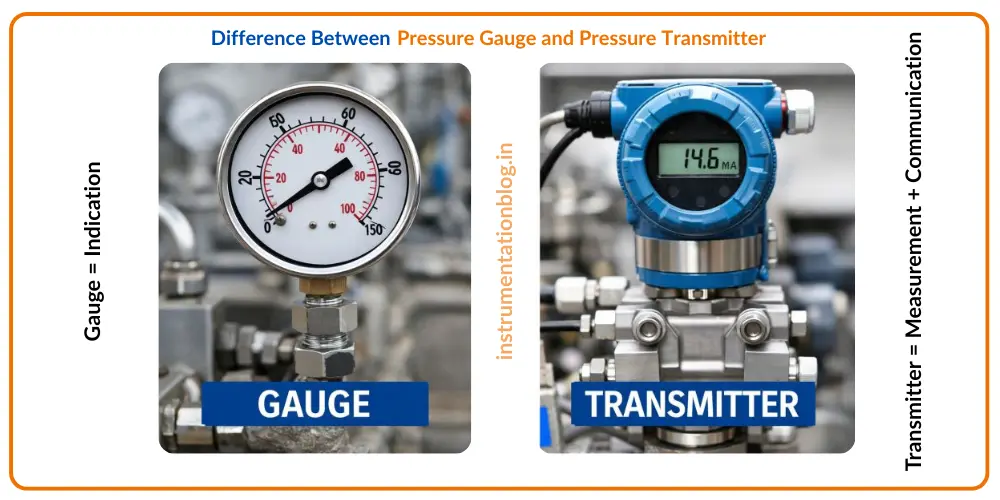
- Gauge = Indication
- Transmitter = Measurement + Communication
That simple rule will always help you understand the Difference between Pressure Gauge and Pressure Transmitter.


I hope you like above blog. There is no cost associated in sharing the article in your social media. Thanks for Reading !! Happy Learning