
Table of Contents
TogglePoint to point connection and multidrop connection: Introduction
In industrial automation and instrumentation systems, how devices talk to each other is just as important as what they measure.
A pressure transmitter sending data to a PLC, a flow meter communicating with a SCADA system, or a temperature sensor connected to a data logger, all of these depend on the network configuration used for communication.
Two of the most common network configurations used in plants are point-to-point and multidrop (also called multipoint) networks.
Each configuration has its own advantages, limitations, wiring style, cost impact, and performance behavior. Selecting the wrong configuration can lead to unnecessary cabling cost, slow communication, troubleshooting difficulties, or future expansion problems.
Let us first understand what these two configurations mean.
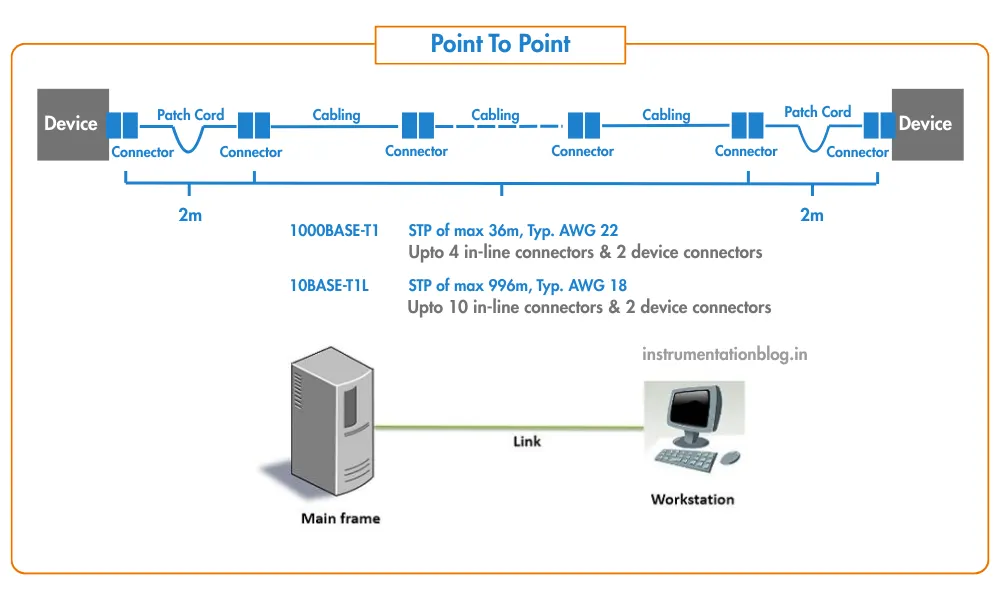
Point to point connection and multidrop connections represent two common ways devices communicate within a network. In point to point communication, a dedicated link exists between only two devices, one acts as the sender and the other as the receiver. The communication path is exclusive and not shared with any other device.
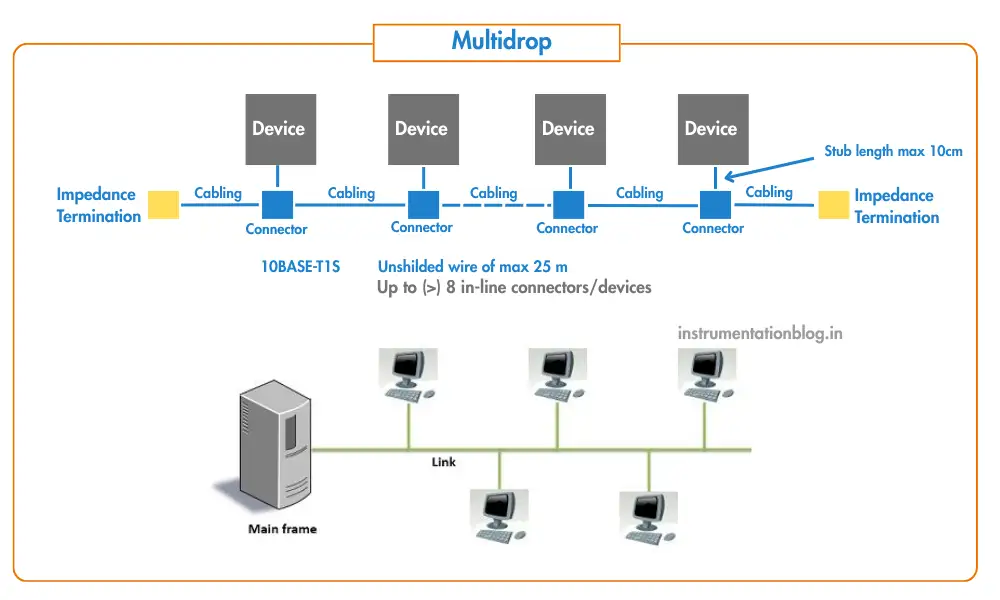
A multidrop configuration allows one sender to communicate with multiple receivers using a shared communication link. Several devices operate on the same network line, and data is exchanged based on addressing and communication rules.
The Definition of a Point to Point Connection
A point-to-point connection describes a communication setup where two devices are connected directly through a single dedicated link. In point to point communication, one device sends data and the other device receives it, without sharing the communication channel with any additional devices. The entire bandwidth of the link is used only by this pair, which ensures stable and predictable data transmission.
To understand this clearly:
Only two devices are connected on the same communication link.
The link is dedicated and not shared with any other device.
The full channel capacity is available exclusively for this communication path.
Data transfer remains stable because there is no competition for bandwidth.
Point to point communication is commonly used when direct and reliable data exchange is required between two nodes. A simple everyday example is a telephone call, where one caller communicates directly with another without any third party sharing the line. In industrial and telecommunication systems, these connections are implemented using circuit switching methods or modern fiber networks that support high-speed data transmission.
In practical network layouts, data packets may still pass through intermediate devices such as switches or routers before reaching the final receiver. In such cases:
The communication path may include multiple network segments.
Link lengths can vary depending on routing.
Selecting the shortest and most efficient path improves response time and reduces delay.
The Definition of MultiPoint (Multidrop) Connection Communication
A multipoint connection refers to a communication method where more than two devices share a single communication link. Instead of having a dedicated line for each device, all connected devices use the same channel to exchange data. Because the link is shared, the available bandwidth is used by each device for a limited time based on communication scheduling.
To understand this clearly:
Multiple devices are connected to one common communication line.
The total channel capacity is shared among all connected devices.
Devices access the link one after another, often using time-based communication rules.
Efficient coordination is required to avoid data collision and communication delays.
In a broadcast-type network, when a sender transmits a data packet, every device on the link receives the packet. Each device checks the address field inside the packet to determine whether the data belongs to it.
This process typically works as follows:
The sender broadcasts the data packet on the network.
All connected devices receive the same packet.
Each device compares the destination address with its own address.
Only the intended receiver accepts and processes the data.
All other devices ignore the packet.
Multipoint connections are widely used in point-to-multipoint communication systems and are commonly seen in applications such as wireless internet networks, IP telephony systems, and industrial multidrop field networks.
Typical network structure
For data transmission speeds ranging from 10 Mbit/s up to 10 Gbit/s, a point to point communication link is commonly used. This type of connection provides a dedicated channel between two devices, allowing stable high-speed data transfer without interference from other nodes.
In many industrial Ethernet applications, these point-to-point links can also support remote device power using Power over Data Line (PoDL) as defined in the IEEE 802.3bu standard. This allows both data and power to be transmitted over the same cable, which simplifies wiring and reduces installation cost in field applications.
The IEEE 802.3cg standard introduces 10BASE-T1S, a physical layer that can operate in two different modes:
It can function as a point to point communication link with a minimum reach of approximately 15 meters between two devices.
It can also operate as a multidrop segment, where one network line is shared by multiple devices, similar to a classical bus system.
When operating in multidrop mode, the network typically supports:
A minimum cable length of around 25 meters.
At least 8 connected nodes on the same segment.
However, one limitation of 10BASE-T1S is that it does not support PoDL, meaning remote powering over the same data line is not available for this configuration.
Point to Point Communication vs Multipoint Communication
| S. No. | Point to Point Communication | Multipoint Communication |
|---|---|---|
| 1 | Point to point communication uses a communication channel shared only between two devices. | Multipoint communication uses a single channel shared among multiple devices or nodes. |
| 2 | A dedicated physical or logical link exists between the two connected devices. | The same communication link is shared by all connected devices at all times. |
| 3 | The full bandwidth is reserved for only two devices, which may sometimes lead to unused capacity. | Bandwidth is shared dynamically, allowing better overall utilization of network resources. |
| 4 | There is exactly one transmitter and one receiver in the communication path. | One transmitter can communicate with multiple receivers on the same network. |
| 5 | Shortest path and direct routing are important to achieve faster and reliable data delivery. | Distance optimization is less critical because multiple devices share the same bus or segment. |
| 6 | Provides better security and privacy because the communication channel is not shared. | Offers lower inherent security since the communication channel is shared by multiple devices. |
What we learn today?
Remember that in point to point communication, there is always one transmitter connected to one receiver through a dedicated link, while in multipoint communication, a single transmitter communicates with multiple receivers on a shared network.
Both communication methods have their own strengths and limitations depending on how the system is designed and operated.
In real industrial and networking applications, the correct choice depends on factors such as network size, number of connected devices, required data speed, acceptable latency, installation cost, and future expansion needs.
A clear understanding of how point to point communication differs from multipoint communication helps engineers and system designers build networks that deliver reliable performance, efficient data flow, and long-term scalability.


I hope you like above blog. There is no cost associated in sharing the article in your social media. Thanks for Reading !! Happy Learning