When pipelines carry steam or other high-temperature fluids, something very important happens, the pipe metal expands.
In industrial systems, thermal expansion can create serious mechanical problems if it is not properly managed.
For example, consider a 30-meter carbon steel steam line operating at 300 °C. That pipe can expand by several centimeters.
Now imagine that pipeline is rigidly fixed between two anchors with no flexibility.
Where does that expansion go?
It turns into stress.
And stress in piping systems leads to:
Weld failure
Flange leakage
Pipe buckling
Equipment nozzle overload
Long-term fatigue damage
This is why expansion loops are not optional in high-temperature piping they are a critical design necessity.
Let us understand this in a simple and practical way.
What Is Thermal Expansion in Piping?
When temperature increases, materials expand. This is basic physics.
For carbon steel pipelines used in steam systems, the coefficient of thermal expansion is roughly:
≈ 12 × 10⁻⁶ / °C
That means every meter of pipe grows in length when heated.
In long steam distribution systems, this expansion becomes significant.
For example:
A 30-meter pipe heated from 30 °C to 300 °C:
ΔT = 270 °C
That expansion can be several centimeters enough to cause serious mechanical stress if restrained.
And here is the key principle:
Pipes do not fail because they expand. They fail because expansion is restrained.
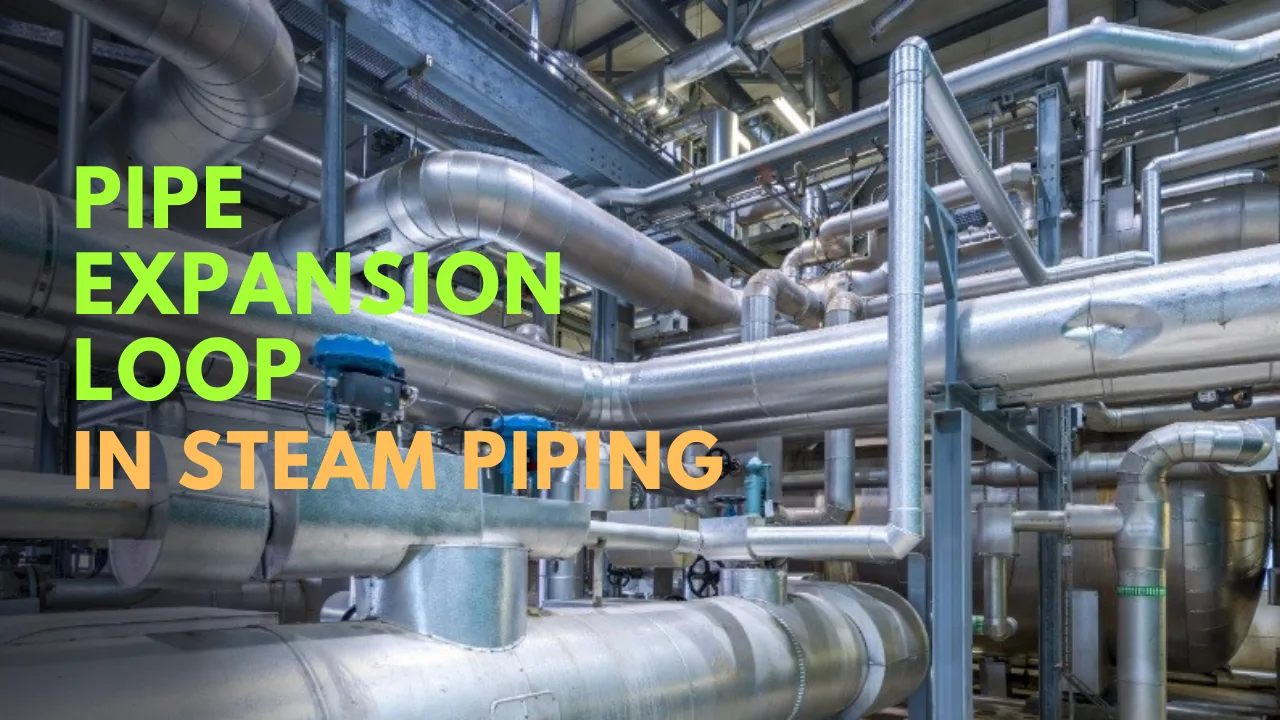
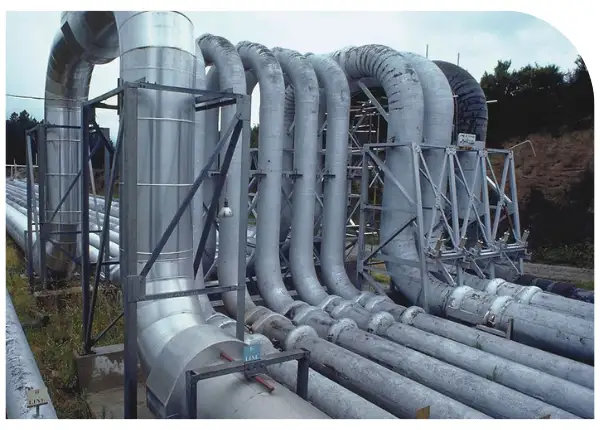
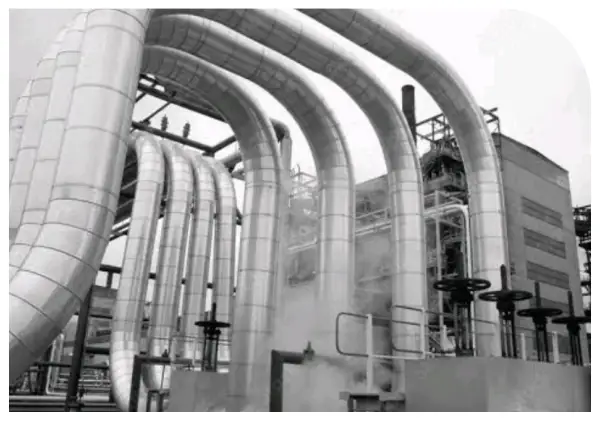
An expansion loop is typically fabricated using straight pipe sections connected with elbows, all welded together to form a U-shaped or rectangular configuration.
There are no special moving parts. No mechanical devices. Just smart geometry.
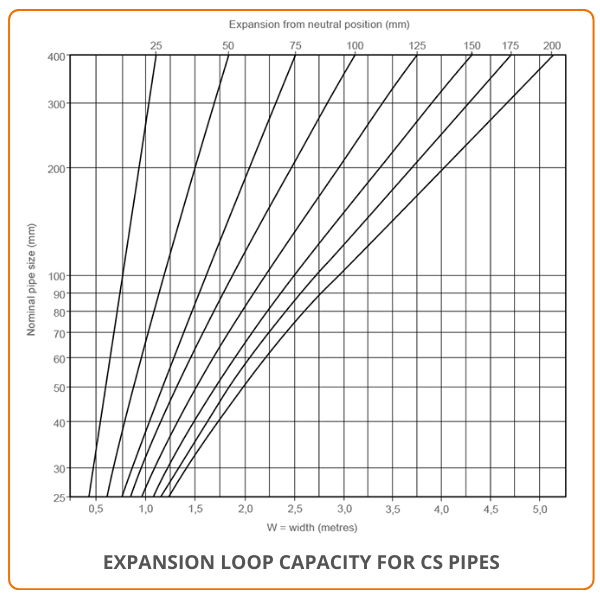
The amount of expansion that the loop can absorb depends on its dimensions.
In general design practice:
The depth of the loop is kept approximately twice its width.
And the width is determined based on the total thermal expansion expected from the pipe sections on both sides of the loop.
In simple words:
More expansion → Larger loop width → Greater flexibility.
Proper sizing ensures that the loop can safely absorb thermal growth without overstressing the piping system.
What Happens If Thermal Expansion Is Restrained?
If a pipe is locked between rigid supports or anchors, it cannot move freely.
So instead of expanding in length, it develops compressive stress.
This stress can:
Exceed allowable stress limits of the pipe material
Cause bending at elbows
Crack weld joints
Create flange misalignment
Overload pump or turbine nozzles
Lead to long-term fatigue damage
In extreme cases, it can cause buckling where the pipe suddenly deforms sideways.
That is why high-temperature piping systems must always include flexibility in design.
What Is a Pipe Expansion Loop?
An expansion loop is a simple geometric modification in a pipeline that provides flexibility.
Instead of running the pipe in a straight rigid line, engineers introduce a U-shaped or rectangular loop.
This loop behaves like a spring.
When the pipe expands:
The loop deflects slightly
Stress is absorbed in bending
Forces are reduced at anchors and equipment
When the system cools:
The pipe contracts
The loop returns to its original shape
Simple design. Powerful effect.
Why Thermal Expansion Must Be Managed
Below are the main reasons thermal expansion control is critical in steam systems.
1. Hot Fluids Increase Pipe Length
Steam at high temperature causes significant pipe growth. Long pipelines amplify this effect.
2. Restrained Expansion Generates High Compressive Stress
If expansion is blocked, stress builds internally. This stress can reach dangerous levels.
3. Stress Can Exceed Allowable Limits
Piping materials have maximum allowable stress values defined by codes such as ASME B31. Exceeding them reduces mechanical integrity.
4. Repeated Expansion and Contraction Causes Fatigue
Steam systems start and stop. Every heat-up and cool-down cycle creates expansion and contraction.
Over time, this leads to fatigue cracking at welds and elbows.
Managing expansion is not just about one event but it is about long-term reliability.
Key Functions of an Expansion Loop
1. Absorbs Thermal Movement
The loop allows controlled deflection during heating and cooling cycles.
2. Reduces Stress on Piping System
It protects:
Weld joints
Flanges
Elbows
Pipe supports
3. Prevents Buckling and Deformation
Without flexibility, pipes may bend or twist. Loops prevent structural instability.
4. Protects Connected Equipment
Pumps, turbines, boilers, and heat exchangers have allowable nozzle load limits.
Expansion loops reduce transmitted forces and protect equipment.
5. Improves Safety and Reliability
Less stress means:
Fewer leaks
Fewer shutdowns
Lower maintenance cost
Longer service life
A simple loop can prevent a major failure.
Why Expansion Loops Are Preferred Over Rigid Piping
Straight piping resists movement.
When expansion occurs in a rigid system, the stress travels throughout the entire pipeline network.
Expansion loops localize flexibility.
Instead of transmitting force to equipment or anchors, the movement is absorbed inside the loop section.
This makes the system:
Mechanically stable
Code compliant
Safer during operation
Where Expansion Loops Are Commonly Used
Expansion loops are widely used in industries where high temperature fluids are handled.
1. Steam Distribution Systems
Boilers to process areas, turbine lines, condensate return systems.
2. Hot Oil and Thermal Fluid Pipelines
Used in heating systems where temperatures are extremely high.
3. Refineries and Petrochemical Plants
Crude heaters, reactors, process transfer lines.
4. Power Generation Facilities
Main steam lines and reheater lines.
5. District Heating Networks
Long above-ground pipelines serving multiple buildings.
6. Long Above-Ground Pipelines
Thermal movement is more pronounced in exposed pipelines.
In underground systems, soil friction can restrict movement — making design even more critical.
Design Considerations Engineers Evaluate
Designing an expansion loop is not random. Engineers carefully evaluate several parameters.
1. Operating Temperature and Thermal Growth
The higher the temperature difference, the greater the expansion.
Thermal growth must be calculated accurately.
2. Pipe Material and Allowable Stress
Different materials have different expansion coefficients and stress limits.
Carbon steel behaves differently from stainless steel.
3. Available Space and Routing Constraints
Loops require physical space. Plant layout must accommodate them.
4. Support Spacing and Anchor Locations
Proper anchors and guides are essential.
Without correct support design, loops will not function as intended.
5. Compliance with Piping Codes
Design must follow applicable codes such as:
ASME B31.1 (Power Piping)
ASME B31.3 (Process Piping)
Code compliance ensures stress remains within safe limits.
How much does steel expand when heated?
Steel expands when temperature rises.
This is not a defect. It is basic material science.
Every steam pipe grows in length as it gets hotter.
The amount of expansion depends on three things:
Original pipe length
Temperature increase
Material’s linear expansion coefficient
We calculate this using:
ΔL = L₀ × α × ΔT
Where:
ΔL = Change in length L₀ = Original length α = Linear expansion coefficient ΔT = Temperature rise
For example:
A 100-inch steel rod exposed to a 5°F increase will expand by approximately 0.0036 inches (using α ≈ 7.2 × 10⁻⁶ in/in°F).
That number looks small.
But now imagine:
30 meters of steam line and 250–300 °C operating temperature
Suddenly, the expansion becomes several millimeters or even centimeters.
And in piping systems, even a few millimeters of restrained movement can generate very high stress.
That is why thermal expansion is never ignored in high-temperature piping design.
What we learn today?
At first glance, an expansion loop may look like unnecessary extra piping.
But in reality, it is a critical mechanical safety feature.
Without expansion control:
Pipes crack
Welds fail
Equipment gets overloaded
Plants shut down
With proper expansion loop design:
Stress is absorbed safely
Mechanical integrity improves
Reliability increases
Service life extends
In high-temperature process systems, managing thermal expansion is important engineering.
I hope you like above blog. There is no cost associated in sharing the article in your social media. Thanks for Reading !! Happy Learning