
Table of Contents
ToggleNegative Pressure in Pipelines
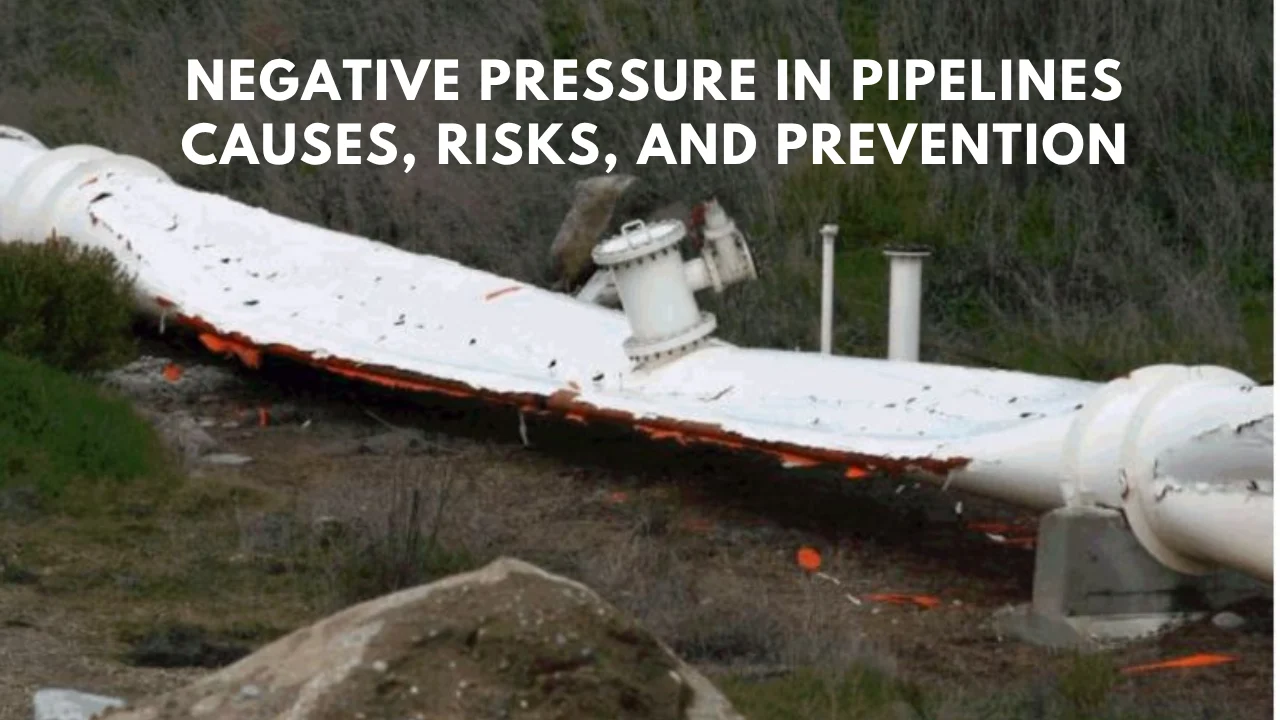
If you have ever seen a thin plastic bottle “crush” inward when the air is removed, you already understand the basic danger of negative pressure in pipelines.
When pressure inside a closed pipe becomes lower than atmospheric pressure, the outside pressure starts pushing inward.
In a strong steel pipe, that inward push may only cause small distortion. In a thin wall pipe, duct line, or ageing pipeline, it can cause buckling, deformation, or even collapse.
Most people often assume pipelines fail only due to “high pressure.” In real plants, vacuum conditions can be just as damaging but sometimes even more sudden because the pipe is being squeezed from outside rather than supported from inside.
What negative pressure actually means
Negative pressure in pipelines means the pressure inside the pipe drops below atmospheric pressure (sub‑atmospheric).
In many engineering articles, this is also described as vacuum pressure.
This condition can show up:
1. at a high point in the line,
2. near a pump suction,
3. during draining,
4. during sudden shutdown/startup events.
Why it matters (the part engineers cannot ignore)
When negative pressure occurs, several practical problems can follow:
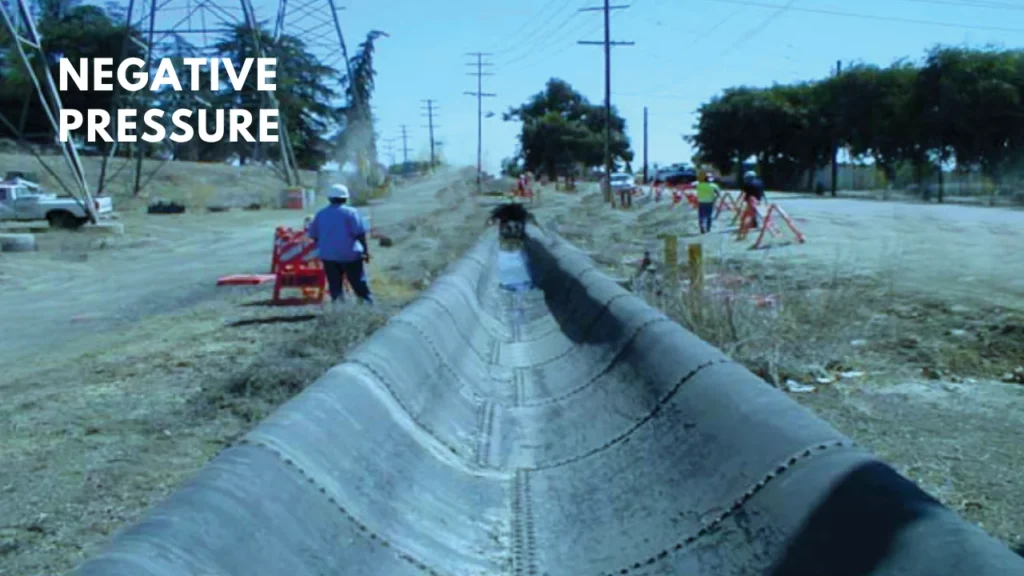
1. Pipe collapse or deformation (especially in thin‑walled pipelines, plastic pipes, ducts, or old assets).
2. Equipment damage due to excessive suction forces and unstable flow conditions.
3. Ingress of air or even toxic gases/contaminants through joints, cracks, and weak points because the pipeline is “sucking” from outside.
4. Higher leakage risk and faster fatigue failure because the pipe wall experiences repeated positive and negative pressure cycles.
A small “vacuum event” that lasts seconds can still leave long‑term damage especially if it repeats again and again during daily operations.
Situations where negative pressure can develop
In practice, negative pressure in pipelines is commonly seen in these situations:
1. Vacuum‑feeding pipelines (systems designed to draw fluid using suction).
2. Steeply inclined pipelines where rapid free flow can pull the pressure down at higher points.
3. Extreme temperature changes of the transported liquid (cooling contraction in closed systems).
4. Sudden changes in velocity (valve closures, pump trip, rapid start/stop).
5. Sudden changes in pipe diameter (geometry changes can cause local pressure drops).
A special warning for buried and underwater pipelines: the external load is not only atmospheric pressure. Soil cover (buried) and hydrostatic seawater pressure (submarine) add extra external pressure, so vacuum conditions can become much more dangerous.
Causes in liquid transport pipelines
Liquid pipelines include water supply, drainage lines, and chemical transfer systems. Here are the most common causes of negative pressure in pipelines for liquids.
1. Excessive pump suction
This is one of the most common real‑world causes.
=> If a pump is oversized or operating at too high speed/head, it may draw liquid faster than the upstream side can supply. The pump inlet pressure drops and can become negative.
=> If there is inlet blockage or restriction (clogged strainer, partially closed suction valve), flow into the pump reduces, but the pump keeps pulling creating a rapid pressure drop.
Mini scenario:
A pump is running fine.
Then a filter slowly clogs.
The operator doesn’t notice immediately.
The pump still “tries” to pull the same flow, so the suction pressure drops.
That’s when abnormal noise, vibration, and unstable readings start.
2. Column separation, transient vacuum, and water hammer
This is where negative pressure becomes sudden and destructive.
During a transient event, the hydraulic grade line can drop to sub‑atmospheric or even full vacuum at some locations.
This can lead to water column separation (vapor pocket formation) and later violent collapse when pressures recover one of the worst water hammer events possible.
In simple words: the pipeline briefly forms a “gap” (vapor cavity). When flow reverses or pressure rises again, that gap collapses hard, producing damaging surges.
3. Draining and venting problems
Negative pressure often appears at high points when a line is drained.
If air cannot enter the pipe (air valve clogged, undersized, or absent), the emptying liquid creates a vacuum pocket.
4. Thermal contraction of liquids
Hot liquids contract when cooled. If a system is isolated (closed valves, no makeup line, no vacuum relief) and the liquid cools, internal pressure drops. That drop can become negative pressure in pipelines and may cause collapse in weaker sections.
Causes in gas transport pipelines
Gas pipelines include ventilation ducts, HVAC systems, and pneumatic conveying.
1. Fan‑induced suction
Fans create negative pressure at the inlet to pull air in. If fan capacity exceeds system intake capacity (blocked louvers, clogged filters), the inlet side can see excessive negative pressure and even duct deformation.
2. Temperature shrinkage in gas systems
Hot gas cools during transportation and its volume reduces. In closed systems without proper compensation, pressure can drop below atmospheric pressure and create vacuum conditions.
Causes that apply to all pipeline systems
Some reasons are common across both liquid and gas systems:
1. Elevation changes and high points: flow movement can pull pressure down at peaks if air management is poor.
2. Blockages and over‑restriction: debris, sediment, freezing, or wrong valve position can cause upstream pressure drop and local vacuum risk.
3. Incorrect sizing and abrupt geometry changes: changes in velocity and diameter can reduce static pressure and increase vacuum risk.
The core principle (the “one line” you should remember)
Here is the simplest way:
Negative pressure in pipelines happens when more fluid is leaving the system than entering it, and the system cannot “breathe” fast enough.
That word “breathe” is important. Pipelines need controlled air release and controlled air intake. Always remember this !
Prevention strategies
Prevention is not just one device but it’s a set of good habits in design + operation.
1. Choose equipment that matches the system
Oversized pumps and fans create unnecessary suction and pressure imbalance. Proper selection reduces the chance of vacuum at inlets.
2. Give the pipeline a way to “break the vacuum”
A vacuum breaker valve is designed to admit air into a pipeline when internal pressure drops below atmospheric pressure. This “breaks” the vacuum and helps prevent collapse and damage.
Also, air valves are not only for releasing trapped air. Their function of allowing air intake during negative pressure events is equally critical.
3. Control transient events
Sudden starts/stops create large pressure swings. Reducing the speed of change reduces both positive surges and negative dips. Water hammer and vapor pocket collapse can be especially destructive after column separation.
4. Keep lines clean and restrictions controlled
Clogged strainers, stuck valves, and sediment buildup are simple problems that cause big pressure drops especially at pump suction.
Common mistakes (teacher note)
These are patterns seen in real maintenance practices:
1. Installing air valves but not maintaining them (a stuck valve behaves like no valve).
2. Oversizing pumps “for safety margin” and later wondering why suction problems occur.
3. Draining lines without ensuring air entry at high points, leading to vacuum pockets.
4. Ignoring vacuum risk in buried/submarine lines where external pressure is higher.
Frequently Asked Questions (FAQs)
What is negative pressure in pipelines?
Negative pressure in pipelines occurs when the internal pressure drops below atmospheric pressure, creating vacuum conditions.
Can negative pressure collapse a pipeline?
Yes. Negative pressure can lead to pipe collapse or deformation, especially in thin‑walled or ageing pipes, because external pressure pushes inward.
What is the most common cause in water pipelines?
Common causes include excessive pump suction (oversized pump or suction restriction), draining without air intake, and transient events like pump trip that can lead to column separation and water hammer.
What is a vacuum breaker valve and why is it used?
A vacuum breaker valve admits air when pipeline pressure drops below atmospheric pressure. It breaks the vacuum and helps prevent collapse and damage.
Why are buried or underwater pipelines more vulnerable?
Because external pressure is higher: buried pipes face soil load and submarine pipes face hydrostatic water pressure, making vacuum damage risk more severe.
Are air valves only for releasing trapped air?
No. Air valves also help by admitting air during negative pressure events, which helps prevent vacuum formation and related damage.
What we learn today?
Negative pressure in pipelines is a practical problem that can collapse pipes, damage equipment, and invite contamination through leaks and joints.
Once you understand the core idea, outflow exceeds inflow and the pipeline can’t breathe you can spot the risk points quickly: pump suction, high points, steep slopes, draining operations, and temperature contraction.
Good venting, vacuum protection, proper equipment selection, and controlled operation are the real solutions.


I hope you like above blog. There is no cost associated in sharing the article in your social media. Thanks for Reading !! Happy Learning