
Table of Contents
ToggleIn automation and electronics, we often need to detect movement, position, speed, or current but without touching the object.
This is exactly where a Hall Effect Sensor becomes powerful.
It can sense a magnetic field and convert it into a usable electrical signal. No mechanical contact. No physical wear. Just clean and reliable detection.
From measuring motor speed to detecting shaft position, from proximity sensing to DC current measurement, Hall Effect Sensors are used everywhere especially in industrial automation, automotive systems, and electronic devices. Because of their simple construction and long life, they are a favorite choice for engineers.
In this article, we will understand the working principle of a Hall Effect Sensor step by step, along with practical industrial examples that every instrumentation student and technician should know.
How does Hall Effect Sensor Works?
The Hall Effect principle is named after a scientist called Edwin Hall. He discovered this effect in 1879 while doing experiments on electrical conductors.
What he found was very interesting.
1. What Did Edwin Hall Observe?
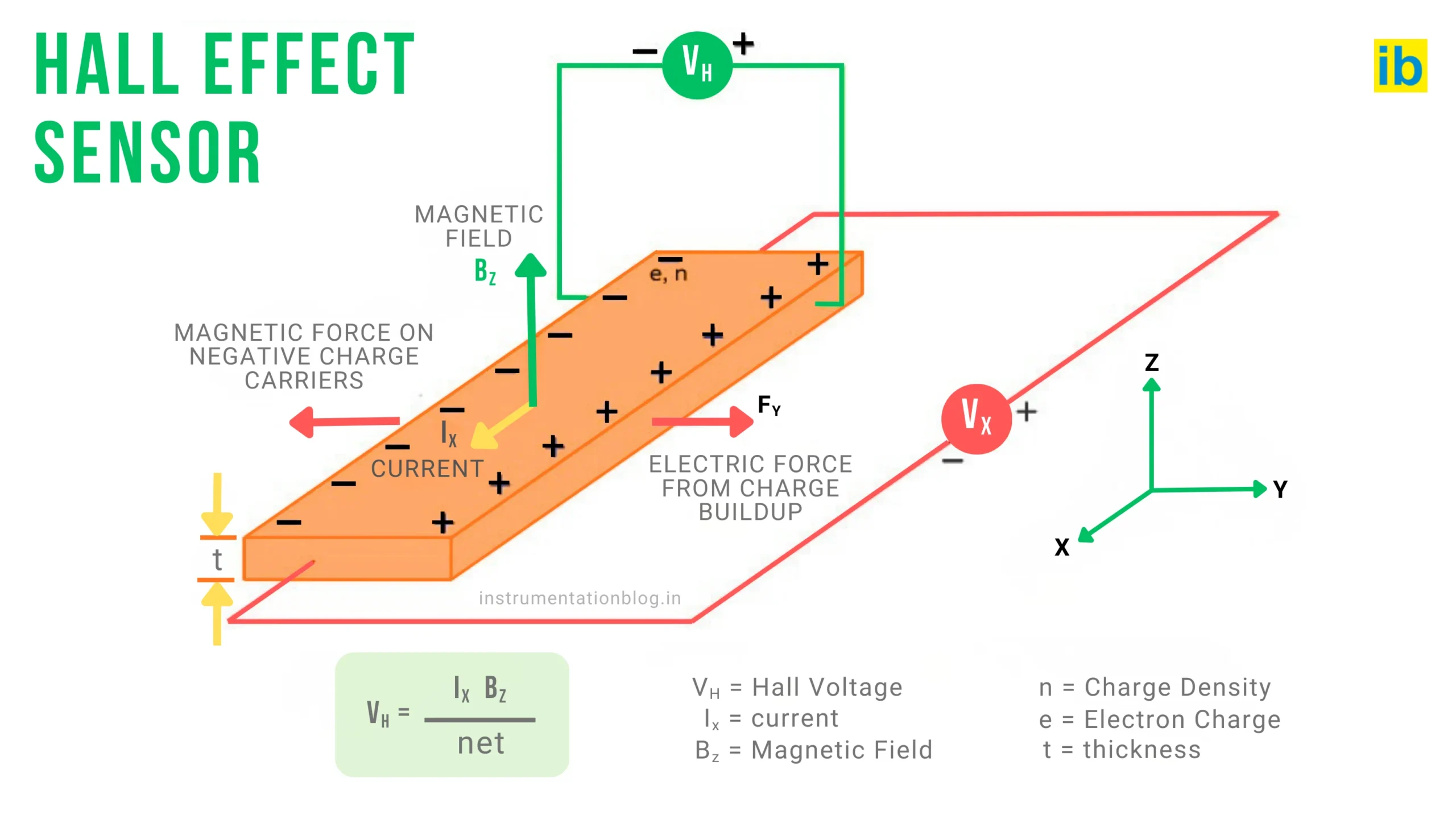
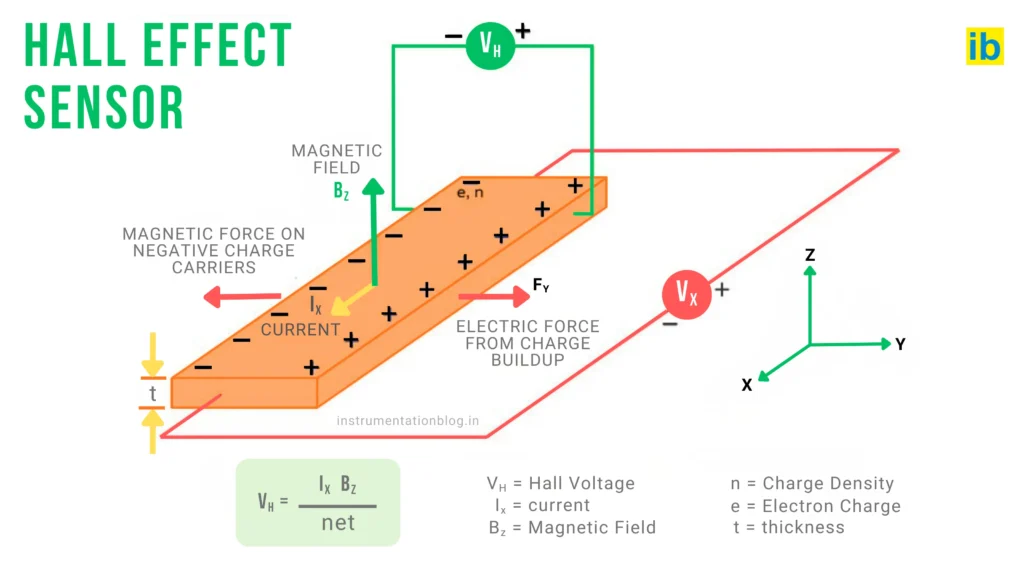
He noticed that when electric current was flowing through a conductor (or semiconductor), and a magnetic field was applied at 90° (perpendicular) to the current direction, a small voltage was generated on the sides of the material.
This voltage was not along the current direction.
It was at right angles to it.
This small voltage is called Hall Voltage.
2. Simple Example to Understand the Concept
At the time of his discovery, scientists compared electric current to water flowing inside a pipe.
Imagine water flowing straight inside a pipe.
Now imagine someone pushing the water from one side.
What will happen?
The water will shift and crowd toward the opposite side of the pipe.
Similarly, when current flows inside a conductor and a magnetic field is applied from the side, the moving electrons get pushed to one side of the material.
Because of this crowding of electrons, a voltage difference is created across the material.
That voltage is what we measure in a Hall Effect Sensor.
3. What Actually Happens Inside the Material?
Today, we understand the physics much better.
The Hall Effect happens because moving charged particles (like electrons) experience a force when both:
An electric field is present (due to current flow)
A magnetic field is applied
This force pushes the electrons sideways.
This sideways movement creates a measurable voltage.
Types of Hall Effect Sensors
Hall Effect Sensors are mainly classified into two broad categories: analog type and digital type. The difference between them is simple and very practical from an industrial point of view.
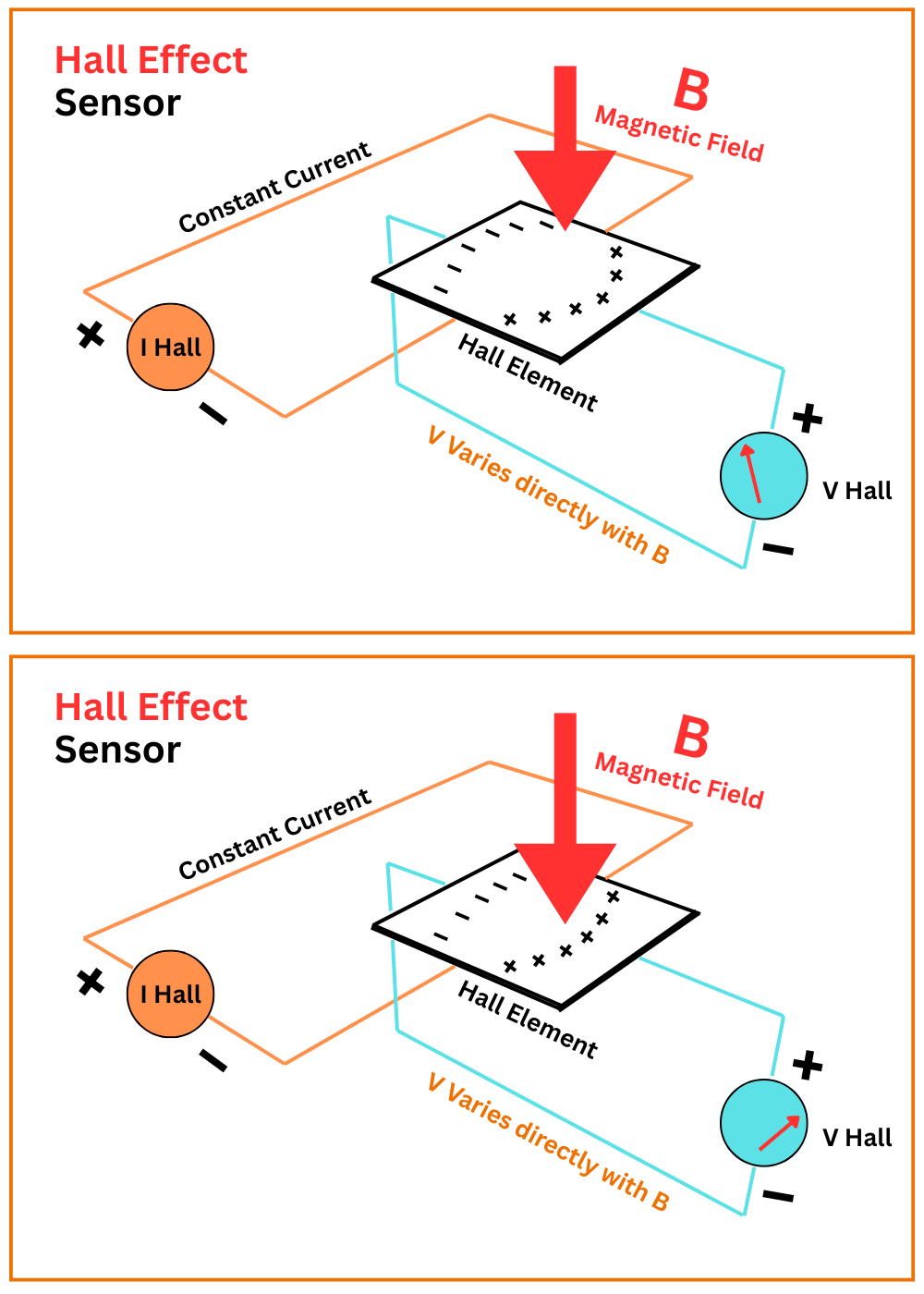
An analog Hall sensor produces a continuously varying output voltage. This means when the magnetic field strength changes, the output voltage also changes proportionally.
If the magnetic field increases, the output voltage increases or decreases accordingly depending on the design. These sensors are used where proportional measurement is required, such as magnetic field measurement, position sensing, and current monitoring.
A digital Hall sensor works like an electronic switch. It does not provide gradual variation. It gives only two output states: High or Low.
When the magnetic field crosses a predefined threshold level, the output changes state. Because of this behavior, digital Hall sensors are often called Hall switches. They are widely used in proximity detection, speed sensing, and counting applications.
Now let us understand the commonly used types in practical applications.
1) Vane-Operated Hall Sensors
Vane-operated sensors are digital proximity sensors. In this type of design, there are mainly two important components:
A permanent magnet
A Hall sensing element
These two components are placed facing each other with a small air gap between them.
When a ferrous metal vane passes through this gap, it disturbs the magnetic field between the magnet and the Hall element.
Due to this disturbance, the output of the Hall sensor changes. When the vane enters the gap, the output switches. When it leaves, the output returns to its original state.
This type of sensor is commonly used in timing systems, speed detection, and position sensing applications
2) Digital Current Hall Sensors
Digital current Hall sensors are designed to detect current flow in a conductor. Whenever current flows through a wire, it generates a magnetic field around it. The Hall sensing element detects this magnetic field.
In this setup, the important elements include:
The current-carrying conductor or electromagnet
The Hall sensing element placed nearby
When the magnetic field reaches a certain level, the output switches from low to high or vice versa.
These sensors are mainly used for overcurrent detection and protection circuits.
3) Linear Current Hall Sensors
Linear current sensors operate on the same magnetic principle, but the output is analog instead of digital.
Here the working is simple.
As current increases, the magnetic field strength increases.
The Hall element detects this change.
The output voltage changes proportionally.
Because of this proportional output, linear current sensors are widely used in motor control systems, battery monitoring, power supply units, and industrial automation panels.
4) Closed-Loop Current Hall Sensors
Closed-loop current sensors are advanced and highly accurate devices. They are also called null balance current sensors.
Their working can be explained in three simple steps:
The Hall element detects the magnetic field produced by the current.
The sensor electronics generate an opposing magnetic field to cancel the detected field.
The balancing current required to nullify the field is measured and provided as the output.
Because of this balancing method, these sensors offer excellent accuracy, fast response, and very good linearity.
They are comparatively bulky and expensive because additional circuitry is required to generate the balancing current.
So, they are mainly used in precision industrial and laboratory applications.
5) Gear Tooth Hall Sensors
Gear tooth Hall sensors are specially designed to detect rotating gear teeth. As each gear tooth passes in front of the sensor, the magnetic field changes.
The sensor converts these magnetic variations into electrical pulses. By counting these pulses, we can determine:
Rotational speed
Shaft position
These sensors are widely used in RPM measurement, speed monitoring systems, and automotive engine applications.
Applications of Hall Effect Sensors
Hall Effect Sensors are widely used in industrial and automation systems because they provide non-contact, reliable detection. Below are some common applications:
Automated Product Handling
Used to detect the position of moving parts, sliders, and assemblies without mechanical contact, which increases system life.CNC Equipment
Used for spindle speed detection and position feedback to ensure accurate machining operations.Compactors and Balers
Used to monitor piston position and movement to control compression cycles safely and efficiently.Motion Detection Systems
Detect movement of rotating or sliding components by sensing changes in magnetic field.Position Sensing (Doors and Panels)
Used to detect open or closed status of industrial doors, cabinets, and access panels.Robotics (Limit Switch Applications)
Act as non-contact limit switches to detect arm position and movement limits.Safety Interlocks
Used in defeat-resistant safety switches where machine operation depends on the presence of a magnetic key.
In simple words, Hall Effect Sensors are preferred wherever non-contact detection, long life, and reliable performance are required.
What we learn today?
Hall Effect Sensors work on magnetic principle and offer powerful industrial applications. By converting magnetic field changes into electrical signals, they allow non-contact detection of position, speed, motion, and current.
Because they have no mechanical contact, they provide long life, reliability, and low maintenance. That is why Hall Effect Sensors are widely used in automation, robotics, automotive systems, and safety applications.
In simple words, whenever reliable and contactless sensing is required, Hall Effect Sensors are a smart and practical solution.


I hope you like above blog. There is no cost associated in sharing the article in your social media. Thanks for Reading !! Happy Learning