
Table of Contents
ToggleGermany LNG import terminals have become the backbone of the country’s new energy security strategy. After decades of dependence on pipeline gas, especially from Russia, Germany has rapidly shifted toward liquefied natural gas (LNG) imports to stabilize its energy supply.
Today, Germany LNG import terminals are not just emergency infrastructure projects they are long-term assets reshaping Europe’s gas market, industrial supply chains and investment opportunities in instrumentation, automation, and process engineering.
The speed at which LNG import terminals have been planned, approved, and commissioned is unprecedented in modern European energy history.
What normally takes a decade has been achieved in a matter of months. This shift is now creating massive opportunities for LNG equipment suppliers, EPC contractors, and especially the instrumentation industry.
Why Germany LNG Import Terminals Became a National Priority
Before the Ukraine conflict, over half of Germany’s natural gas came through Russian pipelines. When those supplies collapsed, Germany faced the risk of severe industrial shutdowns and winter energy shortages. To avoid a prolonged crisis, the government fast-tracked Germany-LNG import terminals as an emergency national priority.
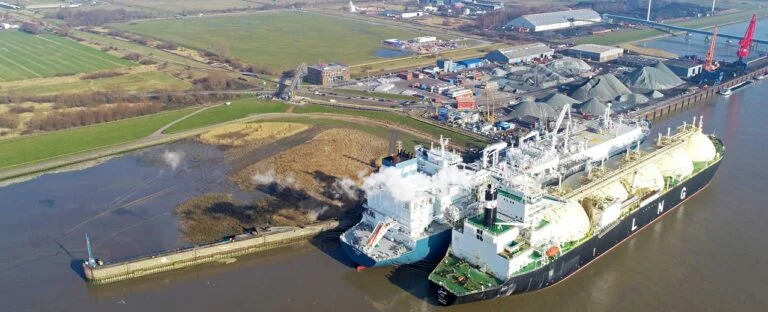
Floating Storage and Regasification Units (FSRUs) were selected as the fastest possible solution. Unlike traditional land-based terminals, FSRUs can be deployed within months. As a result, Germany-LNG import terminals were established quickly in coastal locations such as Wilhelmshaven and Brunsbüttel, creating new gas gateways for the country.
This strategy allowed Germany to secure LNG supply contracts from the United States, Qatar, and other global exporters, drastically reducing geopolitical dependence on pipeline gas.
Key Locations of Germany LNG Import Terminals
Several major Germany LNG import terminals are now either operational or under expansion:
Wilhelmshaven LNG Terminal (North Sea)
One of the most important Germany LNG import terminals, Wilhelmshaven hosts an FSRU that feeds directly into the national gas grid. It plays a critical role in supplying northern and central Germany.
Brunsbüttel LNG Terminal (Elbe River Estuary)
Located near major industrial zones, this Germany LNG import terminal services heavy industries such as chemicals, refining, and manufacturing.
Mukran LNG Terminal (Baltic Sea, Rügen Island)
This is one of the largest planned Germany LNG import terminals in terms of long-term capacity. It is also expected to support future hydrogen and ammonia imports.
Together, these facilities ensure that Germany LNG import terminals can handle a substantial share of the country’s annual gas demand.
How Germany LNG Import Terminals Actually Work
Germany-LNG import terminals follow a precise technical process:
LNG arrives by cryogenic tanker at –162°C
The LNG is transferred into the FSRU or onshore storage
The liquid is regasified using heat exchangers
High-pressure gas is injected into the transmission pipeline network
At every stage of this process, accurate measurement and safety control are critical. This is where LNG-import terminals create strong demand for flow meters, pressure transmitters, temperature sensors, level instruments, and explosion-proof control systems.
Instrumentation Demand Created by Germany LNG Import Terminals
Every Germany LNG import terminal is a highly instrument-intensive facility. Safety, reliability, and regulatory compliance depend entirely on precise measurement and control systems.
1. Flow Measurement Systems
Germany-LNG-import-terminals require continuous monitoring of:
1) LNG unloading flow rates
2) Regasified gas injection rates
3) Export pipeline flow to national grids
Cryogenic-rated ultrasonic flow meters, Coriolis meters, and differential-pressure flow meters are widely used in these applications.
2. Pressure Measurement
Pressure control in import terminals is required at:
1) Transfer pumps
2) Vaporizers
3) High-pressure gas export lines
4) Safety relief systems
Explosion-proof pressure transmitters and gauges are mandatory to meet hazardous-area classification rules.
3. Temperature and Level Measurement
These terminals operate under extreme thermal conditions. Accurate temperature sensors ensure proper regasification, while radar and guided wave radar level sensors monitor LNG storage inside tanks and FSRUs.
4. Hazardous-Area Enclosures and Panels
All Germany LNG import terminals operate under strict ATEX and IECEx requirements. This creates heavy demand for:
1) Explosion-proof junction boxes
2) Stainless-steel enclosures
3) Control panels for hazardous zones
4) Emergency shutdown (ESD) systems
Germany LNG Import Terminals and European Energy Security
Germany LNG import terminals are not serving only domestic demand. They now play a strategic role in stabilizing energy supply across Central and Eastern Europe. By injecting regasified LNG into trans-European pipeline networks, Germany supplies gas to neighboring countries during peak winter demand.
This makes Germany LNG import terminals a regional energy backbone, not just a national solution. As a result, future capacity expansions are already being discussed to support Europe’s long-term supply diversification.
The 5 Powerful Changes Driven by Germany LNG Import Terminals
1. Shift from Pipeline Dependence to Global LNG Supply
Germany has moved away from heavy reliance on pipeline gas to diversified LNG imports from the USA, Qatar, and other global suppliers, greatly improving energy security.
2. Record-Speed Energy Infrastructure Development
Germany LNG import terminals were planned and commissioned in months instead of years using FSRUs, setting a new benchmark for fast-track energy projects in Europe.
3. Surge in Demand for Instrumentation and Automation
The new LNG terminals are creating strong demand for flow, pressure, level, temperature instruments, and explosion-proof control systems.
4. Germany’s Rise as a European Gas Distribution Hub
Regasified LNG from Germany now supplies multiple European countries, positioning Germany as a key gas transit and distribution center.
5. Foundation for Future Hydrogen and Green Fuel Imports
Many LNG terminals are being designed to later handle hydrogen and ammonia, supporting Europe’s long-term decarbonization goals.
Long-Term Vision: From LNG to Hydrogen at Germany LNG Import Terminals
Another strategic reason Germany LNG import terminals are so important lies in their future role in the hydrogen economy. Several terminals are being designed to transition from LNG to green fuels such as hydrogen and ammonia.
This future-proofing means that:
> Instrumentation must be compatible with hydrogen service
> Materials must resist embrittlement
> New safety instrumentation standards will emerge
Thus, Germany LNG import terminals are not merely short-term emergency infrastructure—they are becoming permanent pillars of the future energy system.
Economic Impact of Germany LNG Import Terminals on Industry
Germany LNG import terminals directly support:
Chemical production
Fertilizer manufacturing
Glass and ceramics
Steel and metal processing
Power generation
Without stable gas supplies from Germany LNG import terminals, many of these industries would face severe production risks. As a result, investment around LNG infrastructure continues to stimulate broader industrial growth.
For EPC contractors, automation companies, and instrumentation manufacturers, this translates into steady project opportunities over the next decade.
What Instrumentation Suppliers Should Do Now
For companies supplying flow, pressure, level, temperature, and hazardous-area equipment, Germany LNG import terminals represent a high-value technical market. To capture this opportunity, suppliers should:
1) Develop LNG-specific product certifications
2) Highlight ATEX, IECEx, and DIN compliance
3) Offer cryogenic-rated instruments
4) Build reference documentation for LNG and gas plants
5) Target European EPC companies executing LNG projects
Positioning early around Germany LNG import terminals gives suppliers a competitive advantage in future European LNG projects.
Final Words:
Germany LNG import terminals have transformed Germany from a pipeline-dependent nation into one of Europe’s most flexible gas import hubs in record time. What started as an emergency solution is now evolving into a long-term pillar of European energy security.
Beyond energy policy, Germany LNG import terminals are driving massive downstream demand in:
1) Process automation
2) Instrumentation engineering
3) Hazardous-area safety systems
4) Cryogenic measurement technology
For the global instrumentation industry, this LNG expansion wave represents a rare, high-value growth window tied directly to Europe’s energy transition.
As Germany continues strengthening and expanding Germany LNG import terminals, the world will watch closely—not only for energy security outcomes, but also for the industrial transformation this strategic shift continues to trigger.