
Table of Contents
ToggleDP Level Measurement: Introduction
Differential Pressure (DP) transmitters have been used for decades to measure liquid level in industrial vessels. They are robust, familiar, and relatively easy to install. Because of this, DP level measurement is often the first choice in many projects.
However, DP level measurement comes with a major limitation that is often overlooked during design: it assumes that liquid density remains constant.
In real-world processes, density rarely stays constant. Temperature changes, chemical reactions, aeration, and composition variations can all cause density to fluctuate. When this happens, DP-based level measurement starts giving misleading results.
This article explains why DP Level Measurement fails in varying density applications and introduces 4 proven alternatives that work reliably when density cannot be controlled.
How DP Level Measurement Works
To understand the limitation, it is important to understand the basic principle behind DP level measurement.
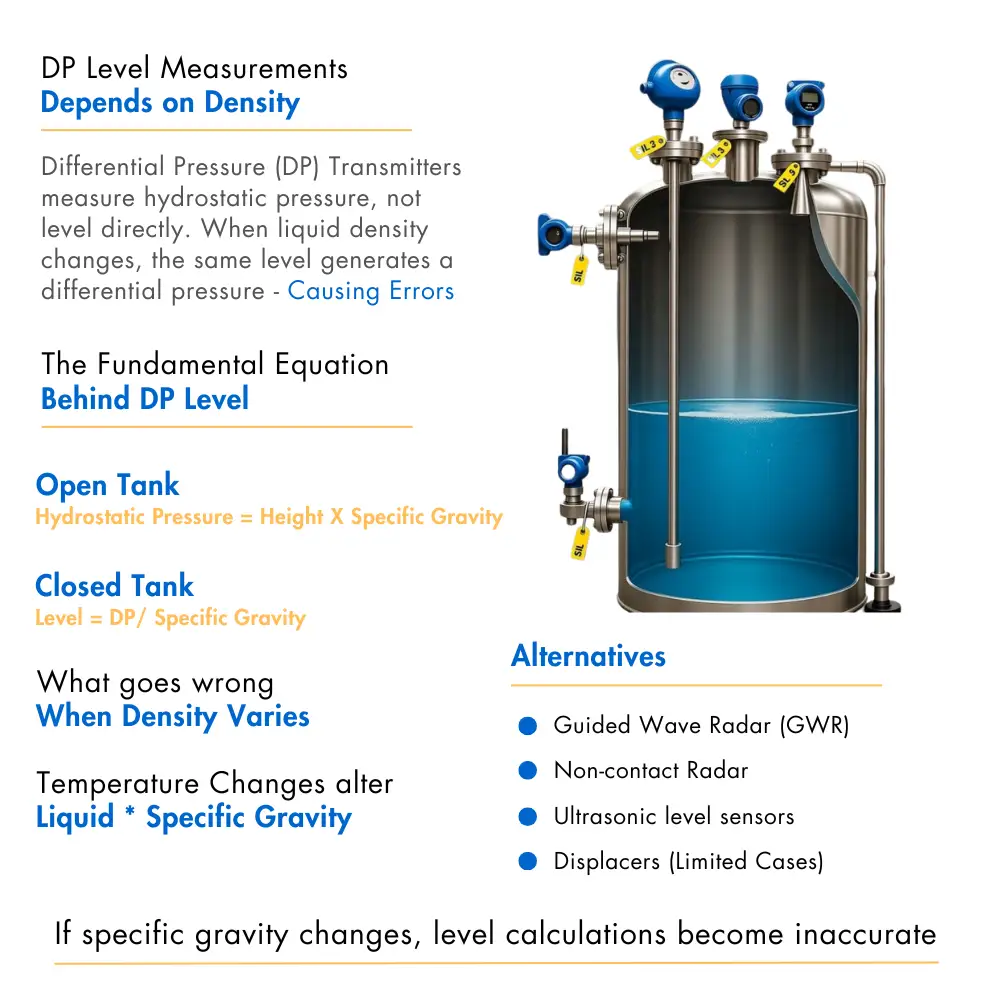
DP transmitters do not measure level directly. They measure hydrostatic pressure, which depends on two factors:
Liquid height
Liquid density (specific gravity)
For an open vessel, the relationship is:
Hydrostatic Pressure = Height × Specific Gravity
For a closed vessel, the level is calculated as:
Level = Differential Pressure ÷ Specific Gravity
This means DP level measurement is only accurate if the specific gravity is known and constant. Any change in density directly affects the pressure reading, even if the actual liquid level remains unchanged.

The Fundamental Problem in Varying Density Applications
The main issue with DP Level Measurement is simple but critical:
DP transmitters cannot distinguish between a change in level and a change in density.
If density increases, the transmitter interprets it as a higher level.
If density decreases, the transmitter interprets it as a lower level.
This leads to incorrect level indication even though the physical level in the tank has not changed.
In many plants, operators try to solve this by recalibrating the DP transmitter frequently. Unfortunately, this only treats the symptom, not the root cause. As long as density keeps changing, the error will keep coming back.
Typical Applications Where DP Level Measurement Struggles
There are many industrial applications where liquid density naturally varies during operation. In such cases, DP level measurement becomes unreliable.
Some common examples include:
Chemical reactors, where concentration changes as the reaction progresses
Slurry tanks, where solids content varies with mixing and settling
Fermentation vessels, where biological activity changes density continuously
Heated vessels, where temperature gradients affect specific gravity
Interface level measurement, where composition changes over time
In all these cases, DP transmitters often cause false high or low level alarms, leading to operational confusion.
Operational Problems Caused by Incorrect DP Level Measurement
When DP Level Measurement is used in varying density applications, the impact goes far beyond a wrong number on the display.
Common consequences include:
Frequent false alarms that operators start ignoring
Unnecessary shutdowns or overfills
Increased calibration and maintenance effort
Loss of confidence in instrumentation readings
Poor process control and product quality issues
Over time, this can result in higher operating costs and reduced plant reliability.
Why Installation Quality Cannot Fix Density Errors
A common misconception is that careful installation can solve DP level problems.
Yes, good practices like correct impulse line slope, proper tapping location, and impulse line flushing are important. They prevent plugging, condensation, and response delay.
However, no installation improvement can eliminate density dependency.
Even a perfectly installed DP transmitter will still give wrong readings if density changes. This is a limitation of the measurement principle itself, not the hardware.
Alternative 1: Guided Wave Radar (GWR)
Guided Wave Radar is one of the most reliable alternatives to DP Level Measurement in varying density applications.
GWR works by sending electromagnetic pulses along a probe. These pulses reflect back from the liquid surface. The level is calculated based on the travel time of the signal, not on pressure or density.
Because of this, GWR is largely independent of:
Density changes
Temperature variations
Pressure fluctuations
GWR performs extremely well in reactors, separators, and vessels with foam or vapor. This makes it a proven replacement for DP transmitters in many critical applications.
Alternative 2: Non-Contact Radar Level Measurement
Non-contact radar level measurement uses high-frequency microwave signals transmitted from the top of the tank toward the liquid surface.
Since radar measures distance, it does not rely on liquid density. As a result, it is unaffected by changes in specific gravity.
Non-contact radar is especially suitable for:
Large storage tanks
Corrosive or aggressive liquids
High-temperature or high-pressure applications
Because there is no physical contact with the process, maintenance requirements are also minimal.
Alternative 3: Ultrasonic Level Sensors
Ultrasonic level sensors measure level by sending sound waves toward the liquid surface and measuring the echo time.
Like radar, ultrasonic level measurement is distance-based, not pressure-based. Therefore, density variations do not directly affect the measurement.
Ultrasonic sensors work best in:
Open tanks
Atmospheric vessels
Clean liquid applications
However, they can be affected by heavy vapors, foam, or turbulence. When process conditions are stable, ultrasonic sensors offer a simple and cost-effective alternative to DP level measurement.
Alternative 4: Displacer Level Measurement
Displacer level measurement is based on buoyancy rather than hydrostatic pressure.
A displacer experiences an upward force proportional to the weight of displaced liquid. This force changes with level.
Displacers can tolerate limited density variation if the change is predictable and compensation is applied. However, they are not ideal for applications with rapid or unpredictable density changes.
Displacers are best suited for:
Stable processes
Narrow operating ranges
Applications with known density profiles
Making the Right Technology Choice
The most important lesson is this:
Level measurement technology must match process behavior, not tradition.
DP Level Measurement works well only when density is stable. When density varies, DP transmitters will always provide misleading readings, no matter how well they are installed or maintained.
Choosing a density-independent technology from the beginning:
Reduces calibration frequency
Improves measurement reliability
Lowers maintenance costs
Prevents false alarms and process disruptions
What We Learn Today?
DP Level Measurement is not wrong but it is simply misapplied in many modern processes.
As processes become more complex, dynamic, and variable, relying on pressure-based level measurement becomes risky.
When density varies, technologies like Guided Wave Radar, Non-Contact Radar, Ultrasonic sensors, and Displacers provide more reliable and accurate results.
Selecting the right level measurement technology is not about familiarity. It is about understanding your process and choosing a principle that truly fits the application.


I hope you like above blog. There is no cost associated in sharing the article in your social media. Thanks for Reading !! Happy Learning