Table of Contents
ToggleCapacitance Level Measurement: Introduction
Level measurement is one of the most common requirements in industrial processes. From small storage tanks to large chemical reactors, industries must continuously monitor liquid or solid levels to ensure safe operation, accurate inventory control, and efficient process management.
Among the many technologies available, capacitance level measurement stands out as a simple, reliable, and cost-effective solution. This technology has been used for decades and continues to be widely applied in industries such as chemical processing, water treatment, food production, and bulk material handling.
Capacitance level sensors work based on a straightforward electrical principle: the capacitance between two electrodes changes when the material level around the probe changes. Because different materials have different dielectric properties, the sensor can detect the presence or absence of a medium and measure the level inside a vessel.
One of the major advantages of this technology is its versatility. Capacitance sensors can be used for:
Continuous level measurement in tanks and vessels
Point level detection for high or low level alarms
Interface measurement between two liquids, such as oil and water
Another reason for the popularity of capacitance technology is its ability to operate in challenging industrial environments. These sensors can work reliably with aggressive chemicals, viscous liquids, sticky materials, and even bulk solids that may cause build-up on the probe.
Because of their simple construction, low cost, and proven reliability, capacitance level sensors are installed in millions of industrial applications worldwide.
In this guide, we will explore everything engineers need to know about capacitance level measurement, including its working principle, types of sensors, advantages, limitations, and typical industrial applications.
Capacitance Level Measurement Principle
Capacitance level measurement works based on the change in capacitance between two conductive surfaces as the level inside a tank changes.
In this system, the sensor probe acts as one electrode, while the tank wall acts as the second electrode. Together they form a capacitor. The material inside the tank acts as the dielectric medium between them.
When the tank is empty, the probe is surrounded mainly by air, which has a very low dielectric constant, resulting in low capacitance.
As the level increases and the probe becomes covered by the process medium, the dielectric constant increases and the capacitance value rises. The transmitter measures this change and converts it into a level signal.
In simple terms:
Empty tank → Low capacitance
Rising level → Increasing capacitance
Higher level → Higher capacitance
2. Benefits of Capacitance Level Measurement
Capacitance level sensors are widely used in industry because they are simple, reliable, and versatile.
Proven Technology
Capacitance measurement is a well-established and reliable principle used in many industrial applications.
Flexible Probe Design
Probes can be adapted in different designs to suit various tanks and process conditions.
Suitable for Difficult Media
These sensors can operate reliably even in viscous liquids or applications with build-up.
Easy Installation
Capacitance sensors are simple to install and require minimal commissioning effort.
Basic Measuring Principle of Capacitance Level Measurement
Capacitance level measurement works on the basic principle of a capacitor formed between the sensing probe and the tank wall.
When a capacitance level probe is installed inside a vessel, the metal rod of the probe acts as one plate of the capacitor, while the metal tank wall acts as the second plate. If the tank is made of non-metallic material, a separate reference electrode is used to complete the capacitor.
Normally, when the tank is empty, the probe is surrounded by air or gas, which has a very low dielectric constant. As the level rises, the process material gradually replaces the air around the probe.
Because most materials have a higher dielectric constant than air, the capacitance between the probe and the tank wall increases. The RF (radio frequency) capacitance transmitter detects this change and converts it into either:
A relay switching signal for point level detection
A proportional output signal for continuous level measurement
This change in capacitance forms the basis of the measurement.
Capacitance Measurement Equation
The relationship between capacitance and the physical parameters of the system is expressed by the following equation:
C = 0.225 K ( A / D )
Where:
C – Capacitance (picoFarads)
K – Dielectric constant of the material
A – Area of the capacitor plates (square inches)
D – Distance between the plates (inches)
The dielectric constant represents the ability of a material to store electrical energy in an electric field. Materials with a higher dielectric constant produce a larger capacitance change.
Effect of Process Conditions on Capacitance
In practical industrial applications, capacitance changes depending on several factors.
Dielectric Constant of the Material
When a material with a higher dielectric constant replaces air around the probe, the capacitance of the system increases.
Electrode Surface Area
Increasing the size or surface area of the probe increases the capacitance output.
Distance Between Electrodes
If the distance between the measuring probe and the reference electrode decreases, the capacitance increases.
These factors determine the sensitivity and accuracy of the capacitance level measurement system.
Types of Capacitance Level Measurement Applications
Capacitance level measurement systems are generally applied in three main categories depending on the type of material being measured.
Non-Conductive Material Measurement
Used for materials such as oils, hydrocarbons, powders, and plastics where the material does not conduct electricity.
Conductive Material Measurement
Used for liquids such as water, acids, and chemical solutions that conduct electricity.
Proximity or Non-Contact Measurement
Used for level detection where the probe senses the presence of material without direct electrical contact.
1) Non-Conductive Materials
As mentioned earlier, capacitance changes when a material comes between the two plates of a capacitor. For example, imagine a level sensor installed in a metal tank to measure the rising level of a non-conductive liquid such as a hydrocarbon. In this case, the sensor probe acts as one plate of the capacitor, while the metal tank wall acts as the second plate. Figure 1 shows a typical arrangement of this system.
The actual capacitance calculation can be quite complex, but for this type of application it can be simplified and expressed in a basic form as follows:
Because the electrode and the tank wall are fixed, the distance between them does not change. The dielectric values of air and the process material also remain constant (for example, air has a dielectric constant of about 1, while a hydrocarbon may be around 10). Because these factors stay the same, the capacitance of the system can be simplified and expressed using a basic equation.
This equation shows that as the amount of material in the tank increases, the capacitance output also increases. In other words, the capacitance value rises in direct proportion to the level of the material being measured.
2) Conductive Materials
The same principle used for non-conductive materials also applies to conductive materials. However, in this case the conductive liquid itself acts as the ground plate of the capacitor instead of the tank wall.
Because of this, the effective distance in the capacitance equation changes. As a result, the capacitance output is generally higher compared to non-conductive materials. Even so, the distance remains constant, so when the level rises along a vertically mounted probe, the capacitance output increases in proportion to the level.
Note: A material is considered conductive if it has an electrical conductivity greater than 10 microSiemens/cm.
Warning: A non-insulated level sensing probe should never come into direct contact with conductive materials, because in that situation the sensor may behave like a simple switch instead of providing a proper level measurement signal.
3) Proximity (Non-Contact) Measurement
In proximity level measurement, the sensing electrode is usually a flat plate installed parallel to the surface of the material.
If the material is conductive, it acts as the ground plate of the capacitor. As the level rises closer to the sensing plate, the distance between the plates becomes smaller, which increases the capacitance.
For non-conductive materials, the tank wall acts as the ground plate, and the material between the plates becomes the variable that affects the capacitance.
In normal capacitance level measurement for conductive and non-conductive materials, the distance between the plates remains fixed while the effective area changes as the level rises.
Proximity level measurement works in the opposite way. In this case, the plate area remains fixed, but the distance between the plates changes as the material level moves closer to the sensor.
Because of this, proximity measurement does not produce a linear output signal. It is typically used only when the level change is several inches or more.
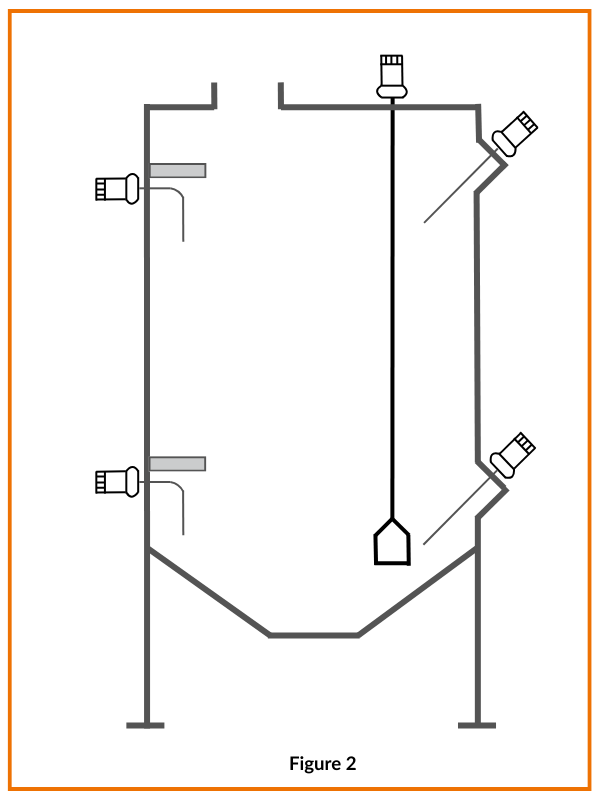
Examples of typical installations for measuring conductive materials, non-conductive materials, and proximity level measurement are shown in Figures 2 and 3.
FAQs on Capacitance Level Measurement
1. What is capacitance level measurement?
Capacitance level measurement is a technique used to measure the level of liquids or solids in a tank by detecting changes in capacitance between a sensor probe and the tank wall.
2. How does a capacitance level sensor work?
It works by measuring the change in capacitance that occurs when the material level around the probe changes. As the level increases, the capacitance also increases.
3. Can capacitance sensors measure both liquids and solids?
Yes, capacitance level sensors can measure liquids, powders, granules, and bulk solids, depending on the sensor design.
4. What is the minimum dielectric constant required for capacitance measurement?
Most capacitance level sensors require the material to have a dielectric constant greater than about 1.5 to 2 for reliable measurement.
5. What industries use capacitance level sensors?
They are widely used in industries such as chemical processing, oil and gas, food and beverage, water treatment, and bulk material handling.
6. What are the main advantages of capacitance level measurement?
Capacitance sensors are simple, cost-effective, reliable, and suitable for many industrial applications, including those with viscous or sticky materials.
What we learn today?
Capacitance level measurement is a simple, reliable, and widely used technology for monitoring the level of liquids and solids in industrial tanks and vessels. By measuring changes in capacitance between the probe and the tank wall, the system can accurately detect level variations. Because of its cost-effectiveness, versatility, and ability to work in many process conditions, capacitance sensors remain a practical choice for many level measurement applications.
I hope you like above blog. There is no cost associated in sharing the article in your social media. Thanks for Reading !! Happy Learning