
Table of Contents
ToggleSurge Protector : Introduction
Every electrical system faces sudden voltage spikes caused by lightning, power switching, or faults in the grid. These short bursts, known as surges, can instantly damage sensitive electronics, automation systems, and control panels.
That is where a surge protector (also called a Surge Protective Device, or SPD) is used. It acts like a shield, redirecting excess voltage safely to ground before it reaches your equipment.
In this article, you will learn what a surge protector is, how it works, the different types, industry applications and best installation practices to ensure your systems stay safe and reliable.
What Is a Surge Protector?
A surge protector is an electrical safety device that safeguards equipment against transient over voltages short-duration voltage spikes typically lasting microseconds.
When the voltage stays within normal limits, the surge protector remains inactive. But when a surge occurs, it instantly conducts the extra energy to ground, keeping the connected equipment safe.
Think of it as a pressure relief valve for electricity it opens only when the pressure (voltage) gets too high.
Surge protectors are essential in homes, industries, and commercial buildings where expensive electronics and automation systems are used.
How Does a Surge Protector Work?
Most modern surge protectors use Metal Oxide Varistors (MOVs) made of zinc oxide. MOVs behave like voltage-controlled resistors:
- Normal voltage: MOV has high resistance (almost no current flows).
- Surge condition: Resistance drops instantly, allowing current to flow to ground.
- After surge: Resistance returns to high, ready for the next event.
Some protectors also use:
- Gas Discharge Tubes (GDTs): Excellent for high-energy lightning surges.
- Spark Gaps: Common in high-voltage and industrial SPDs.
- Hybrid Designs: Combine MOV + GDT for better durability and response.
Surge Protector vs. Surge Arrester
Although people use both terms, they differ slightly in usage:
- Surge Protector (SPD): Common in low and medium voltage systems, such as buildings, control panels, and automation equipment.
- Surge Arrester: Used mainly in high-voltage transmission and substation systems.
In practice, both perform the same job diverting excess voltage to ground but their design and ratings vary by application.
Types of Surge Protectors
Surge protectors are categorized by the IEC/EN 61643 standard based on where they are installed and the level of protection they offer.
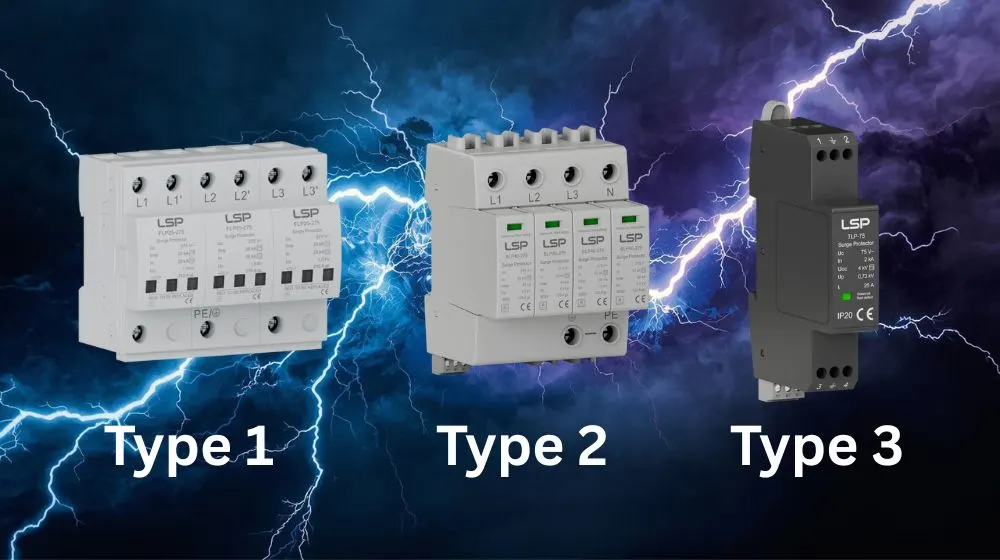
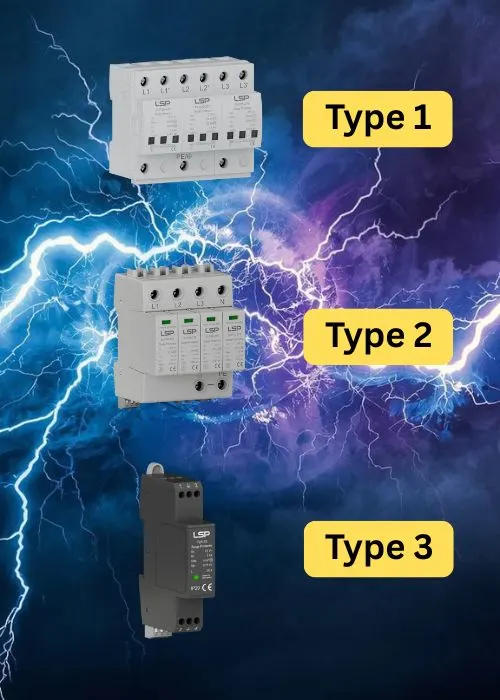
1. Type 1 Surge Protector
- Installed at the service entrance.
- Designed to handle direct lightning currents (10/350 µs waveform).
- Required when a building has an external lightning protection system or overhead power lines.
2. Type 2 Surge Protector
- Installed at the main distribution board.
- Protects against switching surges and indirect lightning effects (8/20 µs waveform).
- The most common SPD type in industrial and commercial installations.
3. Type 3 Surge Protector
- Installed close to sensitive loads such as PLCs, HMIs, or computers.
- Acts as the final layer of defense, ensuring low residual voltage at the device terminals.
Key Performance Terms You Should Know
- Uc (Maximum Continuous Operating Voltage): Max RMS voltage the SPD can continuously withstand.
- In (Nominal Discharge Current): Surge current it can handle repeatedly.
- Imax (Maximum Discharge Current): Highest surge current it can handle once.
- Up (Voltage Protection Level): The voltage clamped during a surge — lower is better.
- Iimp (Lightning Impulse Current): Type 1 SPD’s lightning test current (10/350 µs).
- Response Time: The time it takes to activate, typically in nanoseconds.
Step-by-Step Selection Guide
Know your system voltage and earthing type
(e.g., 230/400V TN-S, TT, or IT systems).Decide SPD type by location
Type 1: Main incoming supply.
Type 2: Sub-panels.
Type 3: Sensitive loads.Evaluate surge exposure
Lightning-prone or high-switching sites need higher Imax/Iimp ratings.Ensure coordination
Cascading Type 1 → Type 2 → Type 3 ensures full protection.Check standards and approvals
Look for IEC/EN 61643-11 or UL 1449 certifications.
Industry Applications of Surge Protectors
1. Water & Wastewater Industry
Used to protect SCADA systems, level sensors, and motor control centers from lightning surges common in outdoor and humid environments.
2. Oil & Gas Industry
Essential in hazardous areas, explosion-proof panels, and offshore platforms where long cable runs are exposed to induced surges.
3. Solar PV Systems
Both DC and AC sides need SPDs:
- DC Side: PV string and combiner boxes.
- AC Side: Inverters and grid interface.
4. Industrial Automation
Protects PLCs, HMIs, VFDs, and sensors from internal switching transients and external overvoltages.
Best Installation Practices
- Keep all SPD leads short and straight to minimize inductive voltage rise.
- Use low-inductance cables or copper strips for grounding.
- Connect SPD earth directly to the main earthing bar.
- Protect signal and communication lines separately with dedicated SPDs.
- Follow correct wiring diagrams for your earthing system (TN-S, TT, IT).
- Check visual or remote indicators regularly for SPD health.
Common Mistakes to Avoid
- Choosing a low Uc value — leads to premature SPD failure.
- Long connection wires — increase the voltage seen by the load.
- Using Type 3 alone without upstream Type 1 or 2 — incomplete protection.
- Ignoring proper grounding — surge energy cannot discharge safely.
- Skipping coordination between stages — leads to poor performance.
Frequently asked questions - Surge Protector
Yes. MOV-based SPDs degrade over time. Replace them when the indicator turns red or after major surges.
In small setups, yes, but in industrial systems, cascading (Type 1 + 2 + 3) gives full protection
Absolutely yes, solar PV and battery systems need DC rated SPDs for each polarity
They minimize the damage but should be paired with a proper lightning protection system (LPS)
What we learn today?
A surge protector is your first line of defense against electrical overvoltage. If you are protecting a solar farm, wastewater plant, oil refinery, or automation panel, selecting the right SPD type and installing it correctly ensures safe and uninterrupted operation.
Remember: short leads, proper earthing, and coordinated protection are key to surge safety and equipment longevity.


I hope you like above blog. There is no cost associated in sharing the article in your social media. Thanks for reading!! Happy Learning!!