
Table of Contents
TogglePressure Gauge Installation Mistakes: Introduction
Pressure gauges are some of the most widely used instruments in industries. From oil and gas to food processing plants, they sit quietly on pipelines, tanks, and machines, giving us one of the most important process values pressure.
A quick look at the dial tells you whether the system is running safely or if there is a problem.
But although a pressure gauge looks like a very simple instrument, it is often misunderstood and misused. Technicians sometimes assume that “a gauge is just a gauge,” but in practice, choosing the right one and installing it correctly makes all the difference.
Many technicians face problems because of Pressure Gauge Installation Mistakes that often go unnoticed. Let us look at the five most common mistakes technicians make with pressure gauges, why they happen, and how to avoid them.
A small mistake in measurement can lead to a big mistake in Judgment
Mistake 1: Wrong Range Selection
One of the most frequent errors is selecting a gauge with the wrong pressure range.
For example, imagine you have a system that normally operates at 6 bar, but you install a pressure gauge that has a range up to 10 bar.
At first, it looks fine. The needle moves, the dial shows pressure, and you carry on. But the reading you see may not be as accurate as you think.
Pressure gauges are most accurate in the middle of their scale. If your system pressure is always at the lower end or too close to the maximum, accuracy drops and the gauge wears out faster. In extreme cases, a sudden pressure spike can even damage the pointer and the internal mechanism.
A good rule of thumb is: Always select a gauge with a full-scale range about twice the normal operating pressure.
This way, the needle sits comfortably in the middle and can handle small surges without damage. Even a small oversight can lead to inaccurate readings, making Pressure Gauge Installation Mistakes a serious concern in plant safety
“The life of a gauge is as long as the care taken in choosing it.”
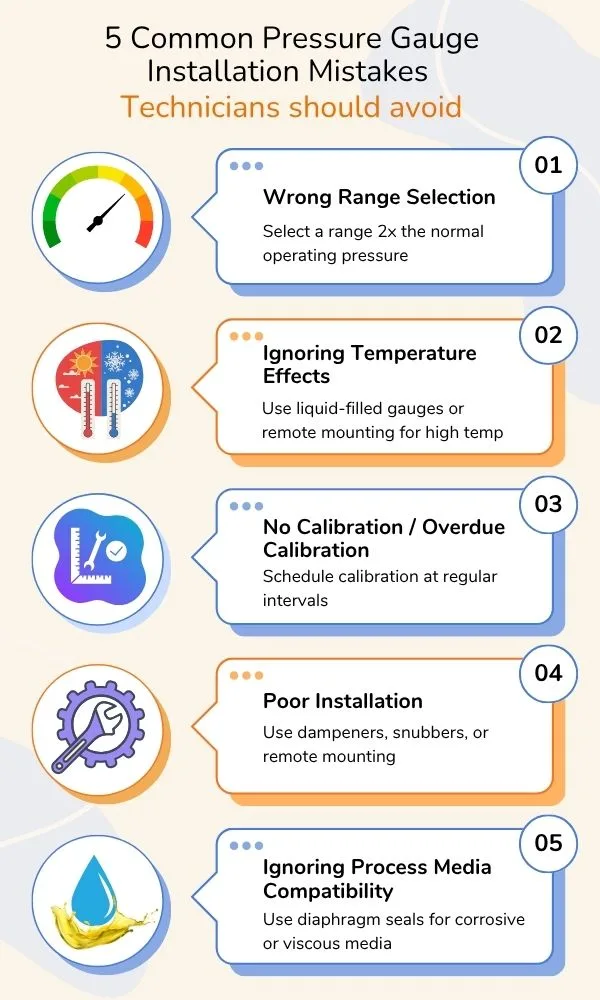
Mistake 2: Ignoring Temperature Effects
Another mistake technicians make is ignoring the effect of temperature. A pressure gauge sitting on a hot steam line or exposed to freezing weather will not behave the same as one at room temperature. The heat can thin the internal oil, expand the metal, and shift the reading. On the other hand, extreme cold can make the parts stiff and sluggish.
The result? The gauge shows numbers, but they may not match the actual pressure in the line.
In many plants, technicians discover this too late when the gauge has already failed or when readings suddenly seem “off.”
The solution is simple:
- Use liquid-filled gauges for high temperature or vibration conditions.
- Install a syphon tube or a capillary to protect the gauge from direct heat.
- For cold environments, choose gauges designed for low temperature operation.
It is worth remembering that a gauge is not just measuring pressure but it is surviving the environment too.
Mistake 3: Skipping Calibration
A brand-new gauge looks reliable. But over time, its accuracy drifts. Vibration, pressure cycles, and environmental stress cause tiny changes in the mechanism. If the gauge is not calibrated regularly, technicians may be making decisions based on false readings.
Unfortunately, calibration is often skipped because gauges are considered “cheap and replaceable.” This attitude can be dangerous. A faulty gauge can mislead operators into thinking a line is safe when in reality it’s over-pressurized. Regular maintenance and calibration can prevent many Pressure Gauge Installation Mistakes that shorten instrument life
“An uncalibrated gauge is worse than no gauge at all”
The fix is to include gauges in your calibration schedule, just like transmitters or other critical instruments. Even a simple comparison with a master gauge during maintenance can save a lot of trouble later.
Mistake 4: Poor Installation Practices
Even the best gauge can fail if it is not installed properly. Some of the common installation mistakes include mounting the gauge directly on vibrating equipment, installing it in awkward positions where the dial cannot be read properly, or forgetting to use accessories like snubbers.
When a gauge is exposed to constant vibration, the pointer shakes continuously, which wears out the movement and makes the reading unreadable.
In some plants, gauges literally “dance” on pumps and compressors.
The correct approach is to use a liquid-filled gauge or to mount it remotely with a capillary line. Snubbers and pulsation dampeners can also protect the mechanism from rapid pressure fluctuations.
Proper installation is not only about protecting the instrument—it’s also about protecting the technician. A gauge mounted at eye level in a safe, accessible location is far easier to monitor and maintain.
Mistake 5: Ignoring Media Compatibility
The last mistake is forgetting to check whether the gauge materials are compatible with the process fluid. Imagine installing a standard gauge directly on a line carrying corrosive chemicals. The result is predictable: the internal parts corrode, the dial fogs up, and the gauge fails quickly.
In other cases, thick or sticky fluids clog the tiny pressure inlet of the gauge, causing the needle to freeze at one position. This can be dangerous because the gauge looks “normal” even though it is no longer responding to pressure changes.
The simple solution is to use diaphragm seals or chemical seals that protect the gauge from direct contact with the process. Selecting the right material stainless steel, Teflon, or other alloys also ensures longer life.
“Choose the gauge for the process, not the process for the gauge.”
Bringing It All Together
Pressure gauges may look simple, but they play a critical role in plant safety and efficiency. Choosing the right range, considering temperature effects, keeping up with calibration, installing them correctly, and matching them with the right process media are all small steps that make a big difference.
Think of a gauge as the “eyes” of the process. If the eyes are not clear, the operator’s decisions will be blurred. A little extra attention during selection and maintenance can prevent costly failures, unnecessary downtime, and even accidents.
In many plants, technicians are under pressure (pun intended) to complete jobs quickly. Gauges get overlooked because they are inexpensive compared to transmitters or control systems. But as experience shows, the smallest instrument can sometimes be the weakest link.
As one engineer once said, “We don’t remember the days the gauges worked fine. We remember the one day it failed.”
So next time you install or check a pressure gauge, pause for a moment and ask:
- Is this the right range?
- Is it protected from temperature and vibration?
- Has it been calibrated?
- Is it compatible with the process fluid?
If the answer to all is yes, you have done your job well. By learning from common Pressure Gauge Installation Mistakes, industries can ensure better accuracy, safety, and reliability in their processes.


I hope you like above blog. There is no cost associated in sharing the article in your social media. Thanks for reading!! Happy Learning!!