Table of Contents
ToggleIntroduction: Silicon Controlled Rectifiers (SCRs)
Electricity is all around us, but not all electricity is the same.
The kind of power that flows through the wires in your house is alternating current (AC). It changes direction many times a second, which makes it great for long distance transmission.
But most of our modern devices, from laptops to medical machines, don’t like AC. They need direct current (DC), a smooth, one way flow of electricity.
That means, before AC can be useful for our gadgets and industries, it has to be converted into DC.
This is where the silicon controlled rectifiers (SCR) comes in.
It is a clever electronics little device that acts as a smart switch. And without it, many of the things we use every day simply wouldn’t work as efficiently.
What is Silicon Controlled Rectifiers?
Silicon controlled rectifiers, also called a thyristors, is a semiconductor device.
To imagine it, think of a valve that controls the flow of water in a pipe. You decide when the valve should open, and once it opens, water flows until it naturally stops. That is basically what an SCR does, but with electricity.
- It has four layers of material and three terminals.
- It switches on only when you give it a small trigger signal (through the gate).
- Once on, it keeps conducting until the current naturally drops to zero.
What makes SCRs special is that they are strong, durable, and efficient. They can handle very high voltages and currents without breaking down. Because of that, you will find them almost everywhere: in factories, in cars, in power grids, and even in hospital machines.
How Silicon Controlled Rectifiers Turn AC into DC?
When AC current flows, the voltage rises and falls in the shape of a sine wave. An Silicon Controlled Rectifier decides when in that wave it should allow current to pass.
Here is how the process works:
At a certain point in the wave, a small signal is sent to the SCR’s gate.
The SCR switches on and allows current to pass for the rest of that half-cycle.
When the wave crosses zero, the SCR automatically turns off.
In the next cycle, another gate signal is needed to start the process again.
By controlling the exact moment the SCR switches on, engineers can adjust the DC output. This means we can have smooth, stable, and controllable power. It also reduces unwanted electrical noise and keeps the current very steady—something industries love.
Why the World is Using More SCRs in 2025?
If SCRs have been around for decades, why are they still such a big deal today? The answer is simple: we are using more electricity than ever, and we want it to be efficient and reliable.
Industries and Automation
Factories are becoming smarter, and machines are running faster. In places like China and India, huge growth in electric vehicle battery production has made SCRs essential. In fact, recent studies show that more than 40% of SCR demand comes from electroplating industries in Asia-Pacific.
Why? Because SCRs can deliver current with ±1% accuracy, which is exactly what is needed for high-quality battery manufacturing.
Renewable Energy
Solar and wind power are becoming the future of energy. But renewable sources can be unstable, and that’s where SCRs shine. In Germany, almost three out of four solar farms installed between 2020 and 2023 used SCR based systems to make the power more stable and reduce distortion. That means cleaner energy feeding into the grid.
Manufacturing and Smart Factories
Globally, industrial manufacturing already makes up about 35% of SCR usage, and it’s still growing fast. Just in China, demand is rising at 18% per year because of automation and smart factory investments.
In short, whether it is powering a smart factory, stabilizing renewable energy, or charging electric cars, SCRs are quietly making it possible.
Applications of SCRs
To see why SCRs matter, let us look at some applications:
- Metal processing and electroplating: Manufacturers need precise current control to make sure coatings on metals are smooth and even. There are many manufacturers in the world who are keeping current within ±1% accuracy.
- High voltage power transmission (HVDC): Power grids use SCRs to transfer electricity over long distances with up to 98.5% efficiency.
- Medical imaging: In 2024, almost 92% of MRI machines used SCR based amplifiers to keep magnetic fields stable, ensuring accurate scans for patients.
These are not small achievements and they show how SCRs play an important role in industries that affect millions of people daily.
Things to Remember When Designing with SCRs
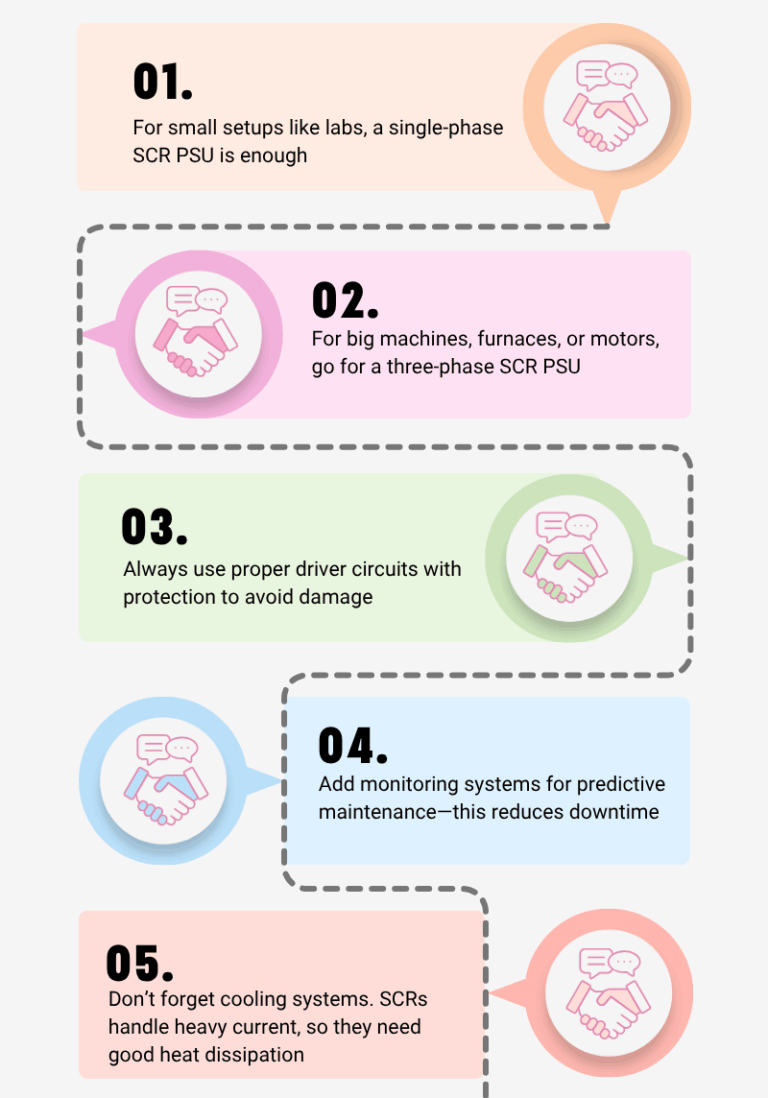
If you are planning to design or upgrade a power supply with SCRs, here are some tips to keep in mind:
Conclusion: Why SCRs Are Still the Heroes of Power Conversion
AC to DC conversion may sound like a background task, but it is one of the most important processes in modern technology.
From powering factories and electric cars to enabling clean energy and life saving medical scans, SCRs make sure electricity is delivered in the right way, every time.
In 2025, as industries demand more efficiency and renewable energy becomes a global priority, SCRs are more relevant than ever.
So the next time you see a motor running smoothly, or an MRI scan showing clear images, remember that there is probably an SCR silently working behind the scenes, making AC to DC conversion look easy.
I hope you like above blog. There is no cost associated in sharing the article in your social media. Thanks for reading!! Happy Learning!!

