
Table of Contents
ToggleWhat are Photoelectric Sensors?
Photoelectric sensors are commonly used to detect the presence or absence of objects, or to measure the distance between an object and a reference point using light.
These sensors are a popular choice in factory automation because they provide fast, reliable, and non-contact detection.
They are mostly used in various manufacturing applications where knowing whether an object is present or measuring its distance is crucial.
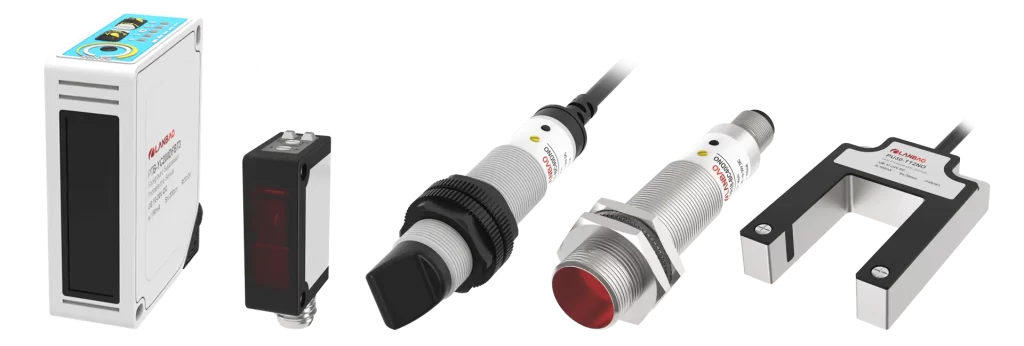
At the core, a photoelectric sensor includes two main parts:
- An emitter, which produces light, and
- A receiver, which detects that light.
The emitter converts electrical energy into light usually a beam of visible or infrared light using a LED or laser diode.
When this light hits an object, it either gets blocked or reflected, changing the amount of light reaching the receiver.
The receiver typically a photodiode or phototransistor detects this change in light intensity and converts it into an electrical signal.
This signal is amplified, checked by detection circuits to confirm the light came from the sensor’s own emitter, and then the system sends an output signal indicating that an object has been detected.
Photoelectric sensors come in a variety of shapes and sizes, making them versatile for many industrial setups.

Type of Photoelectric Sensors
Photoelectric sensors are of three main types based on their sensing method:
- Through-beam sensors
- Retro-reflective sensors
- Diffuse-reflective sensors
Each type uses light in a slightly different way but all are quite effective in detecting object presence and distance.

1. Through-Beam Photoelectric Sensors
Thru-beam photoelectric sensors consist of a separate emitter and receiver, installed directly facing each other. This setup is also known as a through-beam configuration.
Here, the emitter sends a light beam straight to the receiver. When an object crosses the path, it blocks the light beam, reducing the light intensity that the receiver gets.
This drop in light helps the sensor detect that an object is present.

Advantages:
- Offers the longest detection range
- Strong signal due to direct line-of-sight
- Object’s surface color or reflectivity does not affect the detection
Limitations:
- Requires separate installation of emitter and receiver
- Alignment can be tricky and may require precision during setup
2. Retro-Reflective Photoelectric Sensors
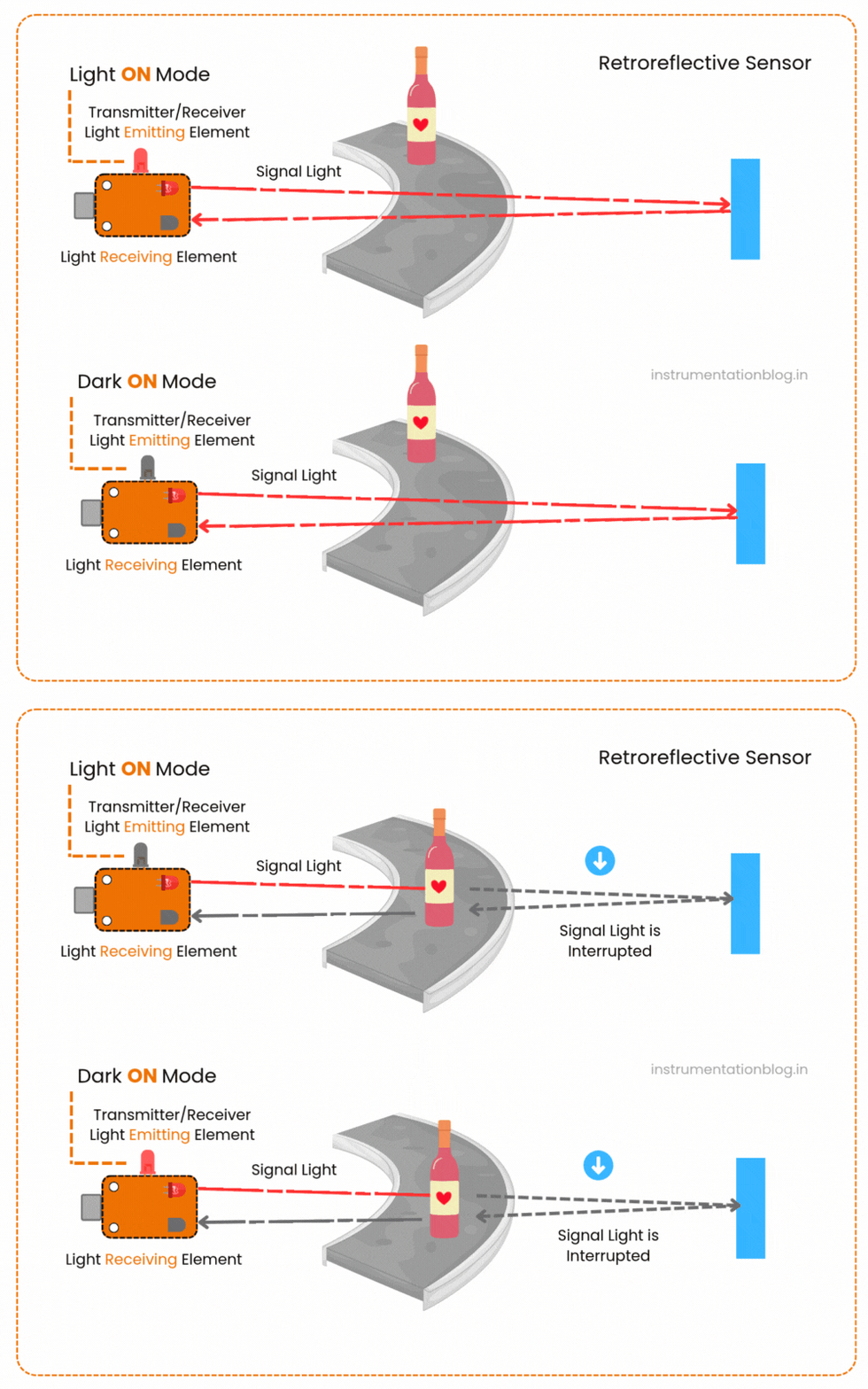
In retro-reflective sensors, the emitter and receiver are housed together, and a reflector is installed on the opposite side.
The light from the emitter bounces back from the reflector to the receiver. When an object blocks this light, the receiver senses a drop in light intensity, which indicates object detection.
This setup is also referred to as retro mode or reflex mode.
Advantages:
- Requires wiring only at one location
- Detects objects from a few centimeters to a few meters away
- Works well even if the object’s color or angle changes
- Ideal for fast-moving, shiny, or large transparent objects
Limitations:
- Struggles to detect mirror-like surfaces
- Has a dead zone at close range
3. Diffuse Reflective Photoelectric Sensors
Diffuse sensors also have the emitter and receiver in the same unit, similar to retro-reflective sensors.
But instead of using a reflector, the object itself reflects the light back to the receiver.
Normally, the light from the emitter does not reach the receiver directly. When an object is present, it reflects the light, and the receiver detects this reflected light to confirm its presence.

Advantages:
- Simple to mount and align
- Can sense objects from a few centimeters to meters
- Useful for detecting translucent items, liquid fill levels, and object orientation
Disadvantages:
- Performance may vary based on object color, surface texture, or dirt
Photoelectric Sensor Outputs
Photoelectric sensors generally have two types of outputs: Digital and Analog
Digital Output
This is also called a switched output, digital output has only two states — ON or OFF.
This typically controls devices like alarms, indicator lights, relays, or PLC inputs.
For photoelectric sensors, two common terms define output behavior:
- Light On: Output turns ON when the receiver detects light from the emitter
- Dark On: Output turns ON when the receiver does not detect light
Example:
If a thru-beam or retro-reflective sensor is connected to a bulb:
- In Light On mode, the bulb will glow when the receiver gets the light
- In Dark On mode, the bulb stays off when light is received but turns on when the beam is interrupted
For a diffuse sensor, the behavior is opposite because under normal conditions, no light returns to the receiver.
Sourcing and Sinking Outputs
Sensor outputs can be either sourcing (PNP) or sinking (NPN):
- Sourcing (PNP): Provides positive voltage when ON
- Sinking (NPN): Connects the load to ground or negative voltage

Analog Output
Analog output gives a continuous range of voltage or current and reflects the strength of the received light.
This output is useful in process control applications where you need to monitor parameters like object position, size, or transparency.
It can also be used to send variable control signals to devices like motor controllers.


I hope you like above blog. There is no cost associated in sharing the article in your social media. Thanks for reading!! Happy Learning!!