
Table of Contents
ToggleWhat is Offset Error in Instrumentation?
In industrial measurement systems, accuracy is everything.
Whether you are measuring pressure, flow, temperature, or level, even a small deviation can affect process control and product quality. One of the most common calibration problems engineers face is Offset-Error.
Offset-Error occurs when a sensor or transmitter shows a constant deviation from the true value across its measurement range.
The output shifts up or down, even though the slope of the measurement remains correct. This type of error is closely related to Zero Point Error, and it is often confused with Span Error during calibration.
Understanding Offset-Error, Zero-Point Error, and Span Error is extremely important for instrumentation engineers and technicians because incorrect zero or span settings can lead to false readings, process imbalance, and unnecessary troubleshooting.
In this article, we will clearly explain what Offset-Error means, how it differs from Zero-Point Error and Span Error, and how these errors affect industrial transmitters.
Offset Error and Zero-Point Error
In pressure measurement, Offset-Error and Zero-Point Error are classified as systematic errors. This means the error is predictable and repeatable it does not change randomly. Instead, the deviation remains consistent between the actual pressure and the sensor output.
Although many technicians use these terms interchangeably, they are not exactly the same. To understand them clearly, we must first understand what Offset-Error really means.
What is Offset Error?
Offset Error occurs when the sensor output shifts by a fixed amount across the entire measurement range. The slope of the measurement remains correct, but the entire output curve moves upward or downward.
You can think of Offset Error as a constant “shift” in the signal.
Example:
If a pressure sensor is designed to output:
0 psi → 0 mV
But instead it outputs:
0 psi → 5 mV
Then the sensor has an Offset-Error of 5 mV.
Now let us check another point.
If the same sensor should output:
10 psi → 100 mV
But instead it outputs:
10 psi → 105 mV
The deviation is still 5 mV.
This confirms that the Offset-Error is consistent across the full pressure range. The slope is correct, but the entire output line has shifted.
What is Zero-Point Error?
Zero-Point Error (also called zero-offset error) is actually a specific type of Offset-Error.
It refers only to the deviation when the input pressure is zero.
In simple words, Zero-Point Error tells us:
“What is the sensor output when it should be reading zero?”
Example:
If a pressure sensor produces:
0 psi → 1 mV
Then it has a Zero-Point Error of 1 mV.
This means the instrument is not correctly aligned at its zero reference point.
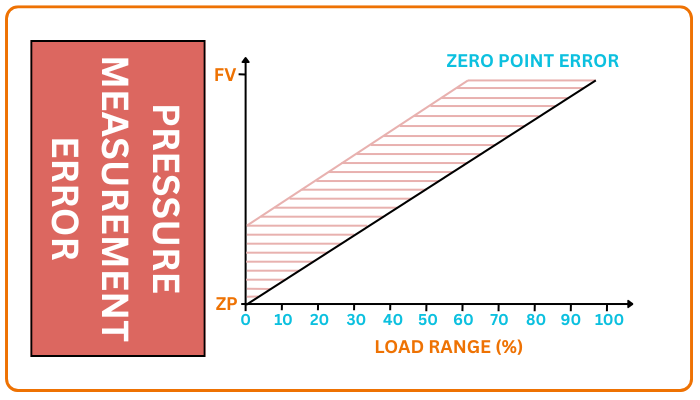
Relationship Between Offset Error and Zero-Point Error
The relationship is simple:
Zero-Point Error is a form of Offset Error.
However:
Zero-Point Error describes deviation only at zero input.
Offset Error describes the consistent deviation across all measurement points.
So every Zero-Point Error is an Offset Error, but not every Offset Error discussion focuses only on zero input.
Understanding this difference is very important during transmitter calibration and troubleshooting.
Offset Error and Span Error
Just like Zero-Point Error, Offset Error and Span Error are also classified as systematic errors in pressure sensors. However, they affect two completely different aspects of sensor performance.
Understanding the difference between Offset Error and Span Error is very important during calibration of pressure transmitters.
What is Offset Error?
As discussed earlier, Offset-Error is a constant deviation present across the entire measurement range.
It behaves like a fixed shift in the output signal.
Example:
Suppose a pressure sensor is designed to output:
0 psi → 0 mV
But instead it outputs:
0 psi → 2 mV
In this case, the sensor has an Offset-Error of 2 mV.
Now check another point.
If the pressure increases to:
10 psi → Expected output: 100 mV
But the sensor reads:
10 psi → 102 mV
The deviation is still 2 mV.
This confirms that the Offset Error remains constant across all measurement points. The slope of the line is correct, but the entire output has shifted upward.
What is Span Error?
Span Error is different from Offset Error because it does not shift the entire curve. Instead, it changes the slope of the measurement curve.
Span Error affects the gain of the sensor.
Gain means the ratio between the change in output and the change in input.
In simple terms, Span Error changes the scale of measurement.
Example:
Suppose a sensor should produce:
10 psi change → 100 mV output
This means the gain is:
10 mV per psi
But if the sensor produces:
10 psi change → 110 mV
Then the gain becomes:
11 mV per psi
This means the sensor has a Span Error.
Here, the slope is incorrect, even though the zero point may be correct.
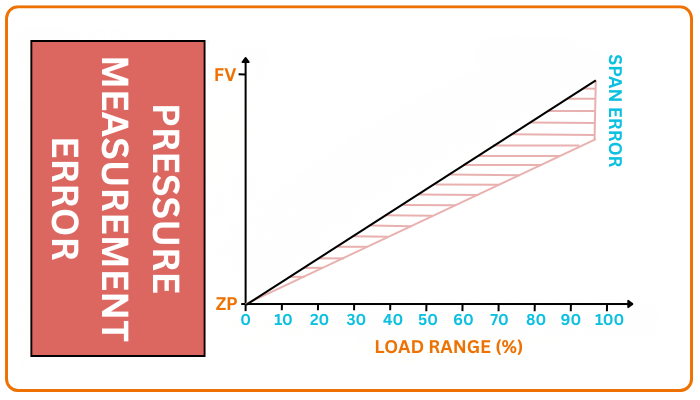
Relationship Between Offset Error and Span Error
It is important to understand that Offset-Error and Span Error are independent of each other.
A pressure sensor can have:
Offset-Error only
Span Error only
Both errors together
Neither error
Let us look at two clear cases.
Case 1: Offset Error Without Span Error
Assume a sensor has a perfect gain of:
10 mV per psi
But it has an Offset-Error of 2 mV.
Then the output will be:
0 psi → 2 mV
10 psi → 102 mV
The slope is correct. The gain is correct. Only the output is shifted.
This sensor has Offset-Error, but no Span Error.
Case 2: Span Error Without Offset Error
Now consider a sensor with a perfect zero point:
0 psi → 0 mV
But the gain is incorrect.
10 psi → 110 mV instead of 100 mV
Here:
There is no Offset-Error, because zero is correct.
But there is Span Error, because the slope is wrong.
Why Correcting Both Errors is Important
To ensure accurate pressure measurement, both Offset Error and Span Error must be identified and corrected.
This is typically done during calibration.
The calibration process includes:
Applying known reference pressures.
Comparing actual output with expected output.
Adjusting the zero trim to remove Offset Error.
Adjusting the span trim to correct Span Error.
If either error remains uncorrected, the transmitter may provide misleading readings, which can affect process control, safety, and product quality.
In industrial instrumentation, even a small Offset Error or Span Error can create significant measurement deviation over time. That is why proper calibration is a critical part of maintenance practice.
What we learn today?
Understanding Offset Error is very important in industrial measurement. Offset Error shifts the entire output signal by a fixed amount, which means the readings stay consistently higher or lower than the actual value. If not corrected, this can lead to wrong process decisions.
Zero-Point Error is a type of Offset Error that appears only at zero input. Span Error is different because it changes the slope or gain of the sensor. While Offset Error shifts the signal, Span Error changes the scaling.
The good news is that Offset Error and Span Error can be corrected through proper calibration. Regular checking and adjustment help maintain accurate and reliable measurements in any industrial system.


I hope you like above blog. There is no cost associated in sharing the article in your social media. Thanks for Reading !! Happy Learning