
Table of Contents
ToggleMembrane Level Switch: Introduction
Level measurement is a critical requirement in almost every industrial process. Whether it is a silo storing cement, a hopper filled with plastic granules, or a bin containing grain, knowing when the material reaches a certain level is essential for safe and efficient plant operation.
Among different point level detection devices, the membrane level switch stands out because of its simple construction, reliable operation, and suitability for bulk solids.
This article explains the working principle of membrane level switch covering its construction, operation, applications, advantages, and limitations.
Introduction to Level Switches
A level switch is a device used to detect whether the level of a material has reached a predefined point. Unlike level transmitters, which provide continuous level measurement, level switches give a discrete ON or OFF signal.
Purpose of level switches
Level switches are commonly used for high-level alarms, low-level alarms, overfill protection, and empty vessel indication in industrial processes.Difference between level switch and level transmitter
A level switch only indicates whether a level point is reached, while a level transmitter continuously measures level and sends a proportional output signal.Use of point level switches in solids
For powders, granules, and bulk solids, point level switches are preferred because continuous level measurement can be difficult due to dust and irregular material surfaces.
What Is a Membrane Level Switch?
A membrane level switch is a type of point level switch that uses a flexible membrane, also known as a diaphragm, to detect the presence of bulk material.
Basic definition
It detects level by sensing the pressure exerted by the material on a flexible membrane.Other common name
Membrane level switches are also called diaphragm level switches.Suitable materials
They are mainly used for powders, granules, pellets, and coarse bulk solids.Typical mounting location
These switches are usually mounted on the side wall of silos, bins, or hoppers at the required level point.
Main Parts of a Membrane Level Switch
Understanding the construction helps in understanding the working principle.
Flexible membrane (diaphragm)
The membrane is the sensing element that comes into direct contact with the process material. It is usually made of rubber, elastomer, or silicone depending on the application.Pressure plate or mechanical linkage
This component transfers the movement of the membrane to the internal switching mechanism.Microswitch
The microswitch is the electrical element that changes its contact state when actuated. It may have normally open, normally closed, or changeover contacts.Housing
The housing protects internal components from dust, moisture, and mechanical damage. It is typically made of aluminum, plastic, or stainless steel.Electrical connection
Electrical terminals or cable glands are provided for connecting the switch output to a control system or alarm circuit.
Working Principle of a Membrane Level Switch
The working principle of a membrane level switch is based on material pressure acting on a flexible membrane.
Condition when material level is below the switch
When the material level is below the mounting point, there is no pressure on the membrane. The membrane remains in its normal position and the microswitch stays in its default state.Material pressure acting on the membrane
As the material level rises, bulk material such as powder or granules starts pressing against the membrane surface.Membrane deflection
When the pressure exceeds a preset value, the membrane deflects inward.Force transmission to the microswitch
The membrane movement is transferred through the mechanical linkage or pressure plate to the microswitch.Electrical signal generation
The microswitch changes its contact state, sending an ON or OFF signal to the control system indicating that the level point has been reached.Reset action
When the material level falls, pressure on the membrane is removed. The membrane returns to its original position and the microswitch resets.
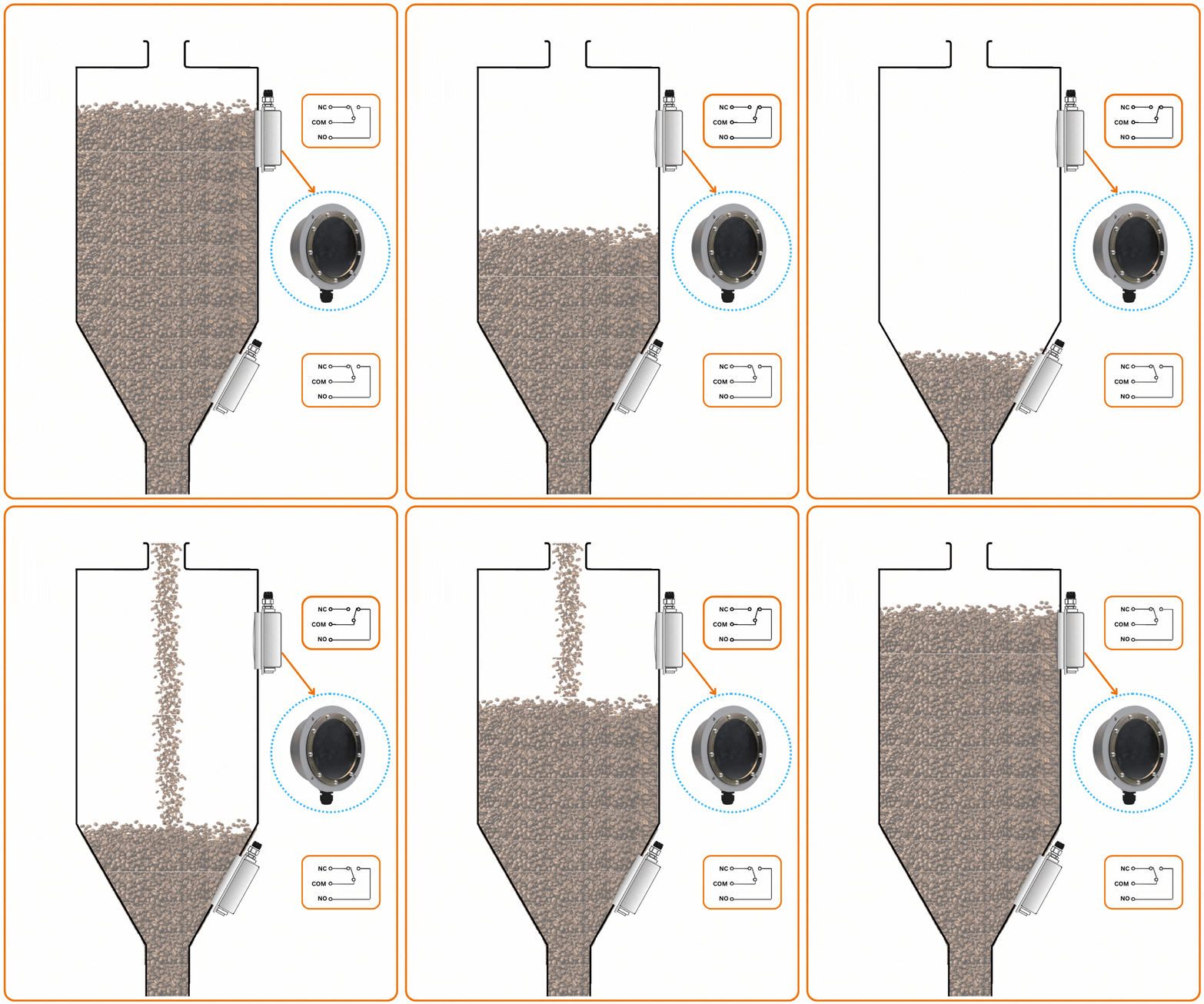
Step-by-Step Working Sequence
The operation can be easily remembered in a sequence.
Material level rises
Bulk material inside the vessel reaches the switch location.Membrane deflects
Material pressure causes inward movement of the membrane.Internal mechanism moves
The force is transmitted to the microswitch.Microswitch changes state
Electrical contacts open or close.Control system receives signal
The level condition is indicated as high or low.
Types of Membrane Level Switches
Different designs are available to suit various process conditions.
Standard membrane level switch
Used for normal bulk solids such as grains and plastic granules.High-temperature membrane level switch
Designed for applications where material temperature is high, using special membrane materials.Heavy-duty or abrasion-resistant membrane switch
Used for coarse or abrasive materials like sand or clinker.Hygienic membrane level switch
Designed for food and pharmaceutical applications where cleanliness is important.
Typical Applications of Membrane Level Switch
Membrane level switches are widely used in industries handling bulk solids.
Silos and storage bins
Used for high-level or low-level detection in bulk storage.Hoppers and chutes
Provide level indication in material feeding systems.Conveying systems
Used to detect material presence or blockage.Process industries
Common in cement, power, chemical, and food industries.
Advantages of Membrane Level Switch
Membrane level switches are popular due to several practical benefits.
Simple mechanical design
The construction is straightforward, making it easy to understand and maintain.Reliable point level detection
Mechanical operation makes it dependable in dusty environments.Low maintenance
Few internal components result in minimal servicing requirements.Cost-effective solution
They are generally more economical than advanced level measurement technologies.
Limitations and Important Considerations
Like any instrument, membrane level switches also have limitations.
Not suitable for continuous measurement
They only provide point level indication.Sensitivity depends on material density
Very light powders may not exert enough pressure to actuate the switch.Mechanical wear
Long-term use with abrasive materials can cause membrane wear.Application limits
Not suitable for very high-pressure vessels unless specifically designed.
Basic Installation Guidelines
Correct installation ensures reliable operation.
Mounting position
Install the switch at the correct height on the vessel wall.Orientation
Side mounting allows material to press naturally on the membrane.Avoid dead zones
Ensure material flow is sufficient at the mounting location.Cable sealing
Proper sealing prevents dust and moisture ingress.
Common Interview Questions for Students
What is a membrane level switch?
It is a point level switch that detects bulk material using a flexible membrane.How does a membrane level switch work?
It works by membrane deflection due to material pressure, actuating a microswitch.Where are membrane level switches used?
They are used in silos, bins, hoppers, and bulk material handling systems.What are the advantages of membrane level switches?
Simple design, reliability, low cost, and suitability for dusty materials.
What we learn today?
A membrane level switch is a simple yet effective device for point level detection of bulk solids. Its working principle is based on material pressure acting on a flexible membrane, which triggers an internal microswitch.
Because of its reliability, low maintenance, and cost-effectiveness, the membrane level switch remains a popular choice in many industries.
Understanding its working principle and limitations helps engineers and students select the right level switch for the right application.


I hope you like above blog. There is no cost associated in sharing the article in your social media. Thanks for Reading !! Happy Learning