
Table of Contents
ToggleSquare Root Extraction: Introduction
Differential pressure (DP) flow measurement is one of the oldest and most widely used methods in the process industry.
Even today, orifice plates, venturi tubes and flow nozzles are commonly installed in pipelines for measuring the flow of liquids, gases, and steam.
DP flow measurement looks simple but create a pressure drop and measure it. Many engineers and students are surprised to learn that flow is not directly proportional to the pressure difference.
This non-linear relationship is the reason why square root extraction becomes essential in DP flow measurement.
In this article, we will explain the concept and why square root extraction is critical for accurate, stable, and reliable flow measurement in industrial applications.
Differential Pressure as a Flow Measurement Method
Differential pressure measurement is one of the most widely used methods for measuring flow in industrial pipelines. In this method, flow is measured by creating an obstruction in the flow path and measuring the pressure difference developed across it.
Use of Primary Elements
This pressure difference is generated using primary elements such as orifice plates, venturi tubes, flow nozzles, and similar restriction devices installed in the flow line.Role of DP Sensors and Transmitters
Differential pressure sensors or DP transmitters measure the pressure difference across these obstructions and convert it into an electrical signal for monitoring and control.Why the DP Method Is So Popular
Nearly 50% of all industrial flow measurement applications still use the differential pressure method because it is simple, reliable, cost-effective, and suitable for liquids, gases, and steam.
Square Root Relationship Between Flow and Differential Pressure
Although DP flow measurement appears simple, the relationship between flow rate and differential pressure is not linear. Understanding this behavior is critical for accurate flow measurement.
Differential Pressure Is Proportional to the Square of Flow
Differential pressure is directly proportional to the square of the flow rate. This means that when flow doubles, the differential pressure increases four times.Non-Linear Nature of DP Flow Measurement
Because of this square relationship, differential pressure does not change linearly with flow. Graphically, the relationship between differential pressure (ΔP) and flow rate (Q) forms a quadratic parabola.What a Pressure Instrument Actually Measures
When a pressure-sensing instrument is connected to a DP flow sensor, it does not directly sense flow. Instead, it senses a signal that represents the square of the flow rate.Why Square Root Extraction Is Required
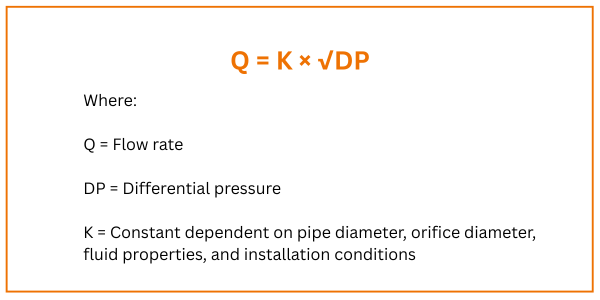
To obtain accurate flow measurement across the entire operating range, a square root function must be applied. Square root extraction converts the measured differential pressure into a signal that is directly proportional to flow.Mathematical Relationship Between DP and Flow
The relationship between differential pressure and flow rate is expressed as:
What Is Square Root Extraction in Flow Measurement?
Square root extraction is a fundamental concept used in differential pressure–based flow measurement systems. It is applied to convert a pressure-related signal into a signal that correctly represents flow.
Square Root Extractor as a Signal Conditioner
A square root extractor is a type of signal conditioner used in flow measurement loops. Its primary function is to mathematically process the input signal coming from a differential pressure device.Why It Is Required in DP Flow Measurement
In DP flow measurement, indicators, recorders, and controllers work with linear signals. However, flow velocity does not change linearly with differential pressure. Square root extraction allows these instruments to display and control flow correctly.Arithmetic Conversion of the Signal
Square root extraction is an arithmetic conversion applied to a linear differential pressure measurement. This conversion transforms the signal into a non-linear square root scale that matches the actual flow behavior.How the Square Root Scale Is Generated
The square root scale is generated by taking the square root of the ratio between the measured differential pressure value and the full measurement span. This ensures that the output signal accurately represents the flow rate.Square Root Extraction and Square Root Scaling
Square root extraction is also commonly referred to as square root scaling. Both terms describe the same process of converting differential pressure into a usable flow signal.Its Importance in Flow Rate Calculation
Square root extraction is a critical step in deriving flow rate from differential pressure measurement. Without it, the measured value would not represent true flow and would lead to significant errors in indication, control, and totalization.
What Is a Square Root Extractor?
A square root extractor is a device used in differential pressure–based flow measurement systems to convert a pressure signal into a usable flow signal.
Conversion of Differential Pressure Signal
A square root extractor converts a linear differential pressure signal into a signal that represents the flow rate, which follows a non-linear square root relationship.Electronic or Pneumatic Instrument
Square root extractors can be electronic or pneumatic instruments. They process the output signal from a flow transmitter and apply the required mathematical conversion.Generation of Linear Flow Signal
By applying square root extraction, the extractor generates a linear flow signal that can be easily interpreted by indicators, controllers, and recorders.Relation to Flow Transmitter Output
In differential pressure flow measurement, the transmitter output inherently represents a squared relationship. The square root extractor corrects this behavior so the final signal accurately reflects the actual flow rate.
Why Flow Rate Is Directly Proportional to the Square Root of DP?
The relationship between flow rate and differential pressure is based on basic fluid dynamics and is best explained using Bernoulli’s principle.
Role of Bernoulli’s Principle
According to Bernoulli’s principle, the square root of differential pressure is directly proportional to the flow rate. When pressure difference increases, the flow rate increases, and when pressure difference decreases, the flow rate also decreases.Connection Between Flow Rate and Velocity
Flow rate in a pipe is equal to the fluid velocity multiplied by the cross-sectional area of the pipe. Since the pipe area remains constant, any change in flow rate is directly linked to a change in fluid velocity.How Differential Pressure Is Created
In a differential pressure–based flow meter, a primary element accelerates the fluid stream. This acceleration causes a pressure drop between the upstream and downstream sides of the obstruction.Effect of Flow Element Restriction
The pipeline is intentionally narrowed using elements such as an orifice plate or venturi tube. This narrowing creates a low-pressure region due to increased velocity, resulting in a measurable differential pressure.Why the Square Root Relationship Exists
Because velocity is proportional to the square root of pressure difference, the flow rate also follows the same square root relationship with differential pressure.
Square Root Extraction Formula
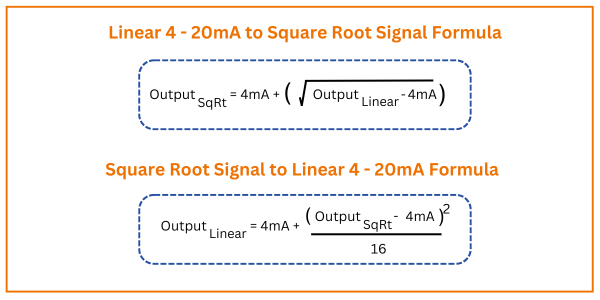
Square root extraction table
| Linear (mA) | Square root (mA) | Square root (mA) | Linear (mA) |
| 4 | 4.00 | 4 | 4.00 |
| 5 | 8.00 | 5 | 4.06 |
| 6 | 9.66 | 6 | 4.25 |
| 7 | 10.93 | 7 | 4.56 |
| 8 | 12.00 | 8 | 5.00 |
| 9 | 12.94 | 9 | 5.56 |
| 10 | 13.80 | 10 | 6.25 |
| 11 | 14.58 | 11 | 7.06 |
| 12 | 15.31 | 12 | 8.00 |
| 13 | 16.00 | 13 | 9.06 |
| 14 | 16.65 | 14 | 10.25 |
| 15 | 17.27 | 15 | 11.56 |
| 16 | 17.86 | 16 | 13.00 |
| 17 | 18.42 | 17 | 14.56 |
| 18 | 18.97 | 18 | 16.25 |
| 19 | 19.49 | 19 | 18.06 |
| 20 | 20.00 | 20 | 20.00 |
We are not using the square root extractor devices anymore, these are replaced with modern DP Transmitters
Differential pressure–based flow measurement is widely used in industrial applications, but its accuracy depends on understanding the square root relationship between flow and differential pressure.
Since differential pressure is proportional to the square of the flow rate, direct measurement without correction leads to non-linear and misleading results.
Square root extraction plays a critical role by converting the differential pressure signal into a flow-proportional signal that can be correctly indicated, controlled, and totalized.
Whether implemented in DP transmitters, flow computers, or control systems, square root extraction ensures reliable and accurate flow measurement across the entire operating range.


I hope you like above blog. There is no cost associated in sharing the article in your social media. Thanks for Reading !! Happy Learning