
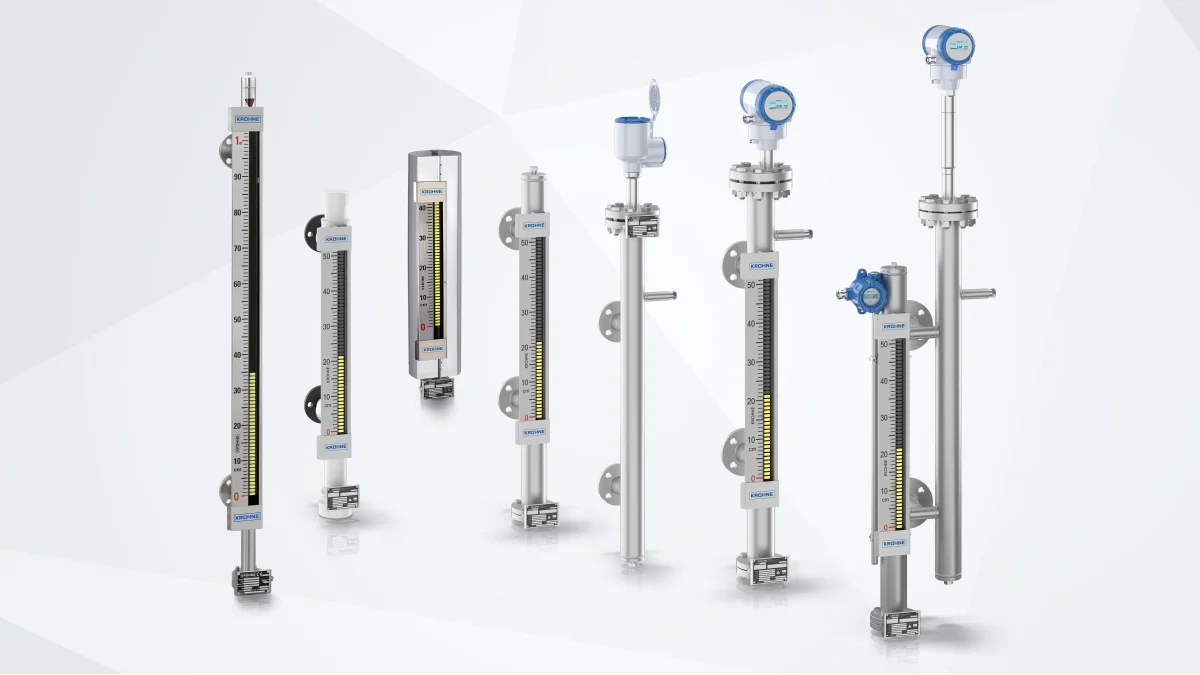
If you have ever wondered how industries keep track of the liquid level inside big tanks or vessels, you are about to learn one of the coolest instruments used : the Bypass Level Indicator (BLI).
Here we will learn what bypass level indicator is and also how it works, where it’s used, and why it’s so useful.
Image Credit: Krohne (Educational Purpose)
Table of Contents
ToggleWhat is a Bypass Level Indicator?
Imagine you are filling a bottle with water, and you want to know how much water is inside without opening the bottle every time.
A Bypass Level Indicator helps industries do exactly that, but on a much bigger scale, with tanks full of water, oil, chemicals, or other liquids.
It works on the principle of communicating vessels. That means if you connect a small pipe (called the bypass chamber) to the side of a tank, the liquid in the tank and the pipe will always stay at the same level.
Inside this bypass chamber, there is a float with a magnet. As the liquid rises or falls, the float moves too. Now here is the magic: the magnet inside the float communicates with displays and sensors without touching the liquid directly.
That makes it safe, clean, and reliable. Please see below illustration for better understanding.
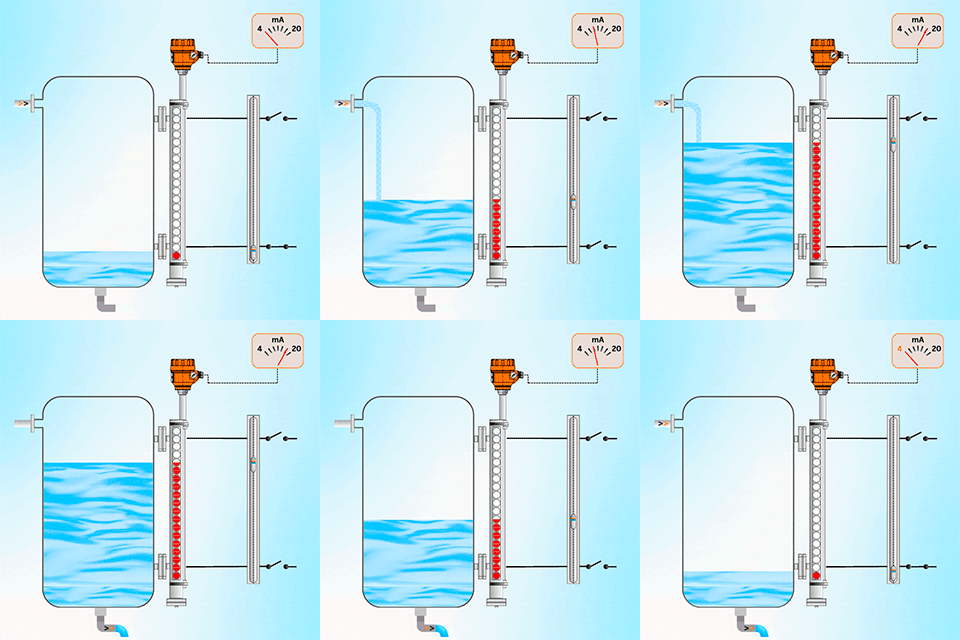
How Does Bypass Level Indicator Work?
Let us understand it step by step:
Bypass Chamber – A side tube mounted vertically alongside the tank. The liquid flows freely into it.
Float with Magnet – This float moves up and down as the liquid level changes.
Magnetic Display – On the outside of the chamber, you’ll see rollers or balls that flip as the float passes by, showing you the level.
Sensors or Transmitters (Optional) – These can send electronic signals (like 4–20 mA) to a control room, so operators know the liquid level even from far away.
So, in short,
the tank fills → liquid enters the bypass chamber → float moves up or down → magnet makes the display or sensor react → you get a reading.
Simple, right?
Key Features of a Bypass Level Indicator
Bypass Level Indicators aren’t just simple; they’re also super reliable. Here are the main features:
- Strong and Rugged: Built with stainless steel or special alloys to survive harsh environments.
- Low Maintenance: Since the float doesn’t touch the liquid directly, there’s little chance of damage.
- Highly Visible Display: The red/white rollers flip clearly, even from a distance.
- Works in Extreme Conditions: High temperature? High pressure? No problem – special models can handle it.
- Options Available: You can add switches for alarms or transmitters for remote monitoring.
- Safe for Corrosive Liquids: Materials like titanium or plastics are used when handling aggressive chemicals.
Types of Bypass Level Indicators
Just like we have different types of cars for different needs, there are different types of BLIs depending on where they’re used. Here are the main ones:
Standard Magnetic Bypass – The most common type, suitable for industrial tanks.
Top-Mounted Version – Used where side access isn’t possible, like underground tanks.
Mini Bypass – A compact version for small tanks or labs.
Rope Version – Uses a float and rope for open tanks (like reservoirs).
Plastic Bypass – Made from plastic for corrosive chemicals.
Economical Version – A budget-friendly option for basic level monitoring.
Glass Tube Bypass – Lets you visually see the liquid directly through glass.
Reflex Level Gauge – Uses light reflection to show liquid vs. gas levels (great for steam boilers).
So, no matter the application from clean water to toxic chemicals there is a bypass level indicator that fits the requirement.
Magnetic Displays: Roller vs. Ball
The float’s magnet communicates with two main types of displays:
- Roller Display: Uses tiny rollers that flip colors (red/white) as the float moves. It gives a sharp, continuous line – great for outdoor or high-temp use.
- Ball Display: Uses small balls that rotate to show the level. They’re easier to see from wider angles and perform well in vibrating environments.
 When to choose what?
- Go for roller displays if you need a clear, continuous line and cost-effective solution.
- Choose ball displays if visibility from different angles matters, or if the tank vibrates a lot.
Where Are Bypass Level Indicstors Used?
Bypass Level Indicators are everywhere in industry. Some common uses are:
- Storage Tanks – For water, oil, or chemicals.
- Mixing Vessels – To see levels during blending.
- Boilers & Pressurized Vessels – For safe monitoring in high pressure/temperature.
- Water Tanks – In municipal or industrial plants.
- Aggressive Media – For corrosive or reactive fluids.
And the industries?
You’ll find BLIs in oil & gas, chemical plants, power plants, water treatment, food & beverage, pharma, and even shipbuilding.
Advantages of a Bypass Level Indicator
Why do industries love these instruments? Here’s why:
No direct contact with liquid – Safe for hazardous fluids.
Handles high pressure & temperature – Works even in extreme conditions.
Maintenance-free – No moving parts inside the liquid.
Clear visibility – Easy to read, even from far away.
Customizable – Can be designed for any tank size.
Durable & corrosion resistant – Built for long life.
Works without power – Roller-type models don’t need electricity!
Safe & reliable – Especially in hazardous or explosive areas (ATEX certified models).
Disadvantages of Bypass Level Indicator
Of course, no device is perfect. Here are a few limitations:
- Not suitable for dirty or sticky liquids (the float may get stuck).
- Needs some space for installation alongside the tank.
- Doesn’t handle rapid level changes very well.
- Float may wear out over time in tough applications.
- Sensitive to magnetic interference from outside.
Sensors and Transmitters
Bypass Level Indicators can be paired with different sensor options:
No Transmitter – Just visual indication.
Reed Chain Sensors – Good for standard accuracy. Affordable and reliable.
Magnetostrictive Sensors – High accuracy, digital output, best for critical applications.
When to choose?
- For simple monitoring: go with visual only.
- For medium accuracy: reed chain sensors.
- For precision and automation: magnetostrictive sensors.
Summary
The Bypass Level Indicator is one of those instruments that looks simple but is extremely clever. It uses basic science (communicating vessels + magnetism) to solve a very big industrial problem:
How do we safely measure liquid levels inside large tanks?
From oil refineries to food factories, from water plants to ships these indicators are trusted everywhere because they are rugged, reliable, safe, and easy to use.
So, next time you see a big industrial tank, remember there is probably a Bypass Level Indicator quietly doing its job, making sure the operators know exactly how much liquid is inside.


I hope you like above blog. There is no cost associated in sharing the article in your social media. Thanks for reading!! Happy Learning!!