
Table of Contents
ToggleTurndown Ratio: Introduction
In industrial processes, flow rate is rarely constant. It increases, decreases, fluctuates with load, process demand, or operating conditions.
This is where turndown ratio becomes a critical parameter while selecting a flow meter.
Many flow measurement problems, poor accuracy complaints, and unstable readings happen not because the flow meter is “bad”, but because its turndown ratio is not suitable for the application.
This article explains what turndown ratio is, why it matters, how it affects accuracy, and how different flow meters compare in simple terms.
What is Turndown Ratio?
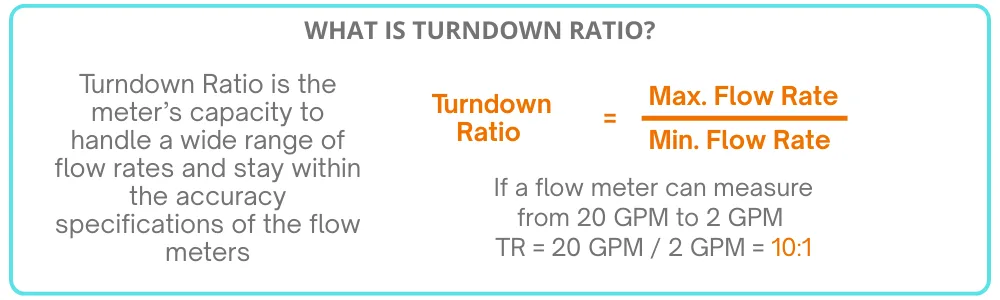
Turndown ratio is a term used in flow measurement that shows how wide a flow meter’s measuring range is while still giving accurate results. It is the ratio between the maximum and minimum flow rates the device can handle accurately.
For example, if a meter can measure flow from 2 units to 10 units, the turndown ratio is 5:1. This term is often used with flow meters and in combustion systems like boilers and gasifiers to describe how flexible the device is in handling different flow levels.
For Example:
If a flow meter can measure from 20 GPM to 2 GPM, then:
TR = 20 GPM / 2 GPM = 10:1
Why is Turndown Ratio Important?
The turndown ratio determines whether a flow meter can reliably capture low flows and peak flows in your process.
- Too narrow a range: You miss low-flow readings or get inaccurate data.
- Too wide without proper meter: You compromise measurement precision or sensor performance.
It is especially crucial in applications like gas distribution, steam flow, and varying process flows where the flow is not constant.
Suppose your gas flow varies from 100,000 m³/day to 1,000,000 m³/day.
- This application needs a flow meter with a minimum 10:1 turndown ratio.
- If your flow meter’s max range is 2,000,000 m³/day, then the required TR becomes 20:1 to maintain accuracy across the range.
A Simple Analogy – The Ruler
Imagine a 12-inch ruler marked every 0.25 inches. You can measure:
- Max = 12 inches
- Min = 0.25 inch
- TR = 12 / 0.25 = 48:1
But if the lower 2 inches are smudged:
- Min = 2 inches
- New TR = 12 / 2 = 6:1
This illustrates how losing visibility of the low end significantly reduces turndown ratio.
Factors Affecting Turndown Ratio
- Sensor Technology – Some sensors are better at low-flow detection.
- Signal-to-Noise Ratio (S/N) – If noise is high, low flow becomes undetectable.
- Fluid Dynamics – Some fluids or conditions (e.g., high viscosity or dirty liquids) reduce range.
Typical Turndown Ratios of Common Flow Meter Types
Below is a practical comparison used widely in the industry:
Orifice Plate
Typical turndown ratio: 3:1 to 4:1
Accuracy drops sharply at low differential pressure.Venturi Tube
Typical turndown ratio: 4:1 to 5:1
Better than orifice but still limited.Flow Nozzle
Typical turndown ratio: 4:1 to 5:1
Common in steam applications.Variable Area (Rotameter)
Typical turndown ratio: 10:1
Simple and reliable for low-pressure applications.Turbine Flow Meter
Typical turndown ratio: 10:1 to 20:1
Sensitive to viscosity and flow profile.Positive Displacement Flow Meter
Typical turndown ratio: 10:1 to 20:1
Excellent for low flow and viscous liquids.Vortex Flow Meter
Typical turndown ratio: 10:1 to 15:1
Requires minimum flow velocity to generate vortices.Electromagnetic Flow Meter
Typical turndown ratio: 20:1 to 40:1
Ideal for conductive liquids.Ultrasonic Flow Meter
Typical turndown ratio: 20:1 to 100:1
Suitable for clean liquids and gases.Coriolis Mass Flow Meter
Typical turndown ratio: 20:1 to 100:1
One of the best performers across wide flow ranges.
Note: Actual turndown can vary based on design, manufacturer, and installation.
Turndown Ratio and Measured Signal Strength
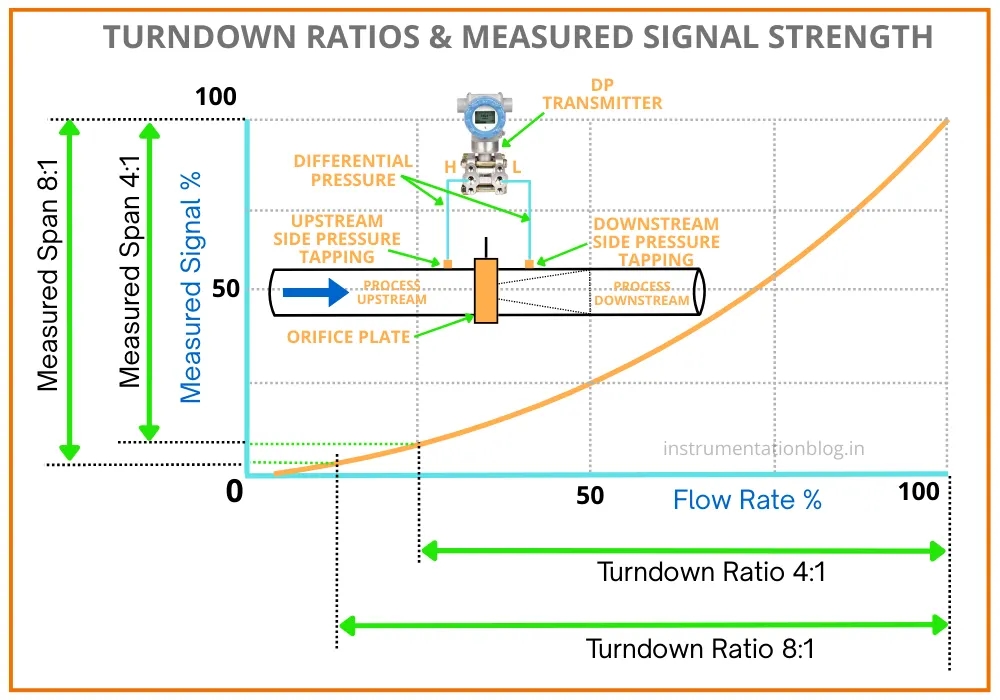
As the flow rate decreases in differential-pressure flow meters, the generated signal becomes weaker, which directly impacts measurement accuracy at low flow conditions.
When high turndown ratios are applied, the signal at the lower end may become too compressed, making accurate flow detection difficult. This highlights the importance of aligning turndown ratio selection with actual application requirements.
How to Select the Right Turndown Ratio
Selecting the right turndown ratio begins with understanding how the process operates under real conditions, not just its design values. Before choosing a flow meter, several key questions should be evaluated carefully.
Minimum Continuous Flow
The minimum continuous flow is one of the most critical factors in turndown selection. Many processes operate at low flow for extended periods during startup, shutdown, or part-load operation. If the flow meter cannot measure accurately at this low end, the readings will become unstable or drop to zero, leading to poor monitoring and control.Maximum Expected Flow
The maximum expected flow defines the upper limit of the measurement range. The flow meter must be able to handle peak flow conditions without saturation, excessive pressure drop, or loss of accuracy. Selecting a meter only for normal flow while ignoring occasional peaks can result in overrange errors and long-term sensor damage.Low-Load Operating Frequency
Understanding how often the process runs at low load is essential. Some systems operate near minimum flow for most of their operating time. In such cases, a low turndown meter may technically meet the specification but perform poorly in daily operation. Frequent low-load operation clearly demands a higher turndown ratio.Criticality of Low-Flow Accuracy
In applications such as dosing, batching, energy monitoring, and leak detection, accurate low-flow measurement is crucial. Even small measurement errors at low flow can lead to product quality issues, energy losses, or regulatory non-compliance. A higher turndown ratio ensures the flow meter remains reliable across the entire operating range.
As a general guideline, processes with stable and predictable flow conditions can operate satisfactorily with a moderate turndown ratio. However, processes with wide flow variation, frequent load changes, or extended low-flow operation perform far better when a flow meter with a high turndown ratio is selected.
Turndown Ratio vs Accuracy
One of the most misunderstood aspects of flow measurement is the assumption that a flow meter maintains the same accuracy across its entire turndown range. In reality, this is rarely the case. A flow meter may be capable of measuring a wide range of flow rates, but its measurement accuracy does not remain constant from minimum to maximum flow.
Reduced Signal-to-Noise Ratio at Low Flow
At low flow rates, the measurement signal becomes weaker while background noise remains relatively constant. This reduction in signal-to-noise ratio makes it difficult for the transmitter to distinguish real flow changes from noise, resulting in fluctuating or unstable readings.Unstable Flow Profile
Low flow conditions often lead to disturbed or non-fully developed flow profiles. In such cases, the assumptions used in flow meter calibration no longer hold true, which directly impacts measurement accuracy, especially for velocity-based flow meters.Decrease in Reynolds Number
As flow rate decreases, the Reynolds number also drops. When flow moves from turbulent toward laminar conditions, many flow meters begin to lose accuracy because they are designed and calibrated for turbulent flow regimes.Mechanical and Sensor Limitations
At very low flow rates, mechanical friction, bearing drag, or sensor sensitivity limits become more significant. Turbine meters may stop rotating smoothly, vortex meters may fail to generate vortices, and electronic sensors may struggle to detect small changes in flow.
For these reasons, flow meter datasheets often specify performance limitations that must be carefully reviewed.
Accuracy Stated Above a Certain Percentage of Full Scale
Manufacturers commonly define accuracy only above a specific percentage of the maximum flow, indicating that performance below this range may not meet stated accuracy figures.Minimum Recommended Flow Velocity
Many flow meters require a minimum flow velocity to function correctly. Operation below this limit can lead to erratic readings or complete loss of measurement.Reduced Accuracy at the Low End of the Range
Datasheets may also indicate increased uncertainty or reduced accuracy at the lower end of the measurement range, even though the meter remains technically operational.
In summary, a high turndown ratio does not mean perfect accuracy across the entire flow range. Instead, it means the flow meter remains usable over a wider range of operating conditions, with acceptable performance when the limitations at low flow are properly understood and accounted for during selection.
Summary
- Always match the meter’s turndown ratio to your application’s flow range.
- Higher turndown allows better accuracy at low flow rates.
- Signal quality and installation conditions affect performance.
- Don’t overlook turndown when selecting a meter—it’s vital for process reliability and cost-efficiency.
Track your actual process flow range and compare it with your meter’s specs before finalizing your purchase or installation.


I hope you like above blog. There is no cost associated in sharing the article in your social media. Thanks for reading!! Happy Learning!!
2 Comments