
Table of Contents
ToggleStrainer and Filter – Introduction
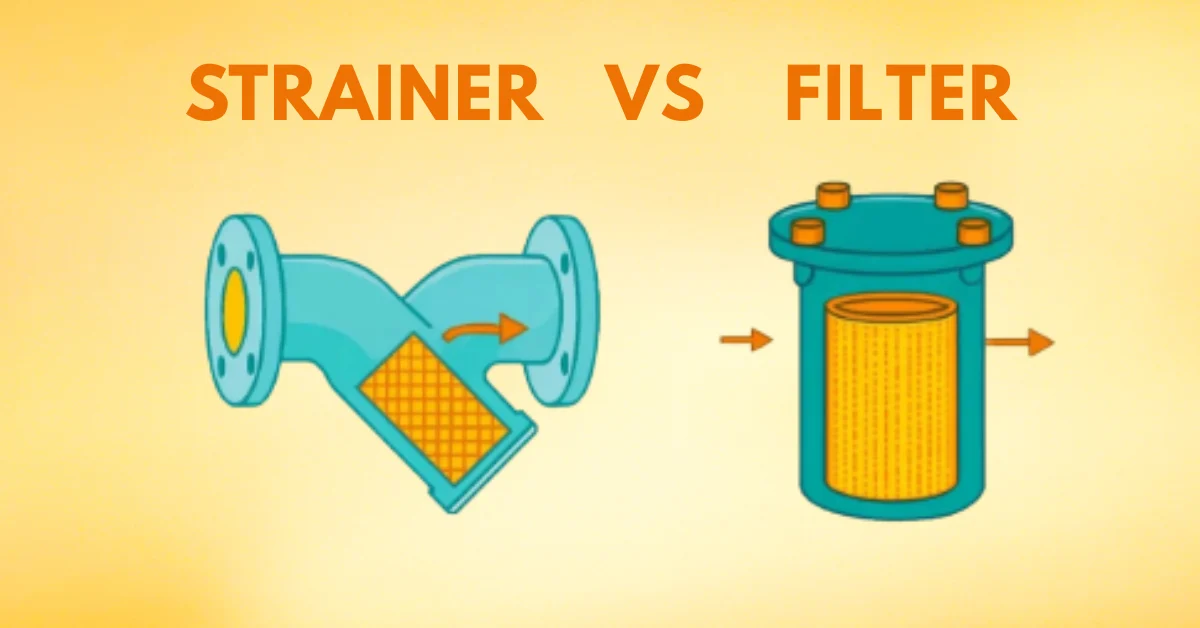
In industrial piping and instrumentation systems, the terms strainer and filter are often used as if they mean the same thing. On drawings, datasheets, or even in site discussions, many engineers casually interchange these two words.
From a technical and application point of view, a strainer and a filter are fundamentally different devices. They differ in particle size removal, working principle, pressure drop, maintenance philosophy, and overall purpose in the system.
We must understand the difference because it is very important and selecting the wrong device can result in equipment damage, unnecessary pressure loss, frequent maintenance, or poor process performance.
This article explains the difference between a strainer and a filter, exactly how it matters in real industrial applications.
What is a Strainer?
A strainer is a mechanical device installed in a pipeline to remove large solid particles from a flowing fluid. Its main role is equipment protection, not fluid purification.
A strainer works on a very basic principle. The fluid passes through a metal screen or perforated plate, and particles larger than the opening size are physically blocked.
Strainers are commonly used as the first line of defense in a piping system.
Typical contaminants removed by strainers include rust flakes, welding slag, pipe scale, gasket pieces, bolts, nuts, and other construction debris.
In simple words, a strainer prevents big unwanted objects from entering sensitive equipment.

What is a Filter?
A filter is a fluid conditioning device designed to remove fine contaminants that affect system performance, accuracy, or product quality.
Unlike a strainer, a filter does not rely only on a metal screen. It uses special filtration media such as paper, fiber, sintered metal, or cartridge elements to trap very small particles.
Filters are selected when fluid cleanliness is critical, not just equipment protection.
They are commonly used in hydraulic systems, lubrication circuits, chemical processes, food and pharmaceutical industries, and precision instrumentation.
Difference in Particle Size Removal
The most important technical difference between a strainer and a filter is how small a particle they can remove.
A strainer removes relatively large particles. In most industrial applications, strainers are designed to capture particles typically larger than 75 to 100 microns. Anything smaller than the mesh opening simply passes through.
A filter, on the other hand, removes much finer particles. Depending on the application, filters can remove contaminants down to:
25 microns
10 microns
5 microns
Even sub-micron levels in critical services
This fine filtration is necessary when small particles can cause wear, blockage, measurement errors, or contamination.
Difference in Purpose
The purpose of a strainer and a filter is not the same, even though both remove solids.
A strainer is primarily a mechanical protection device. It is installed upstream of pumps, control valves, flow meters, spray nozzles, and heat exchangers to prevent physical damage caused by debris.
Strainers are preferred when:
Flow rate is high
Pressure drop must be minimal
Fluid cleanliness is not a strict requirement
A filter is a fluid quality control device. It removes contaminants that directly affect system performance, reliability, or product purity.
Filters are essential when:
Small particles cause wear or malfunction
Process consistency is critical
Instrument accuracy depends on clean fluid
Types of Strainers and Filters
Both strainers and filters are available in multiple designs to suit different fluids, pressures, temperatures, and maintenance requirements. Selecting the right type depends on particle size, flow rate, and system criticality.
Types of Strainers
Strainers are mainly classified based on their body design and cleaning method. Common industrial strainer types include:
Y-Type Strainer
Y-strainers are compact and commonly used in pipelines where space is limited. They are installed in horizontal or vertical lines and are suitable for moderate solid loading. Cleaning usually requires manual removal of the screen.Basket Strainer
Basket strainers are used in applications with higher flow rates and heavier dirt loading. They offer a larger filtration area and lower pressure drop compared to Y-strainers. Basket strainers are easy to clean and widely used in pump suction lines.T-Type Strainer
T-strainers are designed for large pipelines and high-capacity systems. They allow easy screen removal without dismantling the entire pipeline, making them suitable for continuous industrial services.Temporary or Startup Strainer
These strainers are installed during commissioning or startup to catch construction debris like welding slag and pipe scale. They are removed once the system is clean.Automatic / Self-Cleaning Strainer
These strainers clean themselves using backwashing or scraping mechanisms without shutting down the process. They are used in systems where continuous operation is critical.
Types of Filters
Filters are classified based on filtration accuracy, media type, and application requirements. Common industrial filter types include:
Cartridge Filter
Cartridge filters are widely used for fine filtration. They use replaceable elements made of paper, polypropylene, or fiber and are available in various micron ratings.Bag Filter
Bag filters use fabric bags housed inside a pressure vessel. They offer higher dirt-holding capacity and are suitable for liquids with moderate to high contamination levels.Depth Filter
Depth filters trap particles throughout the thickness of the media rather than only on the surface. They are effective for removing fine and irregular-shaped particles.Surface Filter
Surface filters capture particles on the surface of the media. They are easy to clean and provide consistent filtration performance.Magnetic Filter
Magnetic filters remove ferrous particles using strong magnets. They are commonly used in lubrication oil systems and hydraulic circuits.High-Pressure Hydraulic Filter
These filters are designed specifically for hydraulic systems and can withstand high pressures while maintaining precise filtration levels.
Pressure Drop Behavior
Pressure drop plays a major role in device selection.
A strainer causes very low pressure drop because the openings are relatively large. Even when partially clogged, a strainer usually allows sufficient flow for a longer time.
This makes strainers suitable for continuous-duty systems where pressure loss must be kept to a minimum.
A filter naturally causes higher pressure drop because the filtration media is much finer. As contaminants accumulate, the pressure drop across the filter increases steadily.
For this reason, filters often require:
Differential pressure gauges
DP switches or transmitters
Maintenance alarms
Maintenance Requirements
Maintenance philosophy is another major difference.
A strainer is typically cleaned and reused. Maintenance usually involves opening the strainer, removing the screen or basket, cleaning it, and reinstalling it.
Common strainer maintenance methods include:
Manual basket cleaning
Blow-down
Backwashing
Operating cost is low because there are no consumable elements.
A filter requires element replacement once it becomes clogged. Filter cartridges or elements are consumables and must be stocked, replaced, and disposed of properly.
Over time, filters have a higher operating cost, but this is justified where fluid cleanliness is critical.
Filtration Mechanism
The way a strainer and a filter capture particles is very different.
A strainer works purely on physical sieving. Particles larger than the screen opening are trapped, and smaller particles pass through without restriction.
A filter may use multiple mechanisms working together, such as:
Surface filtration
Depth filtration
Adsorption
Layered particle capture
This is why filters can remove much finer and more complex contaminants than strainers.
Typical Industrial Applications
Strainers are commonly used in applications such as:
Cooling water lines
Boiler feed water pre-protection
Pump suction piping
Utility services
In these systems, the main concern is protecting equipment from large debris.
Filters are widely used in:
Hydraulic systems
Lubrication oil circuits
Chemical dosing systems
Food and pharmaceutical processes
Here, fluid cleanliness directly affects performance and reliability.
Common Selection Mistakes
A frequent mistake is using a strainer where a filter is actually required. This can lead to accelerated wear, valve sticking, and instrument malfunction.
Another mistake is using a fine filter where only a strainer is sufficient, resulting in unnecessary pressure loss and higher maintenance cost.
Correct selection should always consider:
Required cleanliness level
Allowable pressure drop
Maintenance capability
Criticality of the process
Simple Rule to Remember
A practical rule used by many field engineers is:
If the goal is equipment protection, use a strainer
If the goal is fluid cleanliness, use a filter
Although strainers and filters may look similar, they serve very different roles in an industrial system. Understanding this difference helps engineers design more reliable systems, reduce failures, and optimize maintenance costs.
In instrumentation and process engineering, selecting the right protection device at the right location makes a measurable difference in system performance.


I hope you like above blog. There is no cost associated in sharing the article in your social media. Thanks for Reading !! Happy Learning